Concrete Slabs and Foundations in Austin, TX
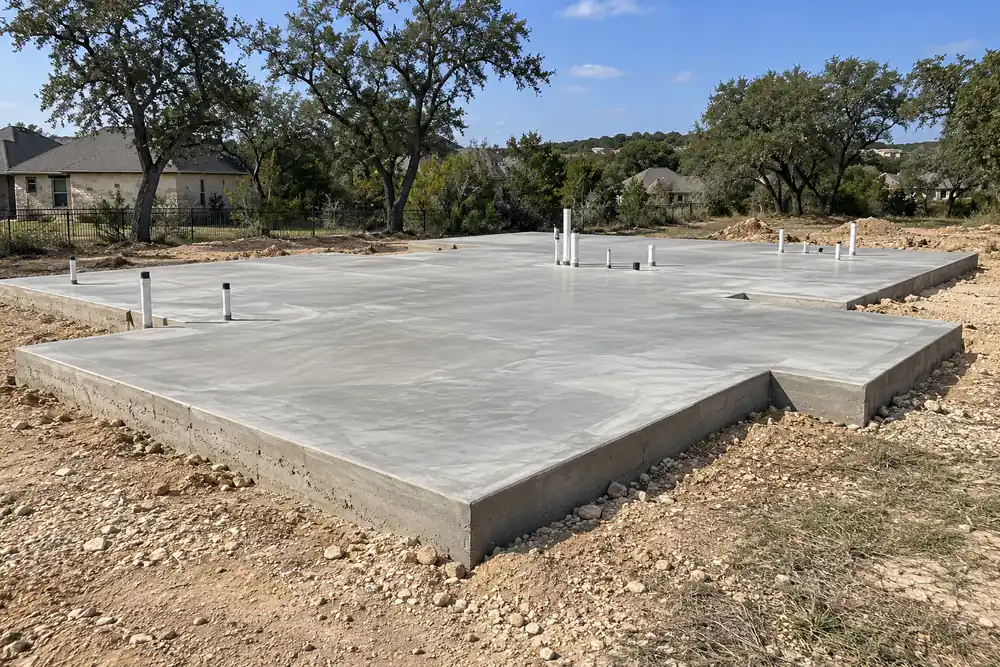
Heritage Concrete Austin pours concrete slabs and foundations in Austin, Texas: slab-on-grade and post-tensioned house foundations, slabs for ADUs and additions, and pads, shop slabs and garage floors. Building permits in Austin authorized 2,079 new single-family homes and 352 homes in two-unit buildings in 2025 (Census Bureau), and the City requires an engineer to design and seal the foundation for any home on expansive soil.
A free estimate starts with a call or the form. We'll go over the engineer's plan, or the size and use of the slab, the ground it sits on, and the timing.
Call or request a free estimate any time, 24/7
No charge · answered 24/7
Get free estimates
Slab foundations for homes on expansive soil
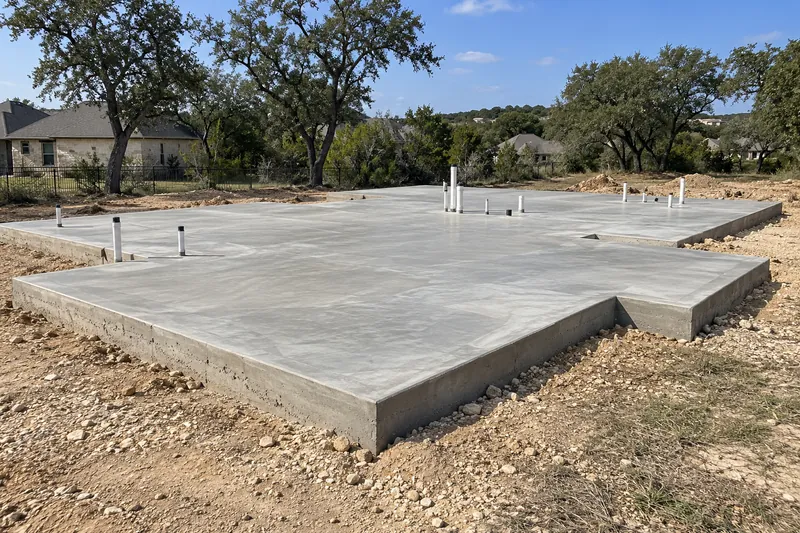
Austin's foundation rules start from the soil. The City's Building Criteria Manual requires slab-on-grade plans for homes and accessory structures on expansive soils to be designed and sealed by a Texas registered engineer, showing the slab layout and interior beams, beam sizes, concrete strength, and the size, spacing and strength of the reinforcing steel.
Who checks the foundation
City inspectors don't inspect foundations on new homes, additions or remodels. Instead, the builder gives the City a report from a registered design professional confirming the foundation was built to the code or the engineered design, uploaded to the permit by the final inspection. Austin uses the 2024 International Residential Code, and its local amendments leave the foundation chapter as published.
Rebar slabs and the code minimums
In the 2021 edition of the International Residential Code, a concrete floor on ground starts at 3½ inches, and its steel must be supported from the center up to the top third of the slab for the whole pour. For floors inside a building, NRMCA calls a vapor retarder of 10 mils or thicker sensible planning under every slab.
Post-tensioned slabs
Post-tensioning puts the slab in compression with stressed steel tendons, and the Post-Tensioning Institute says that compression resists the tension soil movement causes; it calls these slabs a cost-efficient, high-performance answer for homes on shrink-swell soil. Since 1980, its design guidelines have shaped millions of residential foundations. A common post-tensioned design for a house is 8 inches thick, 3,000 psi concrete, with tendons on 48-inch centers.
Call or request a free estimate any time, 24/7.
(512) 588-2862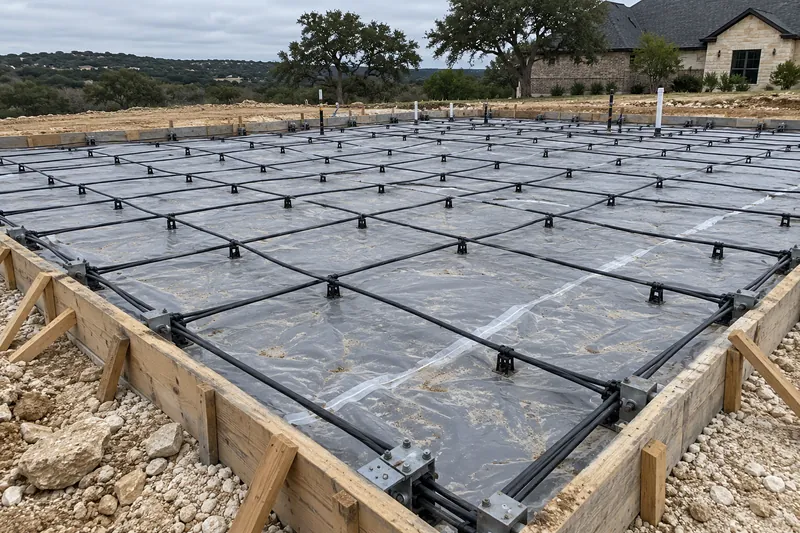
Slabs for ADUs, additions and backyard buildings
The City's HOME amendments made room for more slabs on single-family lots. Phase 1, adopted December 7, 2023, allows up to three homes, tiny homes included, on a lot zoned SF-1, SF-2 or SF-3, and in its first year it led to 436 new units being approved. Phase 2 allows one home on a lot as small as 1,800 square feet.
ADU rules that shape the slab
An additional dwelling unit needs a lot of at least 5,750 square feet and its own address, and the fire-separation rule R302.1(1) applies. For duplexes and two- or three-unit homes, buildings may cover at most 40% of the lot and impervious cover 45%, with garages and carports counting toward both. A tiny home is 400 square feet or less, not counting a loft. Our guide to ADU slab foundations in Austin covers sizes and costs, and Heritage Concrete Austin can price the slab from the engineer's plan.
Sheds, garages and workshops
In Austin, a detached single-story garage or shed up to 500 square feet, with no plumbing or habitable space, is exempt from the structural-drawing requirement for its foundation; the building inspector checks it in the field.
Heritage Concrete Austin also pours slab foundations in Buda.
Call or request a free estimate any time, 24/7.
(512) 588-2862Pads, garage floors and polished slabs
Pads and RV pads
RVs can weigh 12,000 pounds or more, so an RV pad may need 5 or 6 inches where 4 serves cars. Any slab more than 5 inches deep should get rebar or welded wire fabric, especially under heavy loads. Heritage Concrete Austin pours concrete pads for RVs, sheds and equipment.
Garage floors
The IRC wants a garage floor of noncombustible material, pitched so liquids run to a drain or out the main vehicle door, and it exempts garages from its vapor-retarder rule. Coatings are usually epoxy-based; quartz broadcast into 100% solids epoxy resists impact better than color flakes. More on concrete garage floors.
Polished slabs
Polishing grinds the surface with progressively finer diamonds and hardens it with a chemical densifier along the way. The Concrete Polishing Council sorts the result by sheen, from Level 1 ground to Level 4 highly polished, and by how much aggregate shows, from a cream finish to full exposure. See polished concrete.
Call or request a free estimate any time, 24/7.
(512) 588-2862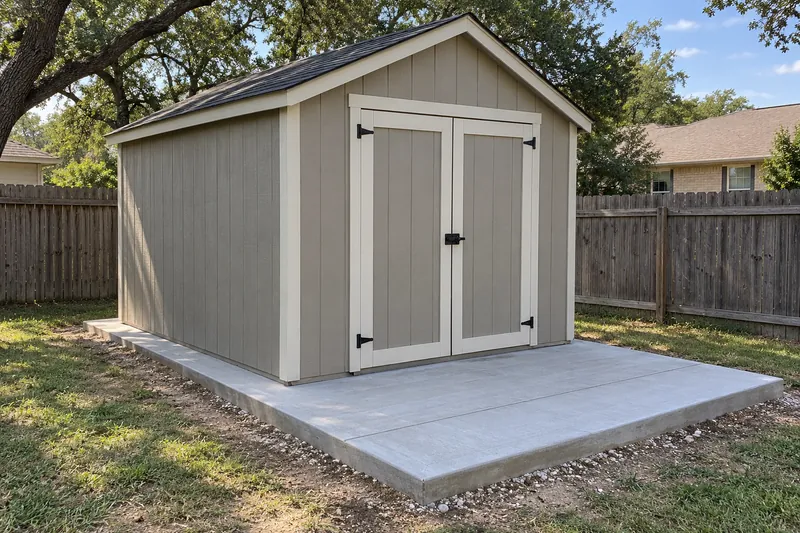
Clay, limestone and settling slabs
East-side clay
USDA's official type location for Houston Black clay is in Travis County, about 3.5 miles east of Manor on U.S. Highway 290. It holds 40 to 60 percent clay with high shrink-swell potential; in the Travis County survey data its linear extensibility is 12 percent and its plasticity index 44, which falls in the "High" swell band of the City's pavement manual. Travis County's hazard plan says slab-on-grade structures are more likely to suffer damage from expansive soils. Heritage Concrete Austin also pours concrete slab foundations in Manor.
West-side limestone
On the other side of the Balcones Escarpment, Eckrant, the most common soil mapped in Austin, sits 4 to 20 inches over hard limestone. USDA rates these shallow soils "Very limited" for excavations up to 5 or 6 feet deep because of the bedrock, and the Bureau of Economic Geology calls the limestone units stable but difficult to excavate.
When a slab settles
A sunken slab can often be lifted by pumping grout or foam beneath it, but InterNACHI lists a slab heaved up by expansive soil among the cases where mudjacking is the wrong fix. A foundation repair of 128 square feet or less is exempt from a permit in Austin. For lifting, see concrete leveling; for the soil itself, our guide to concrete on Austin clay and limestone.
Call or request a free estimate any time, 24/7.
(512) 588-2862
How a concrete slab is formed, poured and cured
Plan and locate
On expansive soil, the engineer's plan sets the beams, steel and concrete strength. Texas law requires an 811 notice before digging 16 inches or deeper with powered equipment.
Pad, forms and vapor retarder
Fill under a slab is compacted, and unless approved the IRC caps it at 24 inches where it is clean sand or gravel and 8 inches where it is earth. Interior slabs get a vapor retarder, 10 mils or more.
Steel or tendons
Rebar is held between the middle and the upper third of the slab; post-tension tendons follow the engineer's layout.
Pour and finish
Heat sets the pace in Austin. Under ACI 305.1, concrete may be no hotter than 95°F at discharge; chilled water can take up to 10°F off a load, ice up to 20°F.
Cure and stress
Curing typically runs 3 to 7 days. Tendons are stressed when the slab reaches 2,000 psi, typically 3 to 10 days in.
On tight lots, concrete pumping carries the mix from the truck to the forms; the American Concrete Institute notes that pumping helps where there's little room for equipment.
Call or request a free estimate any time, 24/7.
(512) 588-2862Concrete slab cost in Austin
In typical Austin-area figures for 2026, a concrete slab runs $4 to $10 per square foot, most projects fall between $3,532 and $7,063, and a thick, complex house foundation can reach $18 per square foot. Reinforcement adds $0.50 to $1 per square foot for rebar or $2 to $3 for fiber mesh. A new foundation in Austin costs 17% less than the national average, at $3,739 to $9,888 for a typical project.
Treat these as published averages; Heritage Concrete Austin prices each slab from its own plan and site. An engineered foundation, a pump truck or a tight lot changes the figure, and the estimate is free.
- Shed foundation, 80 sq ft
- $560
- Parking pad, 200 sq ft
- $1,400
- Garage floor, 350 sq ft
- $2,450
- Patio, 450 sq ft
- $3,150
- RV pad, 640 sq ft
- $4,480
- Home foundation, 2,050 sq ft
- $36,900
Typical Austin-area averages, 2026. Not a quote.
Call or request a free estimate any time, 24/7.
(512) 588-2862Concrete slab and foundation questions
How much would it cost to pour a 20x20 concrete slab?
About $2,800 on average in Austin for a 20-by-20 slab (400 square feet), in 2026 figures; a 10-by-10 averages about $700 and a 30-by-30 about $6,300. A 2024 Austin guide puts a reinforced 20-by-20 higher, at $3,400 to $5,900.
What is the average cost of a 1000 sq ft slab foundation?
In 2026 Austin figures, a new foundation runs about $4.25 to $31 per square foot, so $4,250 to $31,000 for 1,000 square feet. A monolithic slab averages $4,325 to $10,800.
What is the best type of foundation for a house in Texas?
It depends on the soil, which is why Austin requires an engineer-sealed foundation design for homes on expansive soils. Austin homes are mostly built on slabs or pier-and-beam foundations and rarely have basements. For shrink-swell ground, PTI rates post-tensioned slabs as both cost-efficient and high-performing.
Is post tension slab better than rebar?
For the same structural capacity, the Post-Tensioning Institute says a post-tensioned slab needs less concrete and steel, keeps cracks tighter, and can often go in faster than a slab reinforced with rebar or wire mesh. Where soils are expansive, the 2015 International Building Code makes PTI's DC 10.5 the design standard for post-tensioned slab foundations.
What are the disadvantages of post tension slabs?
The main one is cutting and drilling. Once it's poured, you can't casually cut or drill a post-tensioned slab: a severed tendon is very hard to fix, so any coring starts with ground-penetrating radar to locate the cables. Stressing also has to wait until the concrete reaches 2,000 psi.
Get a free estimate on your slab or foundation
Send the slab size, its use and any engineer's plan, or call. Heritage Concrete Austin will price foundations, ADU slabs, pads and garage floors at no charge, day or night.