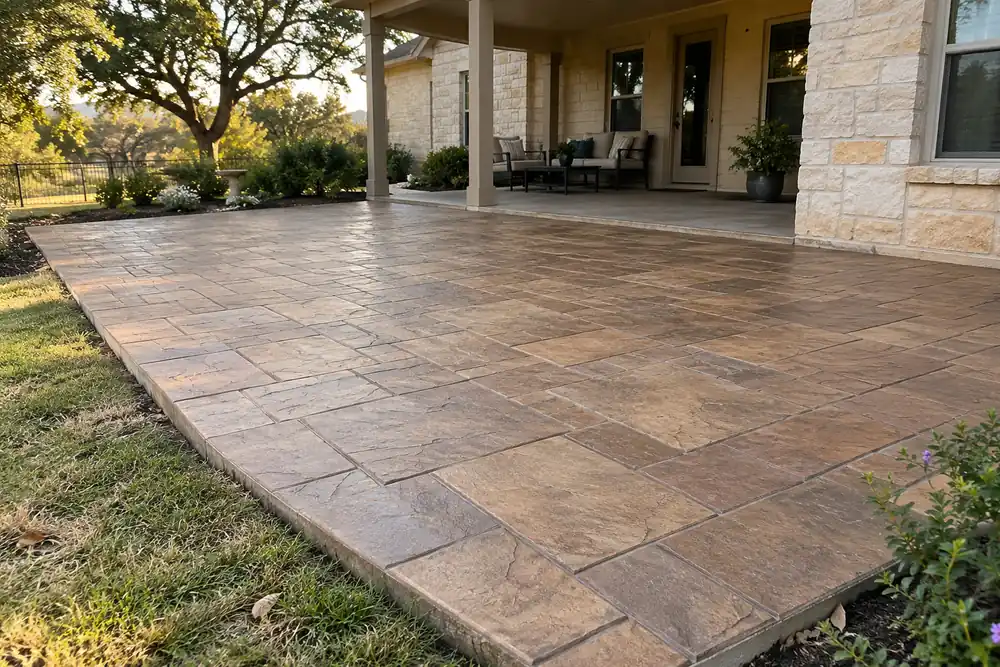
Stamped Concrete in Austin, TX
Heritage Concrete Austin installs stamped concrete in Austin, Texas, on patios, driveways, walkways and pool decks, in patterns such as brick, slate, cobblestone and wood plank. Color stamped concrete is a line item on City of Austin contracts too: bids from 2022 to 2025 had a median of $185 per square yard.
Phone or go online for a free estimate. We'll look at the pattern, the base and accent colors, and the sealer that suits where the slab goes.
Call or request a free estimate any time, 24/7
No charge · answered 24/7
Get free estimates
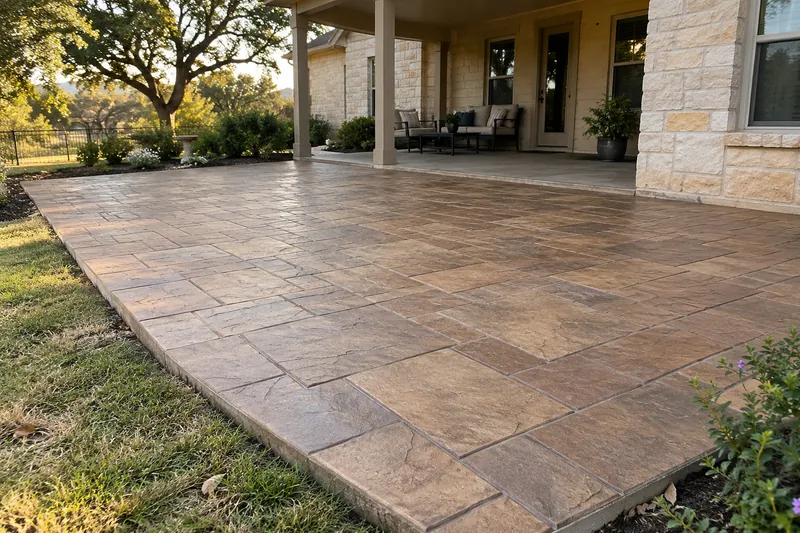
Stamped concrete patterns and color
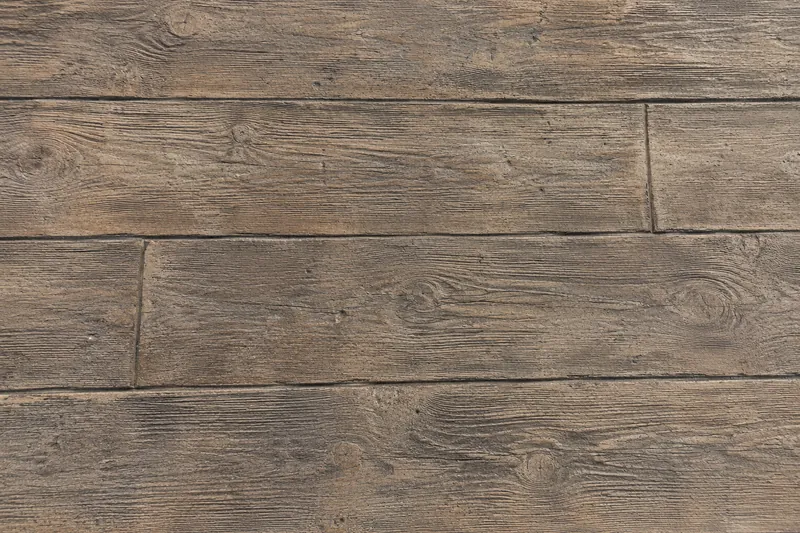
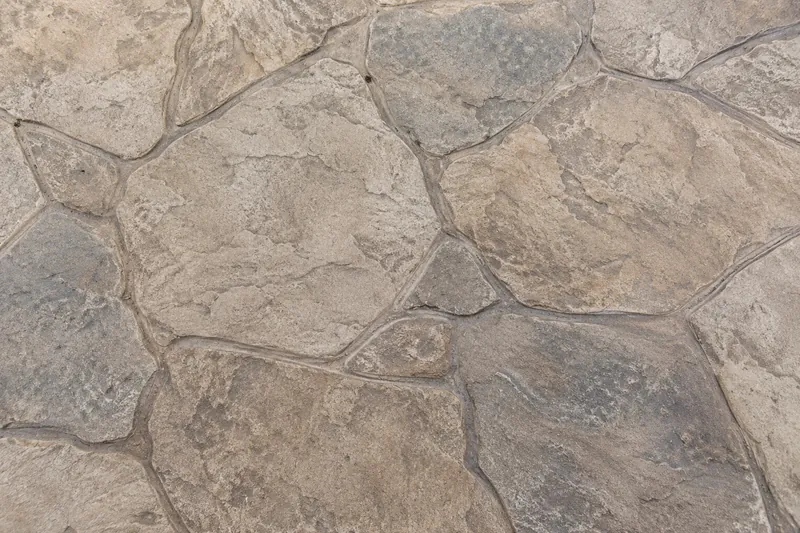
The pattern comes from mats and texture skins pressed into the fresh slab. Austin price tables list brick, slate, cobblestone and wood plank patterns, with a custom logo or inlay costing the most per square foot.
Base color: mixed in or broadcast
Integral color goes into the whole batch, so the slab is colored all the way through, though the choices are mostly earth tones and pastels. Color hardener goes on by hand, scattered over the wet slab, and tints just the top layer, which is why it usually looks stronger. One manufacturer specifies 60 pounds per 120 square feet for most jobs and another 50 pounds per 100, and the second says hardener greatly increases the surface's strength and durability.
Accent color from the release
The antique accent is left by the release, the powder or liquid that stops the mats from sticking. Some 70% to 80% of it is rinsed off after the concrete hardens; the rest stays pressed into the texture as the secondary color, generally between 5% and 30% of the finished surface. Powdered release is the traditional choice because it comes in more colors, while liquid release evaporates quickly and needs little cleanup.
For color with no pattern, stained concrete is another route: a true acid stain is translucent and penetrates the surface instead of coating it. During the free estimate, Heritage Concrete Austin goes over both colors with you.
Call or request a free estimate any time, 24/7.
(512) 588-2862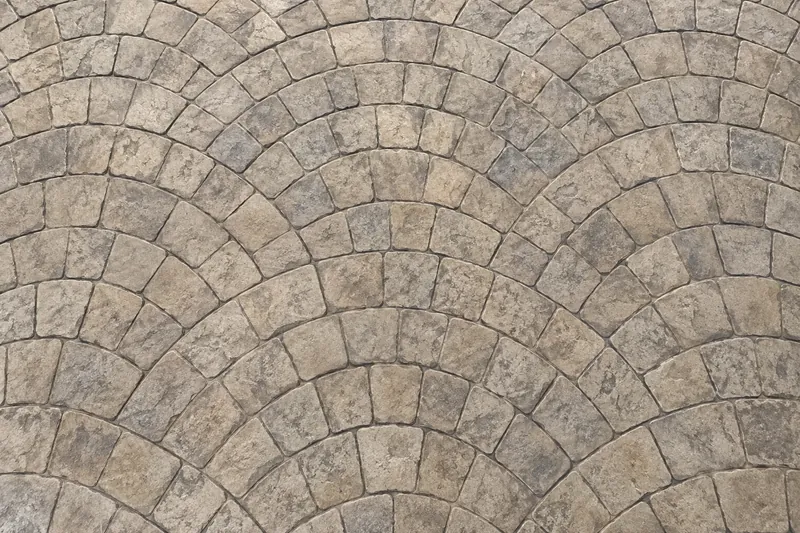
How stamped concrete is placed
Base and mix
One color-hardener maker recommends a compacted gravel subbase of at least 4 inches and a mix of no fewer than 5 sacks of cement to the cubic yard at a slump of 4 inches or less; another asks for 5½ sacks and no calcium chloride accelerators.
Color
Hardener goes on in two passes, roughly 75% to 80% first and the rest after. The first shake sits five to 10 minutes to draw water from the concrete before it is floated in.
Stamping
Stamping can start once a test press leaves a clean print roughly 3/16 to 1/4 inch deep. Mats in the first row are laid along a straight line, and they are pressed in by walking on them, sometimes with light tamping.
Detailing and joints
Seams and edges are touched up by hand with a chisel, roller or texture skin, and control joints are cut at least a quarter of the way through the slab.
Wash-off and sealing
Any leftover release gets washed off no sooner than a day after stamping, and at least 75% of a powdered release must come off before sealing. The final sealer typically goes on about 28 days after the pour.
Timing in Austin heat. From May 26 to September 23, normal highs at Camp Mabry sit above 90°F, and 90-degree days number 122.8 in an average year (1991–2020). Under ACI 305R, heat, low humidity, wind and sun that speed up drying and setting all count as hot weather, and pressing stamps into a surface that has already gotten too hard causes shrinkage cracks.
Call or request a free estimate any time, 24/7.
(512) 588-2862Sealer, grip and drainage
Which sealer
Acrylic sealers are the most common choice for outdoor stamped work, usually in two thin coats. The American Society of Concrete Contractors says penetrating sealers are typically left off stamped work, since they don't protect the antique release color.
Release left on the surface
The same guide lists too much leftover release among the biggest reported sealer problems, and for cleaning powdered release it suggests 15 to 20 parts water to 1 part muriatic acid.
Texture, grip and water
One or two thin coats of a low-solids acrylic can tame a texture that came out too rough, and clear grit mixed into the sealer improves traction. Patterned surfaces shed water more slowly than smooth ones because it collects in the texture, so the fall of the slab matters: a good exterior slope is 2% or more, which is ¼ inch of fall per foot.
Call or request a free estimate any time, 24/7.
(512) 588-2862Stamped patios, pool decks and walkways
Patios
A 100-square-foot stamped patio typically runs $1,000 to $2,000 in Austin (2026). Heritage Concrete Austin covers thickness, slope and size on its page about concrete patios.
Pool decks
Around a pool, a stamped texture can be paired with grit in the sealer for traction, while exposed aggregate concrete is highly slip resistant on its own. More on finishes for concrete pool decks.
Walkways and drives
A 300-square-foot stamped walkway runs $3,000 to $6,000 in Austin (2026), and a 500-square-foot stamped driveway $5,000 to $10,000.
Heritage Concrete Austin also lays stamped concrete patios in Rollingwood, where a patio that adds 250 square feet or more of impervious cover needs a drainage analysis from a Texas-licensed engineer, and stamped concrete in The Hills, where the property owners' association requires masonry matching the house on any patio face 2 feet or taller.
Call or request a free estimate any time, 24/7.
(512) 588-2862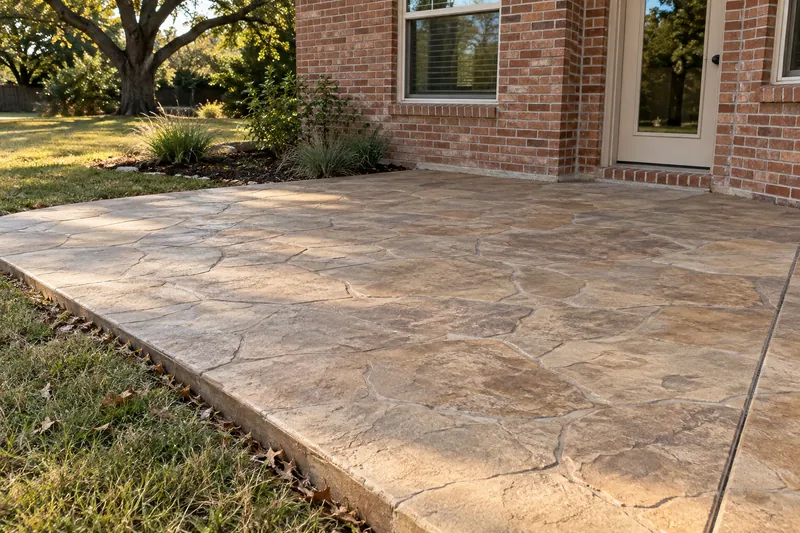
Stamped concrete cost in Austin
Most stamped projects in the Austin area cost between $5,080 and $8,733 (2026), with small jobs from about $3,300 and large ones up to $11,200. Labor costs $4.50 to $6 a square foot, or $40 to $150 an hour. A 2022 Austin guide priced a reinforced stamped patio at $10 to $17 per square foot, against $8 to $15 without reinforcement, and a 2026 Austin calculator puts a 120-square-foot job at about $22.96 to $27.93 per square foot.
Later costs belong in the budget too: repairs run $300 to $1,500, and the estimated return on a stamped project in Austin is 80% to 90%. None of these figures are prices from Heritage Concrete Austin; they're published averages, and the free estimate starts from your size, pattern and site.
- Brick
- $10 / sq ft
- Slate
- $11 / sq ft
- Cobblestone
- $14 / sq ft
- Wood plank
- $16 / sq ft
- Custom logo or inlay
- $20 / sq ft
Typical Austin-area averages per square foot, 2026. Not a quote.
Call or request a free estimate any time, 24/7.
(512) 588-2862Stamped concrete questions
What is better, pavers or stamped concrete?
Each has an edge. National figures put installed stamped concrete at about $8 to $18 per square foot and concrete pavers at $7 to $20, and both can last 30 years or more when maintained. Pavers take longer to install, one unit at a time, and their joint sand may need replenishing every two or three years against weeds. A stamped slab needs only routine cleaning and resealing, but it is often harder and costlier to repair.
Why does stamped concrete crack?
No concrete is completely crack-free, and NRMCA traces most cracking to design and construction mistakes: missing or poor joints, poor subgrade preparation, watered-down concrete, fast drying and little curing. Stamping adds one of its own: pushing the mats in after the surface has gotten too hard leaves shrinkage cracks. Travis County's hazard plan adds that expansive-soil damage peaks when wet periods give way to drought and then to rain once more.
Can you stamp existing concrete?
A stamped overlay can go over a sound slab. Overlays are typically ¼ to ¾ inch thick and, applied properly, should give 10 to 20 years or more, with resealing every 2 to 5 years. An old slab with large cracks, significant spalling or severe settlement may not be a candidate.
When can a stamped slab take foot traffic and cars?
Not right away. The leftover release is washed off one to three days after stamping, and as general practice new concrete takes at least 24 hours before foot traffic and about 28 days to cure fully. After a color-hardened surface is sealed, one manufacturer asks for a day with no foot traffic and five days with no cars.
Is a stamped surface slippery when wet?
Traction depends on the texture and the sealer. Clear grit mixed into the sealer improves grip, a textured overlay can do the same, and for a pool deck, exposed aggregate is highly slip resistant. Where no pattern is needed, broom texture improves grip, and a rock-salt finish adds subtle texture and slip resistance for little cost.
Get a free stamped concrete estimate
Call or use the form with the area's rough size and the pattern you have in mind. Heritage Concrete Austin prices stamped patios, walkways, drives and pool decks at no cost, at any hour.