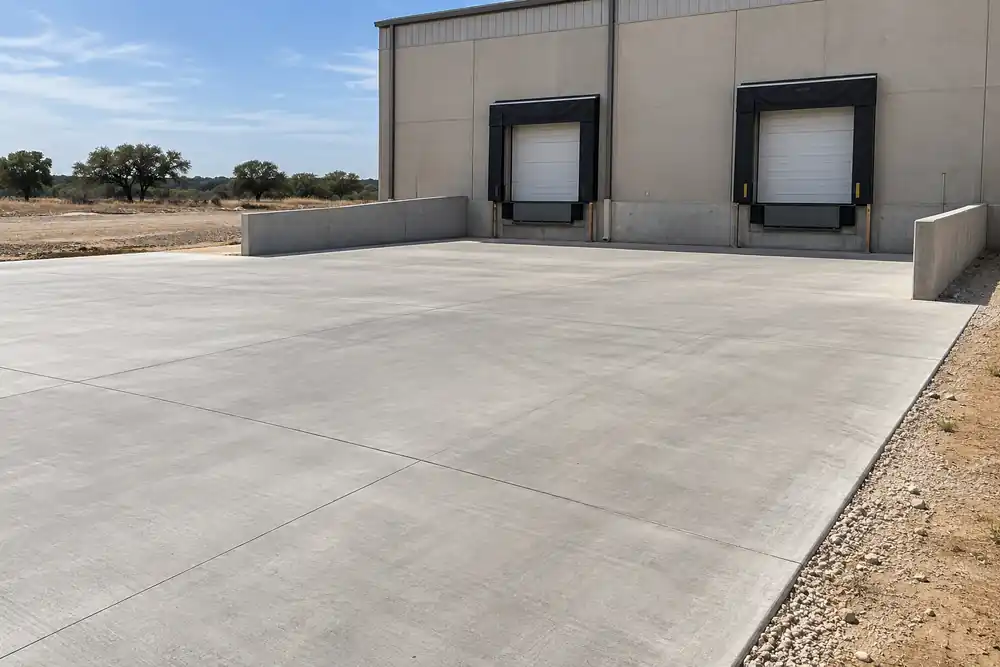
Commercial Concrete Contractor in Austin, TX
Heritage Concrete Austin is a commercial concrete contractor in Austin, Texas, for parking lots and site paving, building slabs and warehouse floors, tilt-wall panels, curb and gutter, and repairs to existing lots, walks and slabs. The City's open permit records show 4,104 commercial building permits issued in 2025, 812 of them for new buildings.
Send drawings, a site plan or a short description for a free estimate. We'll talk through mix, thickness, joints and the City's right-of-way requirements for the job.
Call or request a free estimate any time, 24/7
No charge · answered 24/7
Get free estimates
Parking lots and site paving
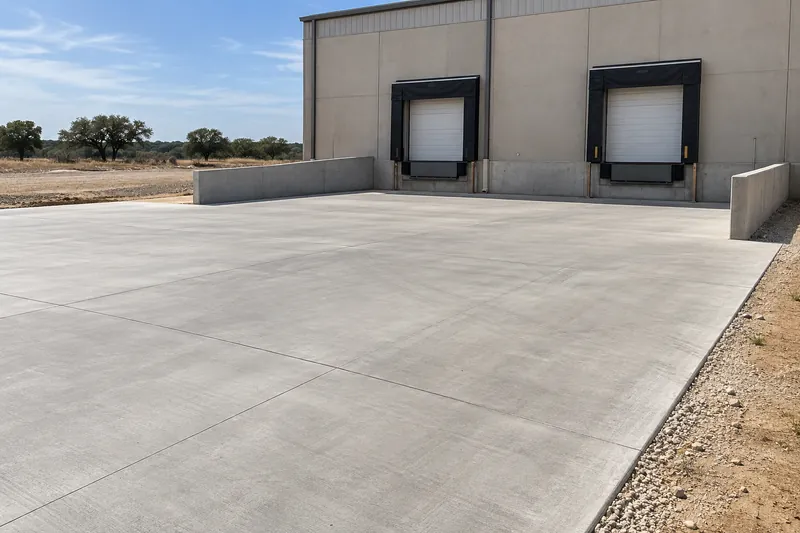
A 4,000 psi mix is enough for parking areas across most of the U.S., by NRMCA's guidance, and ACI 330.1, the American Concrete Institute's specification for unreinforced lots, calls for that strength at 28 days. Heritage Concrete Austin paves concrete parking lots for commercial and apartment properties.
Thickness by traffic
For cars and pickups, 4 inches of unreinforced concrete is usually enough; lanes for light trucks may need 5 or 6. In the ACI 330 table that NRMCA reprints, car parking areas take 4.0 inches and multiple-unit truck entrance lanes 8.0. Welded wire mesh adds no structural capacity to the pavement, NRMCA's parking-lot guidance notes; it only holds cracks tight.
Joints, slope and opening day
Joints go no farther apart than 24 to 30 times the pavement's thickness, 15 feet at most, laid out as square panels where possible. Pavement should fall 1%, or ⅛ inch per foot, toward the drains. New pavement stays closed to cars for 3 days and to trucks for 7, unless tests show it has reached adequate strength, usually 3,000 psi.
Accessible parking
The 2010 ADA Standards set minimum widths of 96 inches for an accessible car space, 132 for a van space and 60 for the access aisle, which must sit level with its spaces. Lots with 26 to 50 spaces need two accessible spaces, and for every six accessible spaces, or fraction of six, one must fit a van.
Soil and slope rules
The City's Transportation Criteria Manual warns that many central Texas subgrades are highly expansive, and it cites swell tests on Eagle Ford Clay from Hester's Crossing and I-35 in Round Rock. Austin's code bars parking areas on slopes steeper than 15%, and in the watersheds that feed Barton Springs it caps impervious cover between 15% in the recharge zone and 25% in the rest of the contributing zone. Heritage Concrete Austin is also a commercial concrete contractor in Round Rock.
Call or request a free estimate any time, 24/7.
(512) 588-2862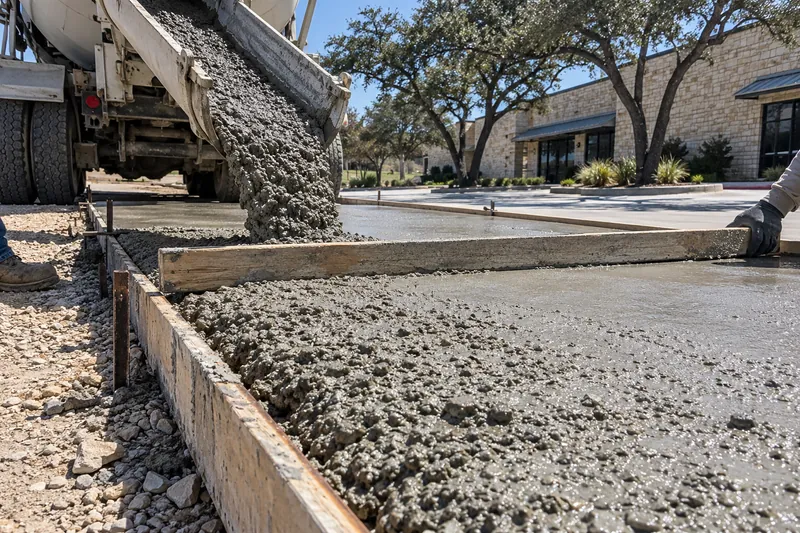
Warehouse floors, tilt-wall buildings and apartments
The City reports 462 megawatts of data-center capacity under construction in the Austin-San Antonio market, now the nation's second-largest secondary data-center market.
Industrial and warehouse floors
Floor flatness and levelness are measured as FF and FL numbers. Typical targets in ACI 302.1R are FF 35 and FL 25 for warehouses with moderate or heavy traffic, rising to 45/35 where air pallets are used. Hard-troweled floors should hold air content to 3% or less, and heavily loaded slabs need metal dowels, NRMCA advises. See industrial concrete.
Tilt-wall construction
In the Tilt-Up Concrete Association's definition, the walls are big concrete panels cast right on the job site, then craned up into place. Most wall panels measure 6 to 8 inches thick and are lifted once the concrete reaches strength, usually in about 7 days. For safety, TCA's guideline sizes the crane to the heaviest panel plus its rigging and wants bracing designed for wind loads. See tilt-wall construction.
Apartments and multifamily
In 2025, building permits in Austin covered 6,459 homes in 113 buildings of five or more units, about 73% of all new housing units authorized that year (Census Bureau). Apartment buildings are one of the building types the Post-Tensioning Institute names for post-tensioned concrete. See multifamily concrete.
Call or request a free estimate any time, 24/7.
(512) 588-2862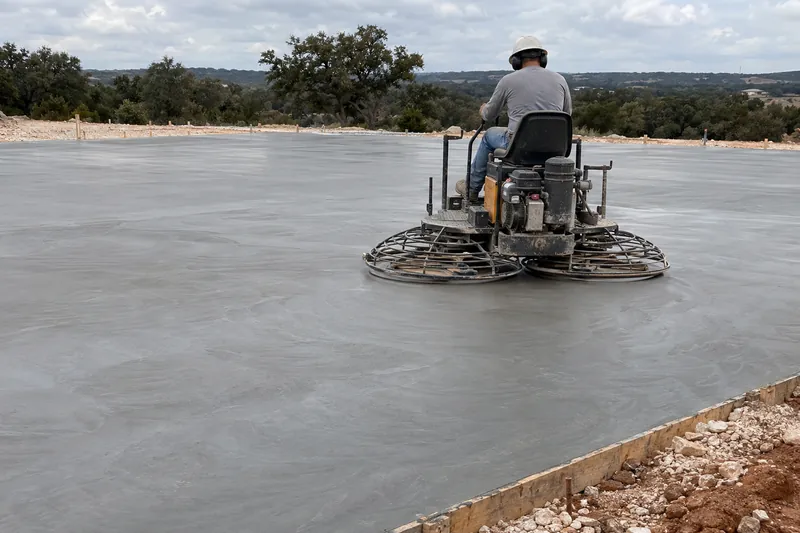
Curb and gutter, approaches and sidewalks in the right-of-way
Work in the public right-of-way follows the City's own standards. Sidewalks and driveway approaches must meet the Transportation Criteria Manual, and curbs and gutters the Drainage Criteria Manual as well. The City's Class A concrete for curb, gutter, sidewalks and driveways has at least 5.0 sacks of cement per cubic yard, reaches 3,000 psi at 28 days, keeps the water-cement ratio at 0.6 or below and is air-entrained.
Permits and the right-of-way license
A Driveway/Sidewalk permit covers installing, repairing or removing sidewalks, approaches, curbs and gutters. Only a contractor holding a City right-of-way license can file it; the license is four documents: a $10,000 bond, insurance, a resolution of authority and an authorized agent form. Subcontractors working in the right-of-way must be named on the permit and licensed too.
Commercial approaches and new-building sidewalks
Any approach serving something other than a one- or two-family home is a type 2 approach under the City's code. A building permit for a new building must show any sidewalk the Transportation Criteria Manual requires, and the certificate of occupancy waits until it's built. TxDOT cures its own curb and gutter for at least 72 hours. See curb and gutter.
Call or request a free estimate any time, 24/7.
(512) 588-2862Commercial concrete repair
Much commercial spalling starts at the steel. As rebar corrodes, the rust occupies two to four times the steel's original volume, and that pressure pops off the concrete cover, NRMCA explains. The American Concrete Institute's repair bulletin for horizontal surfaces starts by sounding the slab to find hollow areas, saw-cuts simple shapes no deeper than the cover over the bars, clears about ¾ inch around corroded bars, and calls in a structural engineer when bars have lost section.
On walking surfaces, the 2010 ADA Standards allow a vertical change in level of ¼ inch at most; up to ½ inch must be beveled, and anything taller must be ramped. Heritage Concrete Austin takes on commercial concrete repair for lots, walks and slabs.
Call or request a free estimate any time, 24/7.
(512) 588-2862How a commercial pour is planned and tested
Estimate and takeoff
We review the drawings or the site, the quantities, access and schedule. The estimate is free.
Pre-pour meeting
For major projects, NRMCA advises a pre-pour meeting where the owner, designers, contractors, concrete supplier and testing agency agree on who handles what.
Permits and subgrade
Right-of-way work gets its Driveway/Sidewalk permit. Under a parking lot, NRMCA calls for no special subbase, only a subgrade that is even in soil type, moisture and density throughout.
Placing in the heat
ACI 301 sets a 95°F ceiling for concrete at discharge, and ACI's hot-weather guide warns that test cylinders kept at 100°F for their first day may test 10 to 15 percent weaker when broken at 28 days.
Strength testing
Acceptance rests on cylinder tests, usually at 28 days: the average of three consecutive tests must meet the specified strength, with none more than 500 psi below it.
Call or request a free estimate any time, 24/7.
(512) 588-2862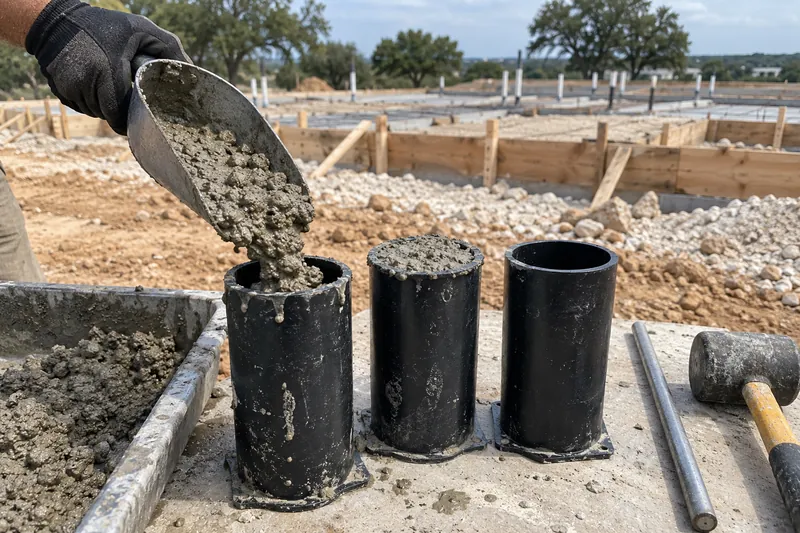
Commercial concrete cost in Austin
Public bids are the clearest local guide to commercial prices. On City of Austin contracts bid from 2022 to 2025, the median bids were $160 per square yard for concrete street pavement, $50 per linear foot for curb and gutter, and $20 per square foot for a concrete driveway. National averages put a concrete parking lot at $5 to $10 a square foot ($1,500 to $3,500 per stall, 2026), and a tilt-up warehouse at $40 to $50 a square foot before land (2025).
Bid medians and national averages aren't prices from Heritage Concrete Austin. Quantities, access, schedule and specs set a real number, and the estimate is free.
- Concrete street pavement
- $160 / sq yd
- Curb and gutter
- $50 / linear ft
- Concrete driveway
- $20 / sq ft
- New 4-in. sidewalk
- $15 / sq ft
- Curb ramp with pavers
- $2,800 each
- Removing sidewalks and driveways
- $4 / sq ft
Median bids on City of Austin public-works contracts, 2022–2025. Not a quote.
Call or request a free estimate any time, 24/7.
(512) 588-2862Commercial concrete questions
How much do concrete contractors charge per hour?
In 2026 Austin figures, concrete repair pros charge $40 to $150 an hour, and experienced concrete pros on patio work $50 to $100. Most commercial work is priced by quantity instead: by the square foot of slab, the square yard of pavement or the linear foot of curb, the same units the City uses for its own bid items.
How to find a reliable concrete contractor?
Check the credentials the job actually needs. Texas has no state general-contractor license, but in Austin a general contractor must register with the City before building-permit work, and only a contractor with a City right-of-way license can pull permits for curbs, gutters, sidewalks and approaches. Get written bids from more than one contractor, as the Texas Attorney General advises, and ask how the pre-pour meeting and strength testing will be handled.
Does a commercial driveway or sidewalk in Austin need a permit?
Usually. The City exempts a commercial sidewalk or driveway from a building permit only when it sits no more than 30 inches above the adjacent grade, isn't over a basement, isn't part of an accessible route and isn't in a flood hazard area. Anything in the right-of-way needs a Driveway/Sidewalk permit, and commercial permits also pay a usage fee of $6.05 per structure per day.
How much does a concrete parking lot cost?
A national-average parking-lot job comes to about $75,000 in 2026, which buys roughly 30,000 square feet, room for around 100 cars, with concrete at $4 to $7 a square foot in the same guide. Striping adds $4 to $5 per standard stall and $25 to $40 per accessible stall.
Can concrete be poured in Austin's summer heat?
Yes, with precautions. Normal highs reach 90°F by May 26 and stay above it until September 23, the National Weather Service says. The City's own specification caps the concrete mix at 90°F, or 100°F with a high-range water reducer; chilled mixing water can lower concrete temperature by up to 10°F and ice by up to 20°F, and NRMCA advises curing for at least 3 days.
Get a free estimate on your commercial project
Send drawings, a site plan or a short description, or call. Heritage Concrete Austin prices parking lots, slabs, tilt-wall, curb and gutter and repairs for free, and picks up day or night.