Concrete Slab Foundations in Buda, Texas
Heritage Concrete Austin pours slab foundations in Buda, Texas, for residential and commercial buildings, from house slabs in the city's master-planned neighborhoods to commercial and multifamily slabs along the Interstate 35 corridor. Buda requires every foundation to be designed by a Texas-registered Professional Engineer, on signed and sealed drawings that cite the site's geotechnical report.
The Handbook of Texas places Buda on I-35, seventeen miles south of downtown Austin, in eastern Hays County; Onion Creek runs through its northwest side, and the 59-acre City Park sits in the heart of downtown. Ring us or send the form and the estimate is free; we'll work from the engineer's drawings, or from the slab's size and use, and talk through the site.
Call or request a free estimate any time, 24/7
No charge · answered 24/7
Get free estimates
Engineered house slabs under the City's foundation letter
The City's foundation certification letter of August 13, 2024 spells out what a foundation design must carry: the geotechnical report's number, date and engineer; the lot, block and subdivision; and the design criteria, meaning the soil bearing capacity, the design plasticity index where it applies, and the potential vertical rise, the distance expansive clay could heave upward. Plasticity index is the span of water content over which a soil behaves as a plastic material, and highly plastic clays score high on it.
Design calculations have to follow the adopted Wire Reinforcement Institute or Post-Tensioning Institute methods, or another rational method allowed by Section 1808.6.2 of the International Building Code. Buda has adopted the 2024 International Building Code and the 2024 International Residential Code, and its building permit checklist calls for engineered foundation plans and structural drawings of the foundation design.
The engineer's report before move-in
Each foundation plan names a Registered Design Professional in Responsible Charge. Before the City issues a certificate of occupancy, that engineer gives the building official a final report of the required foundation inspections, and its checklist runs through:
- the reinforcing steel and its placement, post-tension tendons included
- the moisture barrier
- the formwork's shape, location and dimensions
- slump and air-content tests on the fresh concrete
- the concrete's in-place strength before any tendons are stressed
Call or request a free estimate any time, 24/7.
(512) 588-2862Commercial slab foundations and site plan permits
A commercial project, or a multifamily one of more than four homes, needs a site plan permit when it builds on undeveloped land or when it adds buildings or changes the utilities, paving, grading or drainage on a site. The permit expires after 2 years if the project makes no substantial progress. Review costs $1,500 plus $0.05 per square foot of impervious cover for a site under one acre, and $2,500 plus $0.05 per square foot plus $250 per page for larger sites.
For the building, Ordinance 2026-31, adopted September 15, 2026, sets commercial new-construction plan review at $500 plus $0.35 per square foot and a commercial form survey review at $75. Commercial inspections are $200 for a building under 1,500 square feet, and $200 plus $0.02 per square foot for one of 1,500 square feet or more.
Shop and warehouse slab prices
A 2024 Austin-area guide puts reinforced slabs at $6 to $10 a square foot: $10,300 to $17,600 for a 30-by-40 and $20,600 to $35,200 for a 40-by-60, and taking out an old slab first adds between $1.10 and $1.70 per square foot. Those prices are for plain reinforced slabs, not engineered foundations; a free estimate for a Buda building is priced from its drawings.
Where businesses are building
The Buda Economic Development Corporation markets the city's shovel-ready sites, existing retail space and manufacturing locations. In the City's most recent principal-employer table, from 2021, the largest employers include Capital Excavation with 315 employees, H-E-B Grocery with 249, Wal-Mart with 240, Fat Quarter Shop with 215 and Cabela's with 196.
Call or request a free estimate any time, 24/7.
(512) 588-2862Buda Limestone, Heiden clay and the Hill Country edge
Buda gave its name to a rock. The U.S. Geological Survey's national lexicon describes the Buda Limestone, named from the town, as a hard, whitish or yellowish limestone about 100 feet thick that lies over the Del Rio clays, and the Bureau of Economic Geology lists the Buda among the formations east of the Balcones Escarpment. On the Bureau's Austin West map, the Del Rio Clay is one of the clay units inside the fault zone, and the Bureau calls those clay units weak and unstable, generally needing special engineering designs.
Where the Census Bureau pins the middle of Buda, USDA's soil survey shows Heiden clay on 3 to 5 percent slopes. Its top layer is 50% clay, and its linear extensibility, the survey's gauge of shrink and swell, is 12.1 percent. The reading covers that one spot, not all of Buda. USDA describes Heiden as a deep clay with high shrink-swell potential, which in dry periods splits open in cracks of ½ to 3 inches; potential vertical rise, which Buda wants on every design, is the measure of how far clay like this could push up.
In the Handbook of Texas's account of Hays County, the Balcones Escarpment divides hilly ranch country in the northwest from grassy farm plains in the southeast, with soils ranging between thin limestone and black, waxy, chocolate or grey loam. The Buda Economic Development Corporation puts the city at the edge of the Hill Country.
Call or request a free estimate any time, 24/7.
(512) 588-2862Neighborhoods and lot coverage limits
Buda more than doubled between censuses, from 7,295 people in 2010 to 15,108 in 2020, and the Census Bureau estimates 16,166 for July 1, 2025. The median home in the 2020–2024 survey dates from 2012, and about 86% of the city's 6,242 housing units went up in 2000 or later. For 2025, the Bureau's permit survey lists 66 new single-family buildings valued at $19,633,193 in all.
Neighborhoods run from Shadow Creek, off Windy Hill Road about 3 miles east of I-35 and built from 2006 to 2019, and Garlic Creek in west Buda, whose earliest homes date from 2007, to Bradfield Village just off Main Street beside the 31-acre Bradfield Village Park. Sunfield, a 2,400-acre master-planned community of about 4,000 homes, lies just outside the city limits, so check which rules apply there before planning a slab.
Lot sizes and impervious cover by zone
The Unified Development Code sets minimum lots of 30,000 square feet in Estate Residential (R-1), 9,000 in Suburban Residential (R-2) and 6,000 in One and Two Family (R-3). It caps impervious cover, which counts slabs, drives and other hard surfaces, at 30%, 50% and 60% of the lot in those zones. A house slab, a back patio and a driveway all count against that cap, so any new pour starts with the arithmetic.
Call or request a free estimate any time, 24/7.
(512) 588-2862Residential permits and fees
Buda issues building permits only for platted properties and calls itself a "one-permit city": subcontractors are listed on the main building permit, and a licensed contractor has to be registered with the City. Under Ordinance 2026-31, a residential new-construction review costs $500 plus $0.25 per square foot, a residential form survey review $50, and a residential building inspection $150, with a reinspection at twice that, $300.
A permit expires after 180 days if work hasn't started, and inspections need at least 24 hours' notice. Foundation repairs and driveways are both on the City's permit list. A residential flatwork permit is $150 plus $0.50 per square foot, and building or altering a driveway without a permit is an offense under the development code.
Retaining walls on sloped lots
Where a slab needs a wall to level the pad, Buda's 2024 residential code amendments exempt retaining walls of 4 feet or less, counting from the footing's base up to the top of the wall, unless the wall holds up an added load.
Call or request a free estimate any time, 24/7.
(512) 588-2862More concrete work around Buda
Alongside foundations, we pour driveways and approaches, garage floors, patios, pads for shops and RVs, and sidewalks, and we level and repair older slabs. About four miles northwest up FM 1626, Heritage Concrete Austin offers concrete resurfacing in Hays, and it builds driveway approaches in Manchaca.
Call or request a free estimate any time, 24/7.
(512) 588-2862From soil report to certificate of occupancy
The paperwork and checks Buda's rules set for an engineered foundation, in order.
Soil report
A geotechnical engineer investigates the lot and reports its bearing capacity, plasticity and potential vertical rise.
Engineered design
A Texas-registered engineer designs and seals the foundation by WRI or PTI methods, citing that report.
Permit
The engineered foundation plans and structural drawings go in with the application, on a platted lot.
Form survey review
The fee schedule charges for a form survey review, a check of where the foundation forms sit before the pour.
Pour, test and stress
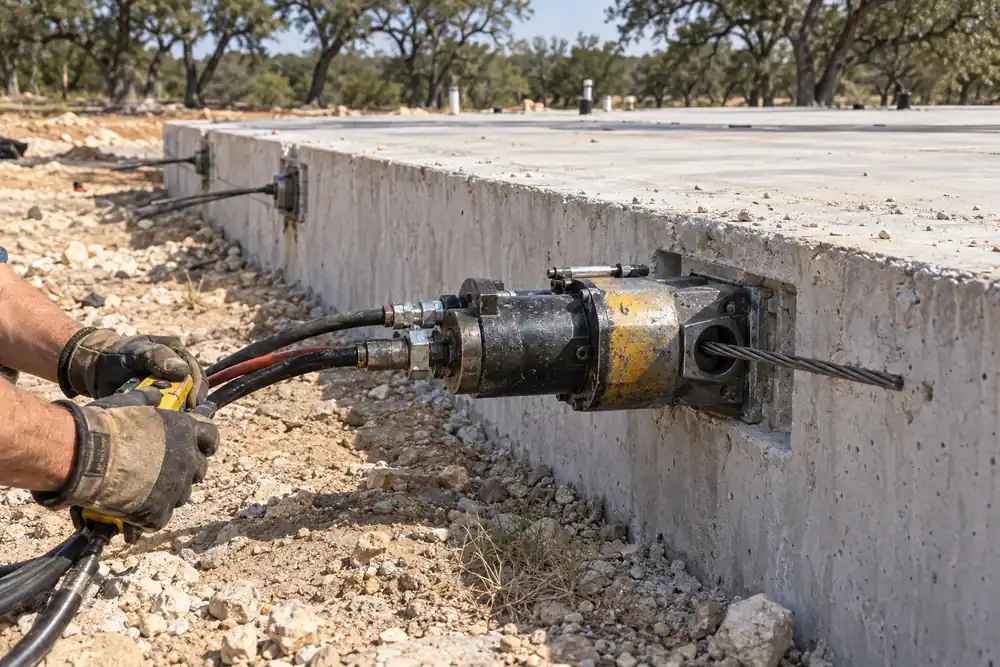
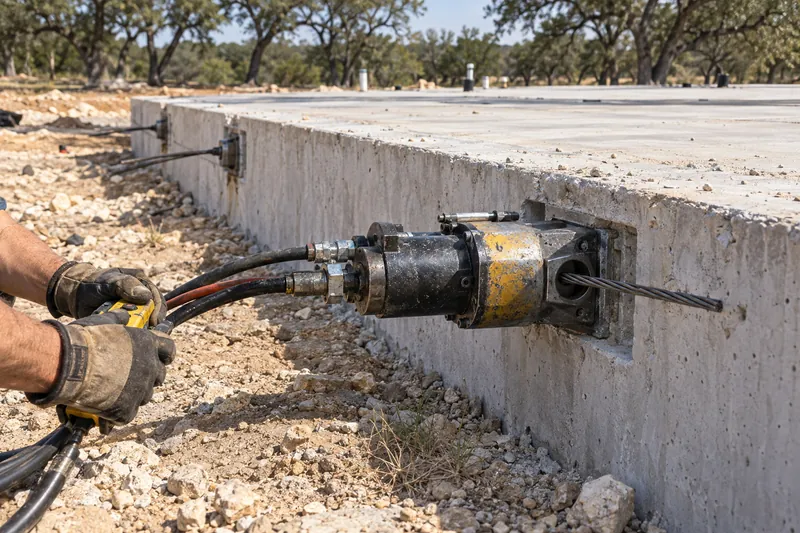
The fresh concrete is tested for slump and air. On a post-tensioned slab, its strength is verified before the tendons are stressed; the pull on each cable is 33,000 pounds, enough to stretch 100 feet of cable about 8 inches.
Final report
The engineer in responsible charge sends the building official a final report of the foundation inspections before the certificate of occupancy is issued.
Questions about post-tensioned slabs
Are post tension foundations good?
Buda's foundation letter accepts them, since designs may follow Post-Tensioning Institute methods, and the institute presents post-tensioning as an economical way to deal with foundation trouble on ground that shrinks and swells. Buda's engineer checklist covers the tendons and a strength check before they're stressed. The trade-off comes later: a national cutting contractor puts the force in each strand at 25,000 to 33,000 pounds and says severing one releases that energy explosively, so the cables have to be located before anyone cuts or cores the slab.
Get a free estimate on a Buda foundation
Call, or send the engineer's drawings or the slab size and use. Heritage Concrete Austin prices residential and commercial foundations in Buda at no cost and answers calls around the clock.