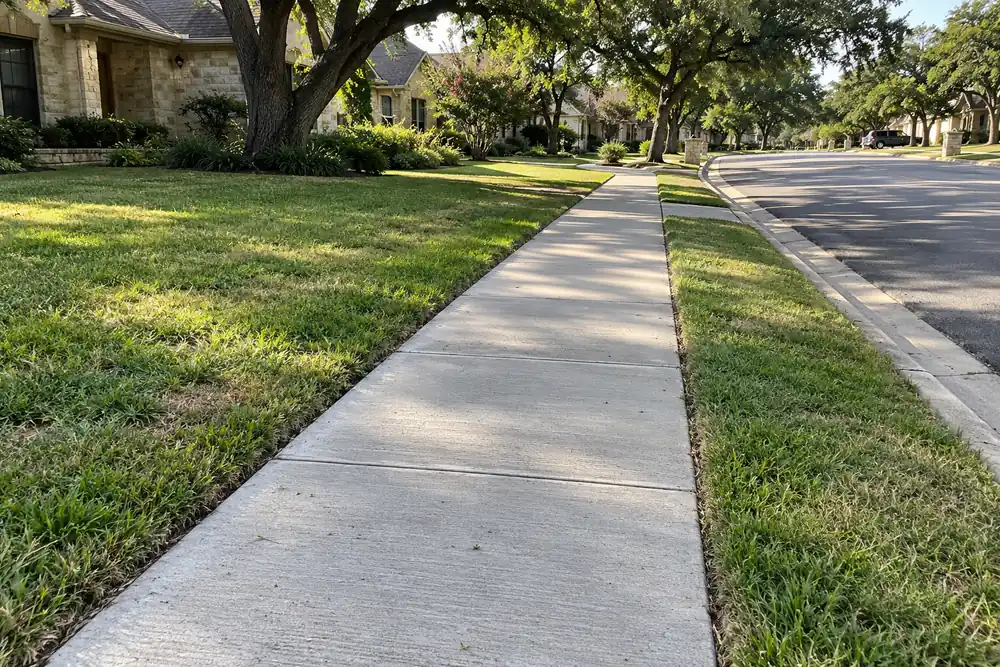
Concrete Sidewalks and Walkways in Austin, TX
Heritage Concrete Austin builds concrete sidewalks and walkways in Austin, Texas: front walks from the drive to the door, garden paths and side-yard walks, and public sidewalks along the street built to the City's standard. The City's sidewalk plan, adopted November 30, 2023, puts the cost of all its roughly 1,500 miles of planned sidewalks and shared streets at about $903 million, against a new-sidewalk budget of about $10 million a year.
Estimates cost nothing; call or use the form. We'll cover the width, the base and the joints, and whether any part of the walk falls in the right-of-way, where the City requires a permit.
Call or request a free estimate any time, 24/7
No charge · answered 24/7
Get free estimates
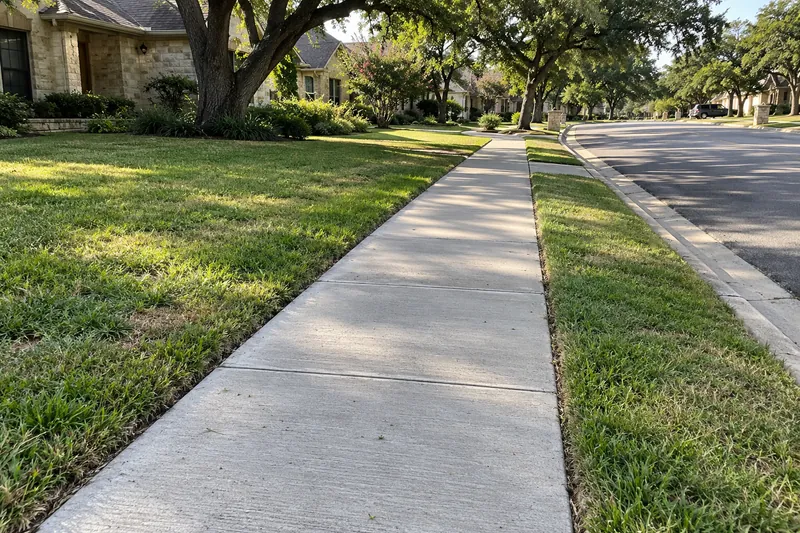
Front walks and garden paths
Width
A residential walkway is ideally 48 inches wide, enough for a wheelchair or for two people side by side. For garden paths, general practice suggests 4 to 5 feet and warns against anything under 3.
Digging and base
Digging for a new walk typically goes about 8 inches deep: half for compacted gravel or crushed stone, half for the concrete.
Slope and joints
A 4-foot walk that runs alongside the house should fall 1 inch from one edge to the other, away from the wall. Control joints on a walk go roughly every 4 feet, each about one-quarter as deep as the slab. Heritage Concrete Austin goes over the fall and the joint layout for your walk during the estimate.
On your own lot
The City's residential FAQ says walkways on private property, outside the right-of-way, need neither a building permit nor a Driveway/Sidewalk permit. Where the walk reaches the porch, concrete steps carry it up to the door, and along the beds beside it, extruded landscape curbing makes an edge a mower can ride along.
Call or request a free estimate any time, 24/7.
(512) 588-2862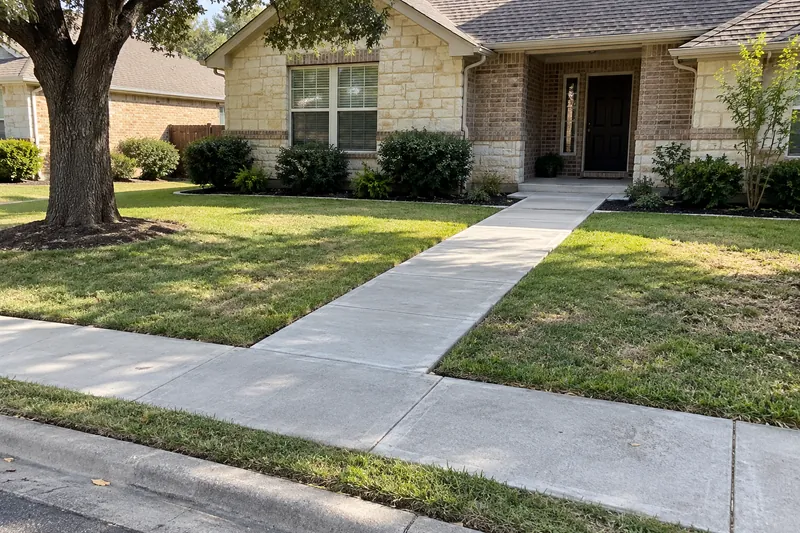
Public sidewalks built to the City standard
Width and slope
Where no other plan applies, the City's Transportation Criteria Manual asks for at least 5 feet of clear width on neighborhood (Level 1) streets and 6 feet on Level 2 and larger streets, with the back edge normally 2 feet off the property line. Standard Detail 432-1 caps the cross slope at 2.1%, and where City details, PROWAG and the Texas Accessibility Standards disagree, the strictest rule wins.
Joints and steel
The City's sidewalk specification, Item 432S, puts weakened-plane joints every 5 feet, expansion joints at most 40 feet apart, and ¾-inch expansion material wherever new work meets an old sidewalk or driveway. Reinforcement can be polypropylene fibers, welded wire or #3 bars, and extra reinforcing goes in where a driveway crosses the walk.
Where the walk crosses a drive
The sidewalk keeps its own elevation across a driveway, a raised crossing, and the City's Type I detail holds that strip to a 2% slope. Our page on driveway approaches covers the rest of the approach.
Accessibility
On public routes, the 2010 ADA Standards call for at least 36 inches of clear width, running slopes of 1:20 or flatter, and cross slopes of 1:48 or flatter. Up to ¼ inch, a change in level may rise straight up; between ¼ and ½ inch it needs a bevel no steeper than 1:2, and above ½ inch it counts as a ramp.
- Weakened-plane joint every 5 ft, ¼ in. wide and ¾ in. deep (City Item 432S)
- Broomed finish for grip (NRMCA)
- Class A mix, air-entrained, 3,000 psi at 28 days (City Item 403)
- #3 bars no more than 18 in. apart each way, or welded wire or fibers (City Detail 432-1)
- 2 in. sand cushion (Detail 432-1); Item 432S allows 2 to 5 in. of granular cushion
- Native ground: deep expansive clay in the east, shallow soil over limestone in the west (USDA)
Call or request a free estimate any time, 24/7.
(512) 588-2862Sidewalk permits and new homes
The Driveway/Sidewalk permit
Installing, repairing, changing or removing a sidewalk in the right-of-way calls for a City Driveway/Sidewalk permit, which only a contractor holding a right-of-way construction license may apply for. Plans are required for new work but not for a repair or replacement. The City charges $336.65 to inspect a sidewalk, plus $1.77 for every linear foot, and $189.34 for a re-inspection (fees effective October 1, 2026). Our guide to Austin driveway and sidewalk permits walks through the steps.
Sidewalks that come with a building permit
A permit for a new building, or for an addition of 50% or more of the floor area, has to include whatever sidewalk the Transportation Criteria Manual calls for, and no certificate of occupancy is issued until it's built or a fee is paid instead. On a corner lot, only the shorter frontage needs one. The City must accept the fee for a home of no more than two units on a lot subdivided before sidewalks were required, where less than half of the block face has sidewalk, and it may accept it when, for example, the slope would call for a retaining wall more than 2 feet high.
Call or request a free estimate any time, 24/7.
(512) 588-2862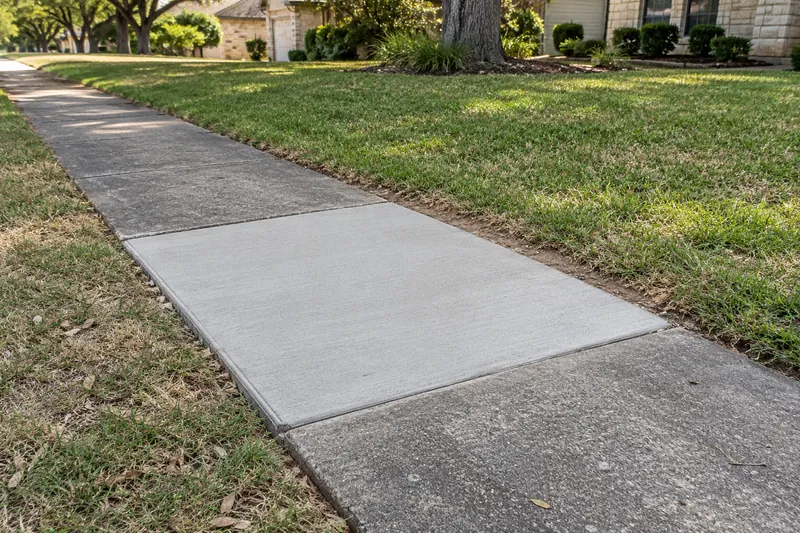
Clay, limestone and Austin sidewalks
The City's pavement guidelines put the zone where soil moisture rises and falls at 10 to 15 feet deep in central Texas, and they count sidewalks and driveways poured against the roadway as a horizontal moisture barrier. Travis County's hazard plan pictures pavement cracking in a new City of Austin subdivision in 2009 and rates future expansive-soil impacts "Likely." Walks that have already heaved or cracked are a job for concrete repair; for a new walk, Heritage Concrete Austin talks through the ground under it at the estimate.
Heritage Concrete Austin also builds concrete walkways in Bear Creek, a village 16 miles southwest of downtown laid out in 5- and 6-acre tracts, where USDA maps about 88% of the land as Brackett-Rock outcrop-Comfort complex.
Call or request a free estimate any time, 24/7.
(512) 588-2862Sidewalk and walkway cost in Austin
In the Austin area, a concrete walkway runs $4 to $30 per square foot depending on the finish (2026 figures); the average project comes to $1,962, and most fall between $1,570 and $2,354. Plain flat concrete runs $4 to $10 per square foot. Prep is extra: taking out an old walk costs $3 to $6 per square foot, a gravel or sand base $1 to $4, and grading $1 to $2. Labor accounts for 40% to 60% of the cost.
On the City's own contracts, a new 4-inch sidewalk drew a median bid of $15 per square foot and a 5-inch one $11 (2022–2025), while rebuilding an existing City walk at 4 inches, removal included, came to $24.50. Figures like these are published averages; Heritage Concrete Austin prices each walk at a free estimate.
- 100 sq ft, 4 in. thick
- $785–$1,180
- 100 sq ft, 6 in. thick
- $885–$1,275
- 200 sq ft, 4 in. thick
- $1,570–$2,355
- 200 sq ft, 6 in. thick
- $1,770–$2,555
Walkway averages for the Austin area, 2026. Not a quote.
Call or request a free estimate any time, 24/7.
(512) 588-2862Questions about sidewalks and walkways
What type of concrete is best for sidewalks?
The City's own sidewalk standard calls for its Class A mix: 3,000 psi at 28 days from 5.0 sacks of cement in each cubic yard or more, with entrained air and the water-cement ratio held to 0.6 or less. NRMCA's advice for exterior slabs is 4,000 psi, or 3,500 where the slab won't stay wet or see deicing chemicals, but that guidance is written for freeze-thaw exposure, and Austin's residential design table rates weathering "Negligible." Ohio Concrete's industry recommendation goes further on water, capping the water-cementitious ratio at 0.45.
How thick should a concrete sidewalk be?
A residential walkway should be at least 4 inches thick, and Austin price tables put most walkways at about 4 inches. The City's own bid items call for a thicker walk on expansive clay: its bids for 4-inch sidewalk on low-expansive soil had a median of $11.875 per square foot, against $13.75 for 5.5-inch sidewalk on soil rated moderate-to-high expansive (bids from 2022 to 2024).
Who repairs a broken sidewalk in Austin?
According to the City, it repairs and maintains some rights-of-way, including sidewalks, but the driveway is the owner's to repair. How far the right-of-way runs differs a lot from street to street, with ten feet back from the street's edge typical, and repair work inside it still needs a Driveway/Sidewalk permit. Austin-area prices for 2026 run from $3 to $10 per square foot for patching up to $12 to $22 for a full repour.
Can tree roots lift a sidewalk?
They can, which is why general practice keeps trees two sidewalk-widths from the edge of a walk. Austin protects the trees as well: in the City's own example, a curb drawn exactly on the half-root-zone line around a regulated tree fails, because the digging behind it reaches past that line, and form bracing and over-excavation also count against the root zone.
Does a walkway count as impervious cover in Austin?
A concrete walk on your lot does: the code counts concrete as impervious cover. Sidewalks in the public right-of-way don't, and neither do gravel paths used only for walking with no compacted base, or porous-pavement walkways outside the Edwards Aquifer Recharge Zone.
Get a free estimate on a sidewalk or walkway
Call or send the form with the walk's rough length and width and where it runs. Heritage Concrete Austin prices front walks, garden paths and street sidewalks for free, and the phone is answered 24/7.