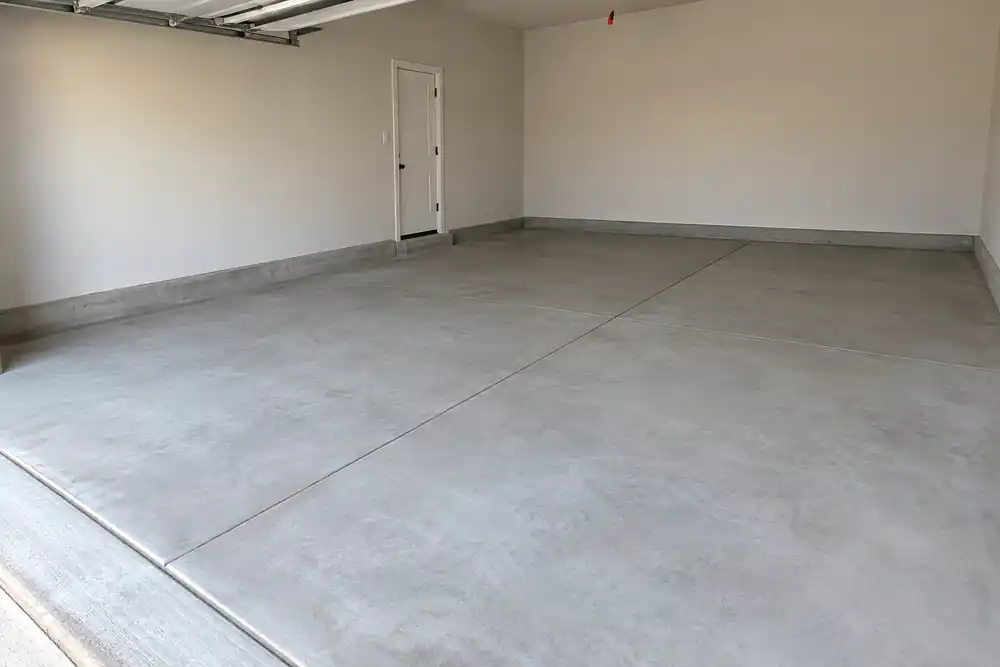
Concrete Garage Floors in Austin, TX
Heritage Concrete Austin pours, replaces and repairs concrete garage floors in Austin, Texas, from a new slab for a detached garage to breaking out a cracked or sunken floor and pouring it fresh. The International Residential Code puts garage floor slabs in its strictest concrete-strength group, alongside porches, carport slabs and steps exposed to the weather.
Pricing the job is free. Phone, or fill in the form, and we'll look at the cracks, any settling, the slope toward the door and the age of the slab, and talk through whether it calls for a repair, a new pour or a new finish.
Call or request a free estimate any time, 24/7
No charge · answered 24/7
Get free estimates
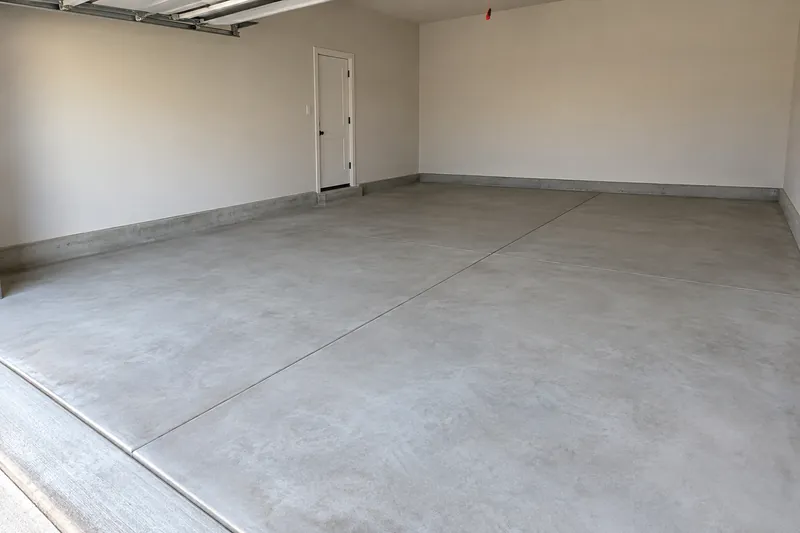
New garage floors and full replacement
What the code asks of the floor
The IRC requires an approved noncombustible floor surface, and the parking area must slope so that spilled liquids head for a drain or the main vehicle doorway. Slab floors on the ground must be at least 3½ inches thick, with a 4-inch layer of clean, graded sand, gravel, crushed stone or crushed concrete beneath where the slab sits below grade. Garages are among the unheated spaces the code exempts from its vapor-retarder rule, though NRMCA recommends a retarder of 10 mils or more under any indoor slab that will get a floor covering. For loads, the IRC's design live load in a garage is 50 pounds per square foot; a slab 6 inches thick adds roughly 75 pounds per square foot of its own weight.
Breaking out an old floor
Replacement means demolishing the old slab, hauling the debris away and pouring new concrete, with hauling and disposal adding $300 to $500 on average in national figures. Where the new floor meets the driveway, an isolation joint lets the two slabs move independently.
Call or request a free estimate any time, 24/7.
(512) 588-2862Repairing a cracked or sunken garage floor
Cracks
Sealing hairline cracks runs $10 to $250 in national 2026 figures, and sealing cracks that let water through $150 to $500. Most cracks start with how the slab was built: missing or poorly placed joints, a badly prepared subgrade, high-slump or watered-down concrete, rushed finishing, or little or no curing.
Settling on Austin clay
Drought is the usual trigger here. Travis County's hazard plan says expansive soils shrink in dry periods and can pull support out from under buildings, with slab-on-grade structures more likely to suffer. A sunken floor can sometimes be lifted instead of replaced; mudjacking one runs $750 to $2,400 in typical Austin-area figures for 2026. Austin Water's drought guidance allows watering a foundation on the household's assigned day and time, aiming sprinklers to wet the soil roughly 18 inches from it.
Heritage Concrete Austin checks whether a floor is a candidate for repair at the free estimate.
Call or request a free estimate any time, 24/7.
(512) 588-2862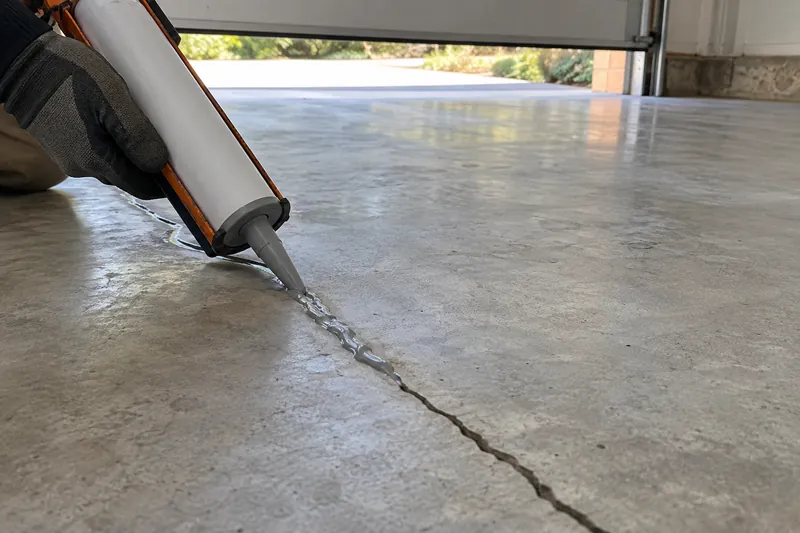
Austin rules for a garage slab
Engineered plans on expansive soil
City rules turn on the soil and the building. On expansive soil, Austin wants foundation plans for homes and accessory buildings designed by a Texas Registered Engineer, who seals them, and City inspectors don't check those foundations themselves: the builder uploads a registered design professional's report to the permit by the final inspection. The exception is a detached single-story garage or shed no bigger than 500 square feet, without plumbing or living space; it needs no structural drawings, and the building inspector looks it over on site. Heritage Concrete Austin pours concrete slabs for garages and houses alike; for a shop or garage slab poured before the walls go up, see concrete pads.
Septic lots and lot coverage
On a septic lot, adding a garage enlarges the developed footprint, so Austin Water reviews the on-site sewage facility. For duplexes and two- and three-unit homes, garages count toward both the 40% building-coverage cap and the 45% impervious-cover cap, and inside the City's McMansion area a garage counts toward the home's floor-area limit, though a carport does not.
Call or request a free estimate any time, 24/7.
(512) 588-2862Finishes and coatings over the concrete
Bare, sealed or stained
An interior concrete floor that is properly installed and sealed can last indefinitely. For color without a coating, a floor can be stained, at about $4 per square foot for a single stain or $10 for several, or stamped at about $14 (national, 2026). Grinding the slab itself to a sheen is covered under polished concrete.
Coatings
Most garage coatings are epoxy-based systems, often with acrylic color flakes; quartz aggregate broadcast into 100% solids epoxy stands up to impact better than flakes do. National figures for 2025 put epoxy at $4 to $10 per square foot over the slab, polyurea at $5 to $10 and polyaspartic at $5 to $12.
Call or request a free estimate any time, 24/7.
(512) 588-2862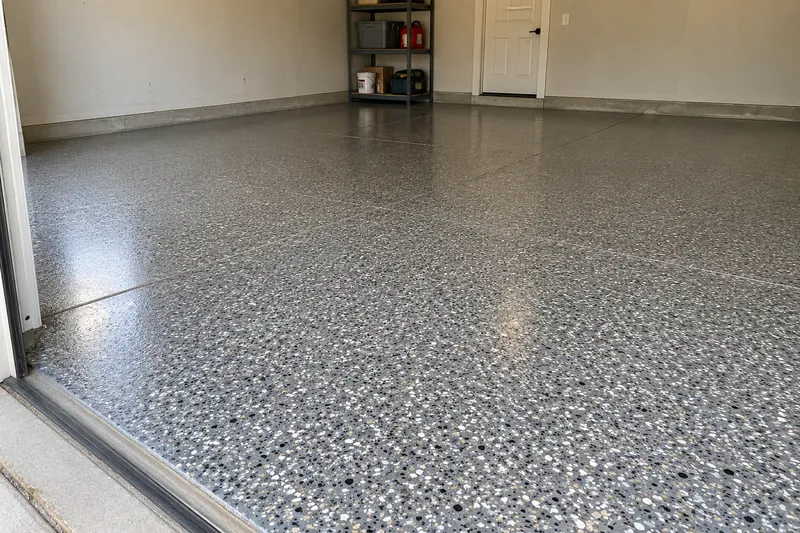
What a garage floor costs
Austin-area figures for 2026 average a 350-square-foot garage floor at $2,450 and put a garage foundation at $1,650 to $5,800. Nationally, a basic garage slab costs $6 to $12 or more per square foot installed, and full replacement, counting demolition, hauling and the new pour, $10 to $16+ a square foot, or $5,800 to $9,200 for a 24-by-24 two-car floor (2025). Another national guide averages replacement at $4,300, or $7 per square foot within a $2 to $14 range (2026).
A coating is a separate line: epoxy flooring in Austin averages $2,388, typically $1,589 to $3,197 (2026). These averages come from published guides, not from Heritage Concrete Austin, and an estimate is free.
- New floor, 350 sq ft (Austin)
- $2,450
- Garage foundation (Austin)
- $1,650–$5,800
- Replace a 24 × 24 ft floor
- $5,800–$9,200
- Lift a sunken floor (Austin)
- $750–$2,400
- Epoxy coating (Austin)
- $1,589–$3,197
Published averages for Austin and the nation, 2025–2026; not a quote.
Call or request a free estimate any time, 24/7.
(512) 588-2862Garage floor questions
How much does a concrete garage floor cost?
By garage size, national 2026 figures run $480 to $3,700 for a one-car floor of about 240 square feet, $800 to $6,800 for a two-car floor of 400 to 484, and $1,700 to $18,100 for a three-car floor of 864 to 1,296. A free estimate prices yours.
What grade of concrete is best for a garage floor?
The code gives the minimum. The IRC's strength table (2015 edition) sets 2,500 psi at 28 days for a garage floor slab in negligible-weathering areas, which is how Austin's residential design table rates the city, rising to 3,000 psi for moderate weathering and 3,500 for severe. An Austin price guide notes that small patios, walkways and indoor concrete floors often call for 3,000 to 3,500 psi.
What is the downside of an epoxy garage floor?
Mostly maintenance and timing. Water-based epoxy may have to be recoated every 3 to 5 years; solid epoxy can last 10 to 20. Epoxy should be applied only in the 60°F-to-85°F range, with relative humidity below 85%, and Austin's normal daily high runs above 90°F from May 26 through September 23 (1991–2020 normals).
How long does a floor replacement take?
National figures put the work at 2 to 4 days from start to finish, and the garage stays out of use through days 4 to 7 while the new slab cures. Concrete generally takes foot traffic after 24 hours and reaches full cure in about 28 days.
Should a cracked floor be repaired or replaced?
National guides draw the line in two places: replace once repairs would cost more than half as much as a new floor, and lean toward replacing a floor more than 20 years old rather than fixing its cracks one by one. If the cause isn't clear, a structural engineer's report runs about $550 and a geotechnical soil report about $1,500 (national, 2026).
Get a free estimate on a garage floor
Call or send the form with the garage size, the floor's age and what is wrong with it, or the plan for a new garage. Heritage Concrete Austin prices new garage floors, replacements and repairs at no charge, 24/7.