Concrete on Austin Clay and Limestone
Heritage Concrete Austin pours concrete on both kinds of Austin soil, and they could hardly be more different: west of the Balcones Escarpment, shallow stony clay sits on limestone, while to the east the deep black clay of the Blackland Prairie swells when wet and splits open when dry.
This guide draws on the USDA soil survey of Travis County, the City's pavement design guidelines, the Bureau of Economic Geology at the University of Texas and the National Weather Service, whose two Austin stations, Camp Mabry and Austin-Bergstrom airport, sit just 10.7 miles apart yet log very different freezes.
Call or request a free estimate any time, 24/7
The Balcones fault splits Austin's ground in two
The Balcones fault zone is a set of faults, most of them dropping to the east. On the Austin West geologic quadrangle map published by the Bureau of Economic Geology, one large break, the Mount Bonnell fault, and many small northeast-running faults add up to about 1,000 feet of displacement. The big movement probably came 20 to 25 million years ago, in many tiny steps, and the fault hasn't moved in recorded history, though small earthquakes in 1893 and 1902 may have come from it.
West: limestone hills
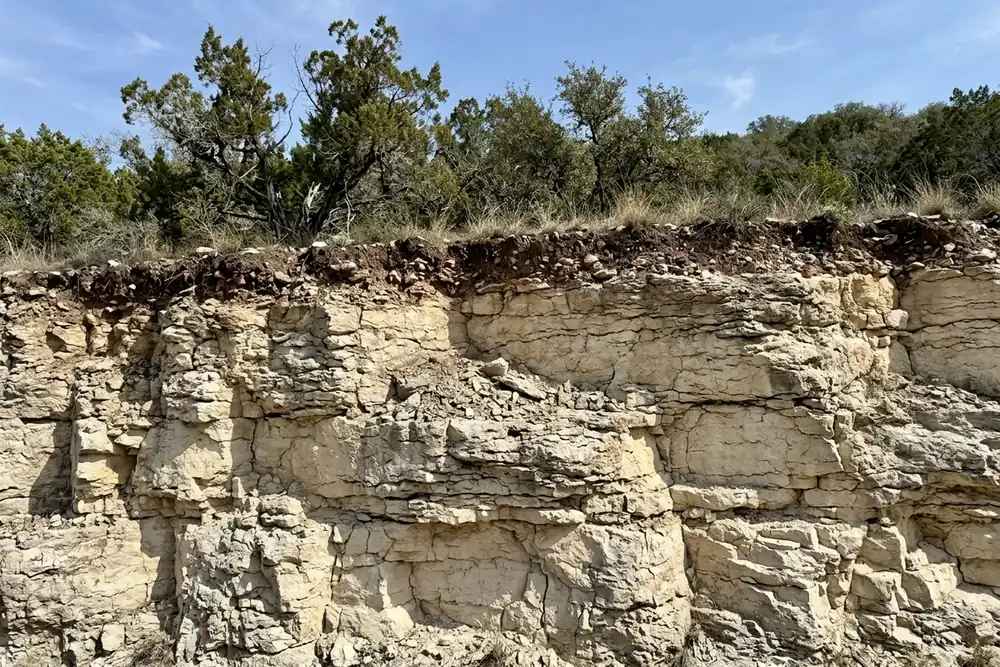
West of the escarpment lie the Balcones Canyonlands, flat-topped hills cut by steep canyons, with Glen Rose and Edwards limestones 100 to 112 million years old at the surface; Mount Bonnell, at 785 feet, is one of the area's most prominent geologic features. Texas Parks and Wildlife describes the Edwards Plateau's limestone as honeycombed with thousands of caves.
East: Blackland Prairie clay
East of the escarpment the rocks are younger, 70 to 100 million years old: the Georgetown, Del Rio, Buda and Eagle Ford formations, then the Austin Chalk and the Taylor Clay. The soils on top are typically dark alkaline clays that Texas Parks and Wildlife says are often called "black gumbo."
The soils mapped under Austin
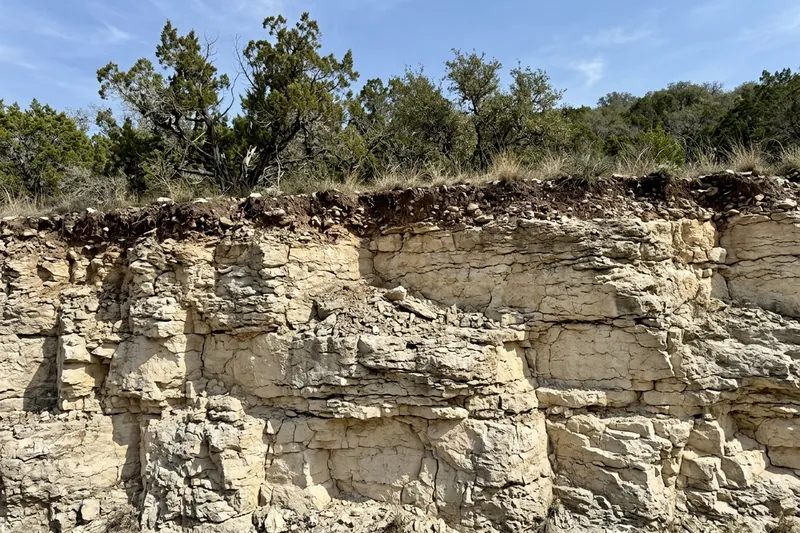
Nearly all of the city falls in the USDA's Travis County soil survey, with smaller slices in the Williamson and Comal-Hays surveys. Counting every mapped soil, Eckrant is the most common, followed by Houston Black, Brackett, Austin, Speck and Heiden.
Thin soil over rock
The limestone soils are thin. In the Travis County survey data, the typical depth to hard limestone is 7.9 inches under Eckrant and 18.1 under Speck, and Brackett reaches soft, weakly cemented rock at 18.1 inches. The Austin series, established in Travis County in 1904, is a moderately deep silty clay that meets chalk at 29 inches in its official description.
Deep clay that swells
USDA measures shrink-swell as linear extensibility, the amount a clod shortens as it dries from moist to oven-dry. In the Travis County data Ferris tops the local clays at 17 percent, with Houston Black and Heiden at about 12 and Crawford at 10 to 11; Brackett, on the limestone, measures 3.0 to 3.3.
How the City sorts swelling soil
The City's pavement guidelines treat subgrade as high-swell, generally, when its plasticity index tops 35, its liquid limit tops 60 and more than half passes a No. 200 sieve, and they warn that central Texas soils vary widely and are often highly expansive. Compared by plasticity index alone against the manual's swell bands, Ferris falls in Very High, Houston Black and Heiden in High, Eckrant in Moderate and Brackett in Low. Its swell-test examples include Eagle Ford Clay at Round Rock, Black Taylor Clay at Manor, Tan Taylor Clay at SH 71 and Riverside Drive, and Houston Black at Hutto, and it says the drying cycle is where most structural distress tends to occur.
Wondering which ground your lot sits on? Call any hour; estimates are free.
(512) 588-2862What the soil survey says about concrete here
For concrete driveways and sidewalks, which NRCS treats as slabs 3 to 6 inches thick, the survey weighs bedrock depth and hardness, large stones and slope for the digging and grading, and shrink-swell for how the slab holds up. Across Austin's mapped soils a large share comes out "Very limited," and hard bedrock near the surface holds back more of the city than swelling clay does, though some soils carry both limits.
Several soils land a step better, "Somewhat limited" for shrink-swell: the Austin series, Lewisville, Altoga, Volente, Georgetown and Whitewright. For homes on concrete slabs, the survey rates the deep clays (Houston Black, Heiden, Ferris and Crawford) "Very limited" for shrink-swell, the stony Eckrant units "Very limited" for large stones, and Austin, Speck, Brackett and Lewisville "Somewhat limited."
Cutting into a slope
Digging brings out both problems. On the west side, hard rock near the surface makes Eckrant and Speck "Very limited" for shallow excavations, which USDA defines as trenches or holes reaching 5 or 6 feet; on the east side the same rating comes from trench walls in cracking clay that can cave in. Austin's code also keeps most cuts and fills to 4 feet outside urban watersheds and bars buildings from slopes steeper than 25 percent. Where a grade change has to be held back, see concrete retaining walls.
Call or request a free estimate any time, 24/7.
(512) 588-2862How concrete is built for clay and limestone
Against swelling clay, the usual defenses are thorough compaction and good drainage, or else a structural or post-tensioned slab built so it doesn't depend on the ground beneath it. Hydrated lime is often worked into Houston Black to stabilize it, according to the Soil Science Society of America, which adds that foundations on this clay need steel reinforcement.
The City's pavement manual lists its own subgrade treatments, among them geogrids, blending, replacement, moisture treatment, lime and lime-cement. It does not normally recommend cement alone for swelling soils, and it reports "very mixed and sometimes poor results" from chemical injection in Central Texas clays. Residential streets must hold the subgrade's potential vertical rise to 3 inches or less, and because the moisture-critical zone runs 10 to 15 feet deep here, the manual notes that vertical moisture barriers usually need a depth of 6 to 10 feet to be effective.
For homes and accessory buildings on expansive soil, the City requires an engineered foundation plan carrying a Texas engineer's seal; more on concrete slabs and foundations. The American Concrete Institute's slab guide adds a caution owners should hear up front: expect some cracking and curling on any project, however good the design and the construction.
Call or request a free estimate any time, 24/7.
(512) 588-2862Austin weather and fresh concrete
Summer heat
Over 1991–2020, the first 100-degree day of an Austin year came on average on July 4 and the last on August 30, and the earliest on record fell on May 4, 1984. The record high is 112°F, reached on September 5, 2000 and again on August 28, 2011, and Gulf moisture can lift the heat index above 110. The American Concrete Institute treats any mix of high air or concrete temperature, low humidity, wind and sun that speeds up drying and setting as hot weather, and it caps concrete at 95°F as it leaves the truck.
Freezes: Camp Mabry against the airport
Freeze figures depend on the station. Camp Mabry, the City's official climate site in central-west Austin, recorded an average of 11.9 freezing nights (32°F or below) a year over 1991–2020; Austin-Bergstrom airport, in the low-lying Onion Creek basin, averaged 33.0, and on clear winter nights Bergstrom can run 10 degrees colder. NOAA's median first freeze is December 3 at Camp Mabry and November 16 at Bergstrom, and its median last freeze February 20 at Camp Mabry against March 12 at Bergstrom.
In the February 2021 storm, 6.4 inches of snow fell at both Camp Mabry and Bergstrom. ACI 306R counts it as cold weather when air temperatures drop, or are forecast to drop, under 40°F during the protection period, and NRMCA warns that fresh concrete freezes once it drops below roughly 25°F, which can rob it of over half the strength it would otherwise reach. Austin's code table puts the frost line at 12 inches.
Storms and flash floods
Most severe weather strikes between March and May, mainly as large hail and strong winds. Floods are the bigger threat: high rainfall rates and fast runoff in the Hill Country make some of the worst flash flooding in the United States, the Bureau of Economic Geology says. A great flood washed away the first Tom Miller Dam in 1900, and in 1981 another came out of the west Austin Hill Country and flooded the city. In the Halloween flood of October 30–31, 2013, 6 to 10 inches fell across central Travis County.
Drought and the clay
Dry years are when the clay moves. Travis County's hazard plan ties expansive-soil damage to droughts and says it is worst when rain gives way to drought and then rain again. The Texas State Climatologist found October 2010 to September 2011 the driest 12 months on record for the state, a little over 11 inches against a 27-inch average, with even deep soil moisture seriously depleted across central and eastern Texas. Austin's driest summer on record brought 0.98 inches of rain, in 1910.
Call or request a free estimate any time, 24/7.
(512) 588-2862When the ground has already moved a slab
Swelling soil typically shows up as cracked foundations and floors, jammed windows and doors and ruptured pipes, and the county plan says slab-on-grade buildings are the more likely to suffer. City permit records show hundreds of residential repair permits a year that mention foundations. For walks, drives and patios, a settled slab can often be raised rather than replaced; see concrete leveling, which covers when lifting works and when it doesn't.
Call or request a free estimate any time, 24/7.
(512) 588-2862Soil and weather questions
Is it possible to install a concrete slab on clay soil?
Yes, with the right design. Austin requires an engineer-sealed foundation plan for homes and accessory structures on expansive soil, and USDA's "Very limited" rating for slabs on the deep clays means the limits can generally be overcome only with special design, major soil work or a costlier installation. The Post-Tensioning Institute presents post-tensioned slabs-on-ground as an economical fix for foundations on shrink-swell soil.
Is expansive clay soil common in Texas?
Around Austin, yes. Houston Black, the best known of the Blackland Prairie clays, has its official type location in Travis County, and Travis County's hazard plan says its entire planning area is affected by expansive soils, with plasticity indexes from 2 to 60. Nationally, a U.S. Department of Housing and Urban Development research article, citing the American Society of Civil Engineers, says one in four U.S. homes has been affected by expansive soils, with damage above $15 billion a year.
How deep do footings need to be in clay soil?
On expansive soil in Austin, the engineer sets it: the City requires a sealed foundation plan that shows each beam's width and depth. Its residential design table lists a 12-inch frost line, while its pavement manual says soil moisture fluctuates as deep as 10 to 15 feet in central Texas.
Get a free estimate for concrete on your ground
Call or send the form any hour with where the lot is and what you want built. We'll talk through the base, the steel and the timing for your soil, and the estimate is free.