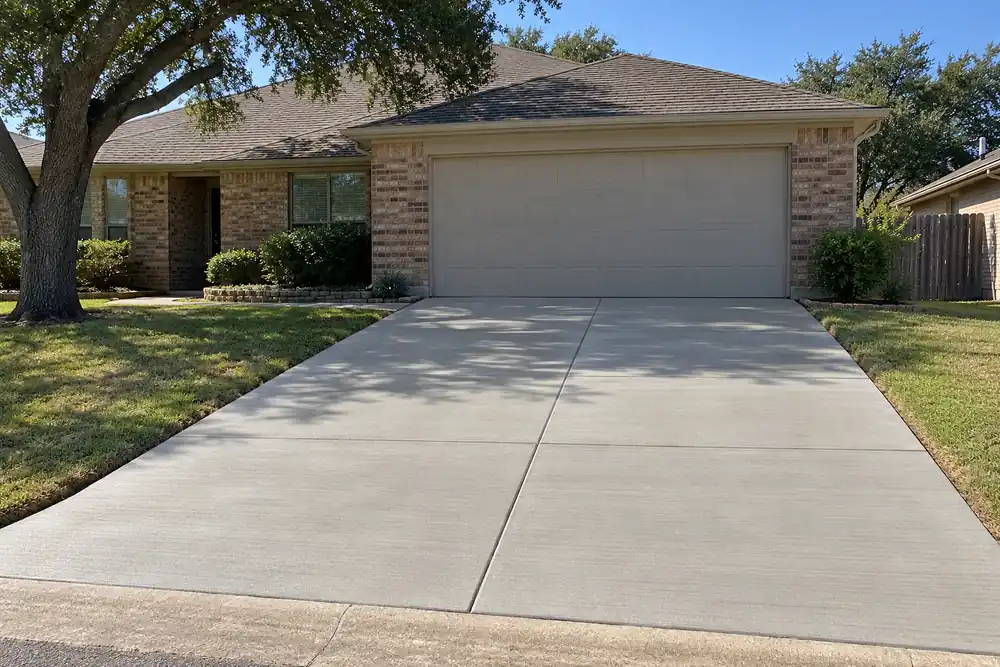
Concrete Driveway Installation and Replacement in Austin, TX
Heritage Concrete Austin installs and replaces concrete driveways in Austin, Texas, from a first drive on a new lot to a widened drive or a full tear-out of a cracked, sunken slab. The City issued 1,173 driveway and sidewalk permits in 2025, and 972 of them were for new residential work.
Estimates are free; phone us or fill in the form. We'll talk through the thickness your vehicles need, the base for the ground under your lot, and whether the approach at the street needs a City permit.
Call or request a free estimate any time, 24/7
No charge · answered 24/7
Get free estimates
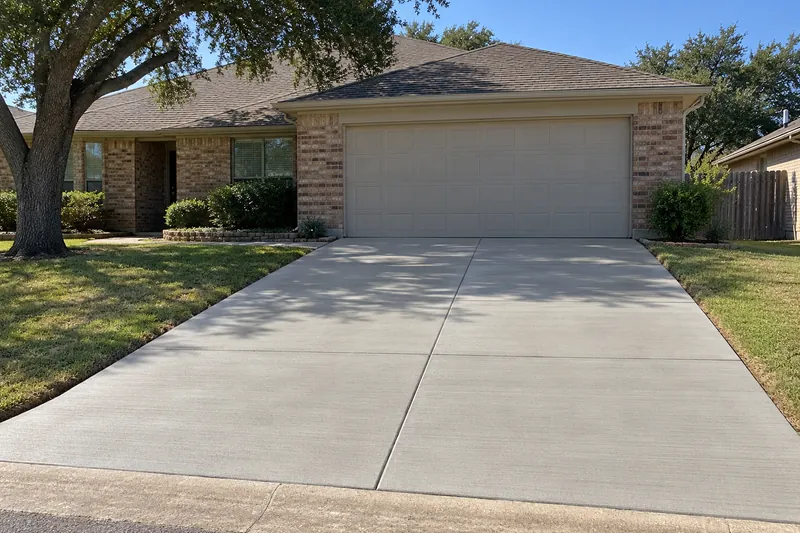
New concrete driveways: size, thickness and finish
Size the drive around the vehicles: each one needs at least 10 feet of width (12 is better for a single drive), and each car 18 to 20 feet of length, or 22 to 24 for a full-size pickup.
Thickness for what you park
What you park decides the slab. Passenger cars and SUVs, at 3,000 to 6,000 pounds, are generally fine on 4 inches; a large RV, 12,000 pounds or heavier, may need a 5- or 6-inch slab. The Tennessee Concrete Association puts the step from 4 to 5 inches at roughly 20% more concrete cost for nearly 50% more load capacity. Because the edges have less soil under them, a thickened edge 1 to 2 inches deeper, running 4 to 8 inches in from the side, is a common addition.
Lot limits in Austin
A property with less than 300 feet of street frontage gets one driveway under the City's Transportation Criteria Manual, and the approach for a single-family home is 10 to 20 feet wide. Driveways also count as impervious cover, which zoning caps at 45% of the lot in SF-2 and SF-3.
Finishes
Most drives get a push-broom texture for grip. For pattern and color, stamped concrete can take integral pigment or a color hardener, which gives deeper color and sharper imprints, while exposed aggregate concrete leaves a rugged, nonskid stone face that needs little upkeep beyond sealing and cleaning.
Heritage Concrete Austin also pours concrete driveways in Garfield and other towns nearby.
Call or request a free estimate any time, 24/7.
(512) 588-2862
Driveway replacement or repair?
Replacement usually wins when the slab is old, broken up or sinking. Past the 30-year mark, a full replacement is generally the most cost-effective choice, and spalling that covers much of the surface usually means the slab has to come out anyway.
When repair is enough
Fine cracks around ⅛ inch can usually just be filled; for much wider ones, it's worth checking whether the slab's structure is at risk. Damage confined to one area can be cut out and replaced on its own, though new concrete rarely matches old in color. For those jobs, see concrete driveway repair.
Why driveways crack and sink here
Travis County's hazard plan says swelling-soil damage is worst when a wet spell is followed by drought and then rain again, and that leaking water or sewer lines can do the same. Roots or a leak washing out the base under a drive can leave replacement as the only real fix.
Tear-out and haul-away
Replacing costs more than a first pour because the old slab has to be broken out and hauled off, and the cause of the damage fixed. Typical Austin-area removal runs $2 to $8 per square foot (2026), and once the old concrete is gone, heat and clay can call for deeper digging, regrading and a thicker gravel layer.
Heritage Concrete Austin also handles concrete driveway replacement in Lost Creek.
Call or request a free estimate any time, 24/7.
(512) 588-2862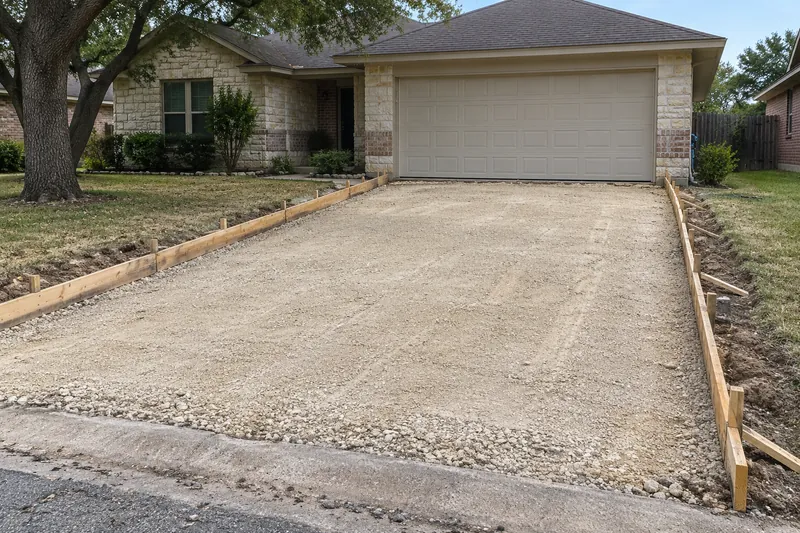
Thickness, steel and joints for the drive itself
Reinforcement
Outside the right-of-way, the drive follows general practice: wire mesh in drives 4 to 5 inches thick, and #4 rebar on a grid about 12 inches apart once the slab reaches 5 inches, set on supports that keep it centered in the slab.
Joints and slope
Plan the joints before the pour. The Illinois Ready Mixed Concrete Association wants control joints no farther apart than 10 feet, cut to a quarter of the thickness, plus a center joint on any drive over 12 feet wide; NRMCA adds isolation joints wherever the drive meets the garage slab, a walk or steps. For drainage, the Portland Cement Association's minimum is a fall of ⅛ inch per foot toward the street.
Clay and limestone ground
USDA rates the deep clays east of the Balcones Escarpment "Very limited" for concrete driveways because of high shrink-swell, and the shallow limestone soils to the west "Very limited" because hard bedrock sits close to the surface. On expansive clay, the usual crushed-rock base runs from 2 inches up to 8, depending on how much the soil swells, and Heritage Concrete Austin goes over the base your lot needs during the estimate.
Call or request a free estimate any time, 24/7.
(512) 588-2862The approach at the street and City permits
Built to the City's Type I detail
The approach, the part of the drive from the street to the right-of-way line, follows the City's Standard Detail 433S-1: at least 5 inches of Class A concrete with #3 bars 18 inches on center on a 2-inch sand bed, the steel held at mid-depth, poured in one piece with a contraction joint down the center and an expansion joint where it meets the right-of-way line. A single-family approach is 10 to 20 feet wide, slopes toward the street at no more than 10%, flattens to 2% where the sidewalk crosses, and sits at least 6 inches above the gutter. Our page on driveway approaches has the details.
Permits and fees
Concrete on your own lot needs no building permit, but installing, relocating, removing or repairing an approach needs a Driveway/Sidewalk permit and a transportation review. New work needs approved plans; repairs and replacements need no further documents. Filing is limited to contractors holding a City right-of-way license, backed by a $10,000 bond and insurance. A new permit is $345 and the residential approach inspection $525.01 (fees effective October 1, 2026).
Inlets and trees
If a storm inlet sits within 10 feet of the curb cut, the City adds a grading and drainage review. Disturbing the root zone of a tree 19 inches or more in diameter needs a tree review even when the drive itself needs no permit.
- Contraction joint down the center, ¼ in. wide and ¾ in. deep (City of Austin)
- Broom texture for grip (NRMCA)
- 5 in. minimum Class A concrete, 3,000 psi at 28 days (City of Austin)
- #3 bars at 18 in. on center, held at mid-depth, never on the sand (City of Austin)
- 2 in. sand bedding (City of Austin Type I detail)
- Native soil: expansive clay or shallow limestone, by part of town (USDA)
Call or request a free estimate any time, 24/7.
(512) 588-2862Concrete driveway cost in Austin
In typical Austin-area figures for 2026, new drives run $9 to $19 per square foot, most projects land between $2,649 and $14,225, and the average is $6,278. Labor alone is $4.50 to $13 per square foot. On its own street work, the City pays more for the same driveway on expansive clay: median bids of $18.25 per square foot on moderate-to-high expansive soil against $16.875 on low-expansive soil (2022–2024).
These numbers are published averages, not quotes from Heritage Concrete Austin: your price comes from your site, and estimates are free. Our guide to concrete cost in Austin covers driveways, slabs and patios.
- 10 x 20 ft (200 sq ft)
- $1,570–$2,945
- 12 x 24 ft (288 sq ft)
- $2,255–$4,220
- 20 x 20 ft (400 sq ft)
- $3,140–$5,890
- 24 x 24 ft (576 sq ft)
- $4,510–$8,435
- 24 x 36 ft (864 sq ft)
- $6,770–$12,755
Austin-area driveway averages for 2026. Not a quote.
Call or request a free estimate any time, 24/7.
(512) 588-2862Driveway questions and answers
How much does it cost to install a new concrete driveway?
With removal of the old concrete included, Austin projects often total $2,659 to $14,240 and can reach $19,640 or more (2026). A 2024 Austin guide prices a reinforced drive lower, at $6 to $10 per square foot before any demolition.
How much does a 50 ft concrete driveway cost?
A 24-by-50-foot reinforced concrete drive runs $7,300 to $12,600 in a 2024 Austin cost guide, and a 24-by-40 runs $5,900 to $10,100. Those figures leave out tearing out an existing drive, which adds $1.10 to $1.70 per square foot in the same guide.
Is it cheaper to repair or replace a driveway?
Repair is cheaper when the damage is limited. Austin figures for 2026 show the gap: crack filling at $0.50 to $5 a linear foot and an average repair bill of $1,436, against $10 to $15 a square foot to replace damaged slabs. Age changes the math, though: for a drive older than about 30 years, replacement usually wins.
Is it cheaper to concrete or pave a driveway?
Asphalt is cheaper to put down: about $4.50 to $8 per square foot in Austin, against roughly $8 to $13.30 for concrete (2026). Concrete lasts longer, 30 years or more when it's properly installed and maintained, compared with about 15 years for asphalt.
Is a concrete driveway worth the money?
In Austin, a new concrete drive is estimated to return 50% to 80% of its cost (2026), and the Illinois Ready Mixed Concrete Association expects concrete drives to carry daily traffic "often for over 30 years."
Get a free estimate for your new driveway
Call or send the form with the drive's rough size and what's there now. Heritage Concrete Austin prices new driveways, widenings and replacements free of charge, and answers 24/7.