Concrete Resurfacing and Sealing in Austin, TX
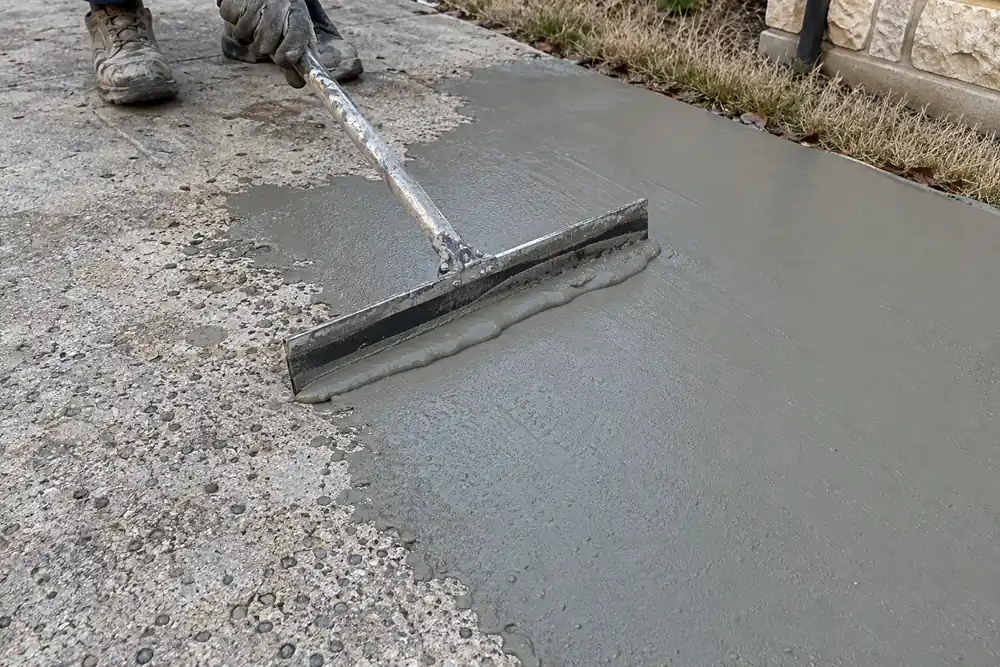
Heritage Concrete Austin offers concrete resurfacing and sealing in Austin, Texas, renewing scaled, stained or worn driveways, patios, walks and pool decks with a thin overlay bonded to the old slab, then sealing the new surface. Camp Mabry, the city's official weather station, averages 122.8 days a year at 90°F or hotter (1991–2020 normals), and overlays and sealers come with upper temperature limits for application.
There's no charge for an estimate; call or send the form. We'll judge whether the old slab can carry an overlay or needs its cracks and settling fixed first, and talk through which sealer suits the surface.
Call or request a free estimate any time, 24/7
No charge · answered 24/7
Get free estimates
When concrete resurfacing works, and when it won't
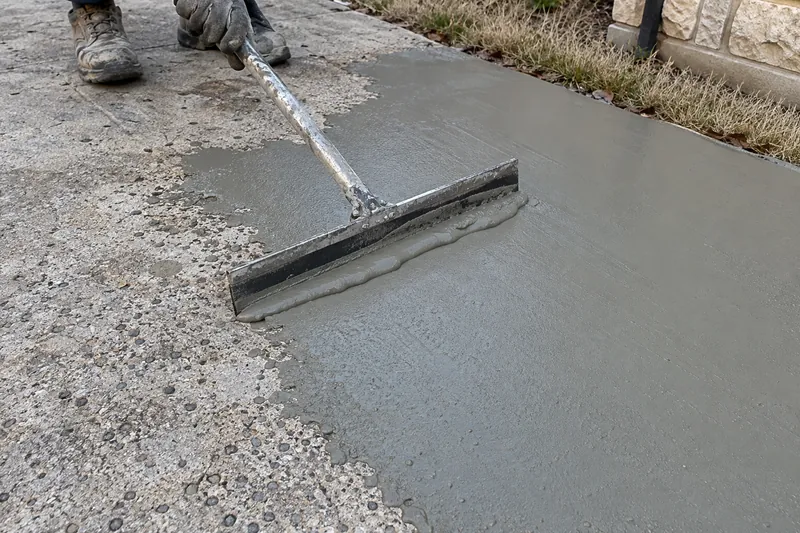
Resurfacing renews the top of a slab, not the slab itself. NRMCA says a thin bonded topping can fix light or moderate scaling on clean, sound concrete; the topping can never be stronger than the slab beneath it, and its color will differ from the original.
Good candidates
Minor flaking, light scaling, discoloration and small cracks are what resurfacing is for. One national cost guide draws the line this way: minor flaking and cracks under ¼ inch suit resurfacing, while large cracks, crumbling, structural trouble, or a topping that would have to exceed two inches call for replacement.
Repair or replace first
Over concrete that is already broken up or still shifting, an overlay won't last long. Deep, wide or growing cracks, above all where one edge stands proud of the other, usually signal settling ground that no topping can cure, and a driveway that is badly cracked throughout is no candidate for resurfacing at all. Those slabs go to concrete repair first, or for drives, concrete driveway repair.
Old cracks and moving clay
One resurfacer maker says old cracks reflecting up through its product can never be fully ruled out, most of all on slabs short of control joints or still settling. On the east side's clays that is a real risk: USDA gives Houston Black a high shrink-swell potential, and when it dries out the soil splits open in cracks from ½ inch to 4 inches across.
Heritage Concrete Austin also offers concrete resurfacing in Hays, where the Census Bureau's survey puts the median home's year built at 1970, and concrete resurfacing in Jonestown, where damaged flatwork is on the City's list of common reasons a building final fails.
Call or request a free estimate any time, 24/7.
(512) 588-2862Concrete overlay types and thicknesses
Polymer-modified resurfacers
The simplest overlay is a polymer-modified portland cement resurfacer. One widely sold product can be feathered to nothing at the edges or built up to ½ inch; people can walk on it 8 hours later and drive on it after 24, and a 40-pound bag covers roughly 16 square feet at ¼ inch.
Fine and stamped overlays
A professional fine overlay is thinner still: one maker's polymer-modified topping goes down 1/16 to 3/16 inch thick and reaches 5,860 psi in compressive strength at 21 days. A stamped overlay, pressed with a pattern like new stamped work, typically runs ¼ to ¾ inch over the existing slab and should last 10 to 20 years or more if it is resealed every 2 to 5 years; large cracks, heavy spalling or severe settlement can rule it out. Color can go on with the new surface; see stained and decorative concrete.
Spray-down deck coatings
Around pools, a spray-down or knockdown texture is common. One maker's spray deck grout goes on no thicker than ¼ inch, dries for at least 24 hours, and is then sealed, with a grip additive mixed into the sealer if needed; pool decks, walkways and patio decks are its listed uses. More on concrete pool decks.
Heritage Concrete Austin prices each overlay from the slab's condition and size at a free estimate.
Call or request a free estimate any time, 24/7.
(512) 588-2862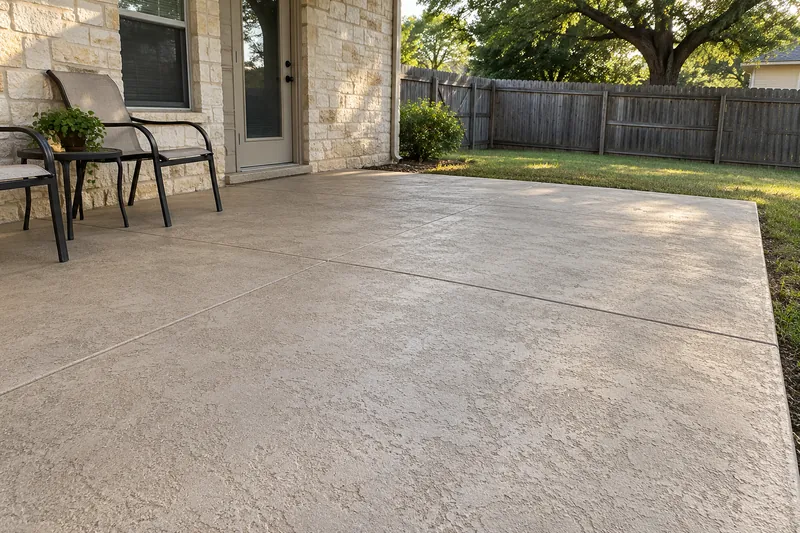
How a concrete resurfacing job is done
When a new overlay cracks or lifts, poor prep is the usual culprit, so most of the job happens before any topping goes down. The steps below are general practice with makers' figures.
Check the slab
At the free estimate we look at the cracks, any settling, the joints and the drainage, because an overlay can only be as sound as the concrete under it.
Repair what moves
Active cracks are routed and sealed or filled, spalled spots patched, and sunken sections dealt with before resurfacing; a topping over moving concrete fails early.
Clean and roughen
The surface is pressure-washed, at 2,500 psi in one maker's instructions, then profiled to a concrete surface profile of CSP 3 to 5. Contamination left behind makes an overlay peel away.
Carry the joints up
Existing control joints are extended up through the new layer, so the overlay cracks along them rather than at random.
Apply in the right weather
One professional overlay is installed only when air and slab are between 45°F and 85°F, and never where it will see steel wheels, strong chemicals, standing water or water pressure from below.
Seal once it has cured
A resurfaced slab is commonly sealed about a month later. The sealer protects the new surface, and a higher-gloss sealer also deepens its color.
Call or request a free estimate any time, 24/7.
(512) 588-2862Concrete sealing for sun, rain and wear
Penetrating or film-forming sealers
Silane and siloxane sealers soak in and react chemically within the concrete, blocking moisture without adding shine or slickness. Film-forming acrylics are used most, with pure acrylics holding out against yellowing longer than styrene blends; polyurethane and epoxy coats are for busy floors where scuffs and stains are the worry. The American Society of Concrete Contractors wants any sealer laid on thin, 1 to 3 mils a coat, and blames most solvent-based sealer failures on coats applied too heavily.
How often to reseal
ASCC treats a decorative sealer as a sacrificial coat: high-traffic and sun-exposed areas need a fresh coat every 2 to 3 years, indoor and lighter-traffic areas every 4 to 5. A driveway, patio or pool deck in full sun falls in the first group. A plain drive is usually resealed on a roughly two-year cycle, sooner if the surface looks worn.
Weather windows in Austin
ASCC limits water-based sealers to a 45°F-and-rising window that tops out at 90°F, for both the air and the slab, and says to hold off on any sealer when rain or dew is forecast inside 12 hours. Both limits bite here: the normal daily high reaches 90°F by May 26 and stays above it until September 23, and a single Austin thunderstorm can unload over 5 inches in several hours. Moisture trapped in the sealer layers is what turns a sealed surface white.
At the estimate, Heritage Concrete Austin goes over which sealer fits the surface and how it will be used.
Call or request a free estimate any time, 24/7.
(512) 588-2862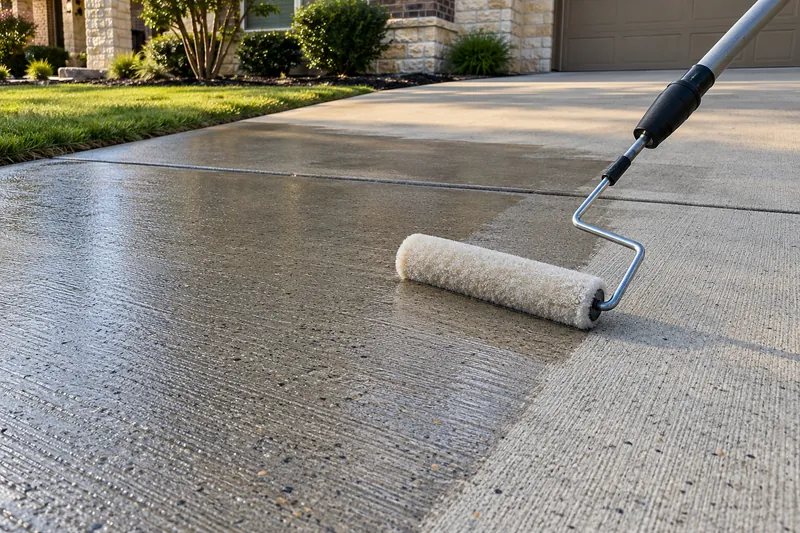
Questions about resurfacing and sealing concrete
What is the average cost of concrete resurfacing?
In typical Austin-area figures for 2026, full concrete resurfacing costs $3 to $10 a square foot, and a resurfaced driveway about $5 a square foot, where the national range is $3 to $5. Nationally, a resurfacing project averages $2,000 within a range of $600 to $13,000, while stamped or decorative overlays run $7 to $20 per square foot. An estimate from Heritage Concrete Austin is free.
Does concrete resurfacer really work?
On sound concrete, yes: bonded to a clean, roughened slab, it covers scaling, pitting, stains and small cracks. It fails when the prep is skimped or the slab underneath is still cracking or shifting, and early failures usually trace to poor preparation, low-quality materials or mistakes in mixing and application. It also can't stop every old crack from showing back through.
What are the downsides of using a concrete overlay?
Old cracks can reflect through, the color won't match any untouched concrete beside it, and it needs resealing, every 2 to 5 years for a stamped overlay. It isn't meant for every use, either: one professional overlay's maker rules out steel-wheel traffic, strong chemicals, areas that are periodically underwater and slabs with water pressure pushing up from below. Over a slab that is still moving, it won't last.
How long will concrete resurfacing last?
Expect roughly 8 to 15 years from a good product put down by a professional, and as long as 25 where upkeep is steady and the climate kind. A properly applied stamped overlay should last 10 to 20 years or more. Skimped preparation is what most often cuts that short.
What is the best way to seal concrete to prevent moisture buildup?
For keeping water out of the slab itself, a penetrating silane or siloxane sealer, which reacts inside the pores and forms no film. One maker estimates its siloxane's service life at more than 10 years and says it can go on new concrete 14 to 28 days old, though by its maker's own account it does nothing for cracks, defects or open joints, which get filled first. Efflorescence trapped under an old sealer is a strip-and-wash job in ASCC's guide: remove the sealer, then wash lightly with 1 part muriatic acid in 20 to 40 parts water.
Get a free estimate for resurfacing or sealing
Call or send the form with the surface (driveway, patio, walk or pool deck), its rough size and what's wrong with it. Heritage Concrete Austin prices resurfacing and sealing jobs free of charge, and answers 24/7.