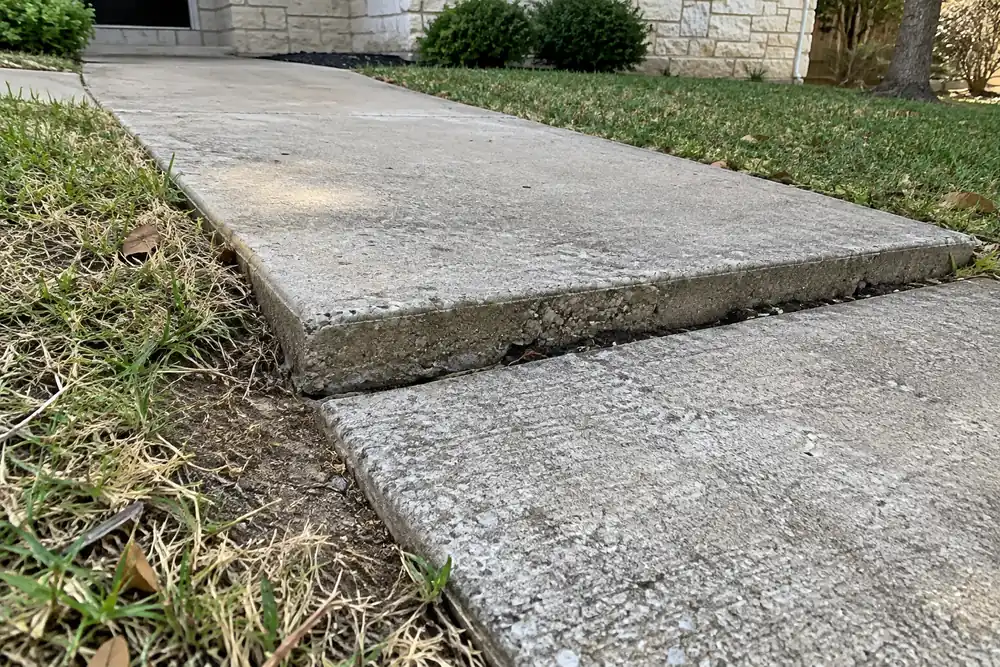
Concrete Leveling in Austin, TX
Heritage Concrete Austin offers concrete leveling in Austin, Texas, lifting sunken driveway sections, sidewalks, patios, steps and pool decks back toward level by pumping cement grout or polyurethane foam beneath them. Travis County's hazard plan says drought shrinks expansive clay and can take support from under buildings, and that slab-on-grade structures are the more likely to be damaged.
Estimates are free; phone us or send the form. We'll measure how far the slab has dropped, look for the cause, from a washed-out base to a leaking line, and tell you whether a lift, a repair or a new pour makes more sense.
Call or request a free estimate any time, 24/7
No charge · answered 24/7
Get free estimates
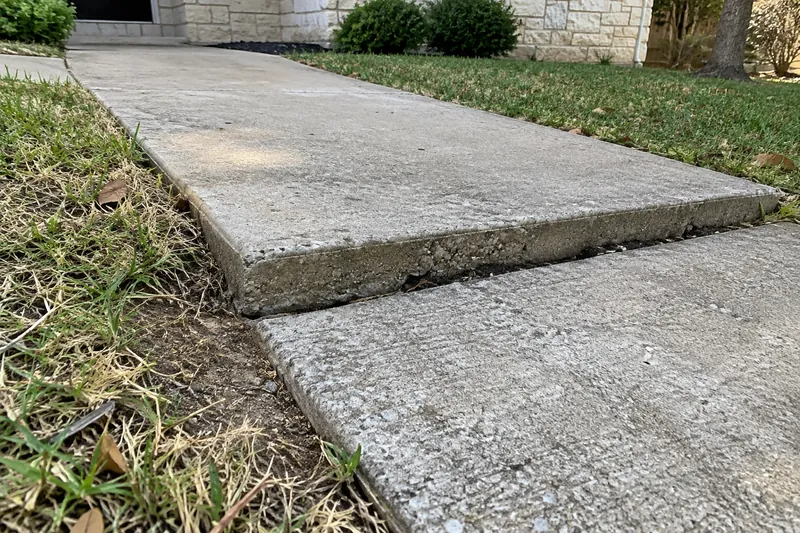
Foam leveling and mudjacking: two ways to lift a slab
Mudjacking with cement grout
Mudjacking, or slabjacking, forces a cement grout through holes drilled in a pattern across the sunken slab, usually 1½ to 2 inches in diameter, until the slab floats back toward its old level. The grout mixes portland cement and water with limestone dust, fly ash, sand or some blend of them. It is heavy, up to 100 pounds per cubic foot, and it can wash away over time.
Polyurethane foam lifting
Foam lifting injects polyurethane foam through holes as small as ⅜ inch, which are much less noticeable once patched. By one foam maker's figures the material is light, 2 to 4 pounds per cubic foot, resists water, and reaches 90% of its strength in about 15 minutes. The data sheet for one lifting foam, from a maker in Missouri City, Texas, rates it at 4 pounds per cubic foot when it rises freely and 80 psi in compression, 95% cured after half an hour and fully cured within a day.
Heritage Concrete Austin talks through grout or foam for your slab, and why, at the free estimate.
- Sidewalk
- $400–$1,100
- Patio
- $550–$1,800
- Garage floor
- $750–$2,400
- Driveway
- $900–$3,000
- Pool deck
- $900–$3,200
Mudjacking averages in the Austin area, 2026. Not a quote.
Call or request a free estimate any time, 24/7.
(512) 588-2862How a sunken slab is lifted
The steps below are general practice; hole sizes and cure times are the makers' and industry figures.
Measure and find the cause
At the free estimate we check how far the slab has dropped and look for what moved it: loose fill, a washout, roots or a leak.
Drill the injection holes
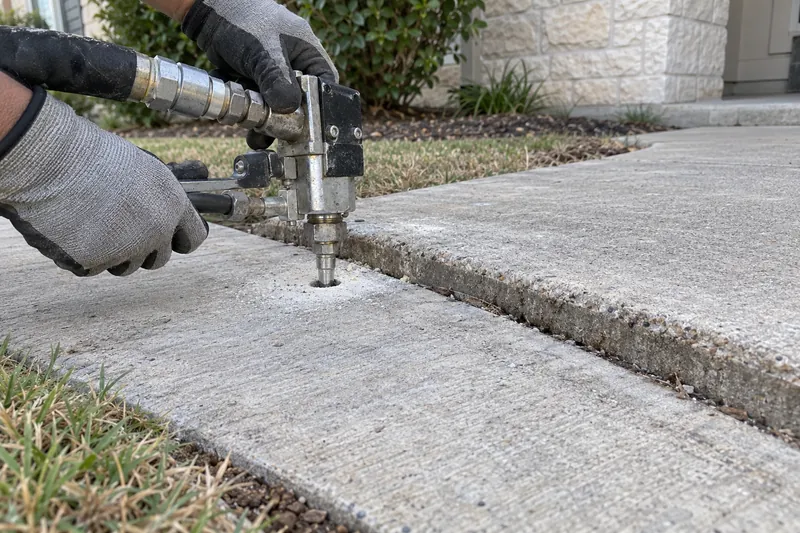
A pattern of holes goes through the sunken slab, typically 1½ to 2 inches across for grout and about ⅜ inch for foam.
Pump and lift
Grout or foam is pumped beneath the slab, filling the void and raising the slab back toward its original level.
Patch the holes
The injection holes are patched; small foam holes are much less noticeable afterward.
Seal the cracks
Surface cracks are sealed once the slab is up; nationally that adds $75 to $200 to a foam lifting job (2026).
Call or request a free estimate any time, 24/7.
(512) 588-2862What makes concrete sink around Austin
Loose fill, washouts and leaks
A sinking slab was very often poured on poorly compacted fill dirt; erosion under the slab and shrinking soil are the other usual causes. Tree roots and leaking pipes that scour out the base do the same, and lifting only lasts if the cause is dealt with: InterNACHI says mudjacking isn't appropriate when the reason for the settling hasn't been addressed.
Drought and shrinking clay
On the east side's deep clays, dry years show up in the concrete. Travis County's plan says expansive-soil problems there typically come during droughts. In 2011 Austin got 19.68 inches of rain and a record 90 days at 100°F or hotter, and the summer of 2023 brought only 1.31 inches of rain from June through August. Austin Water's drought guidance lets homeowners water around a home's foundation on their assigned day, with sprinklers set to wet the ground about 18 inches from the foundation.
Heritage Concrete Austin also offers concrete leveling in Wells Branch, where the largest single group of homes went up in the 1980s, the utility district's first decade. Our guide to Austin's clay and limestone soils covers the ground in more detail.
Call or request a free estimate any time, 24/7.
(512) 588-2862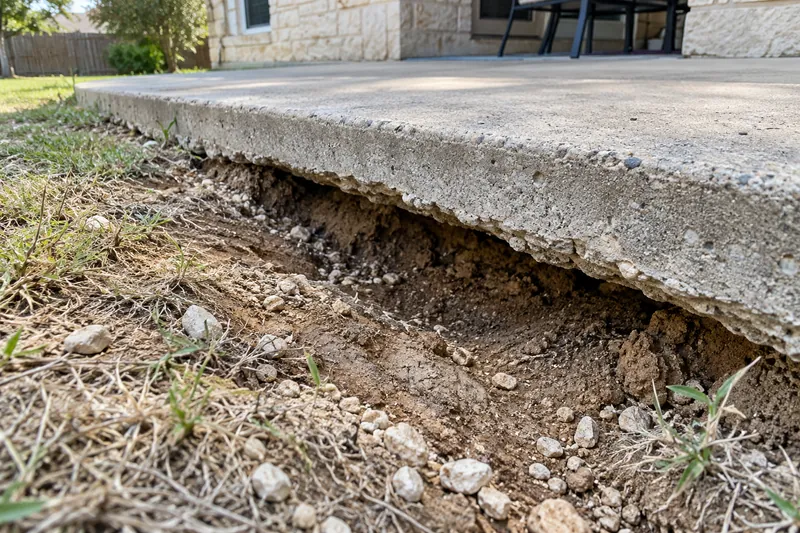
When leveling isn't the answer
Slabs that rose, crumbled or sit over voids
InterNACHI, the home inspectors' association, names five situations where mudjacking is not appropriate: a surface that is spalling or otherwise damaged, a slab pushed up by expansive soil, settling whose cause hasn't been fixed, swampy soil, and a sinkhole under the concrete. Much of south and west Austin sits above the Edwards Aquifer, limestone with honeycomb-like passages called karst, the City says.
Broken or badly cracked slabs
A lift won't mend concrete that is broken through. Cracked and spalled sections go to concrete repair, and a slab past saving is replaced; for house, garage and shop slabs, see concrete slabs and foundations. Self-leveling compound is no substitute for a lift: it is meant only for slabs that dropped under an inch, and only after whatever caused the drop is repaired.
Uneven walks and trip edges
On public walking routes, the 2010 ADA Standards accept a vertical lip of up to ¼ inch, require a bevel of 1:2 or gentler between ¼ and ½ inch, and treat any taller change as a ramp. Those rules govern public routes, not private homes. In Austin the City repairs and maintains select sidewalks, while the owner maintains the driveway; see concrete sidewalks and concrete driveway repair.
Call or request a free estimate any time, 24/7.
(512) 588-2862Concrete leveling questions and answers
Is it cheaper to level concrete or replace?
Usually leveling. In typical Austin-area figures for 2026, mudjacking runs $4 to $8 per square foot, while replacing damaged slabs runs $10 to $15. National figures put mudjacking at 30% to 50% below the cost of demolition and a new pour. Foam is the exception to watch: national guides note that polyjacking is sometimes more expensive than complete slab replacement, though faster and less disruptive.
What is the cheapest way to level a concrete floor?
For a floor that has dropped only slightly, a self-leveling compound, at $1 to $5 per square foot nationally (2026), but only for a drop of under an inch, once its cause is fixed. For deeper settling, mudjacking is the lower-cost lift, at $3 to $6 per square foot nationally against $5 to $25 for polyurethane foam.
Does concrete leveling really work?
On a sound slab that has sunk, yes: the grout or foam fills the void and raises the slab back toward level. National guides expect a well-done mudjacking lift to hold 5 to 10 years or more, and foam 10 to 15 years or more. It is the wrong fix for a crumbling surface, a slab pushed up by swelling soil, or settling that is still going on.
How much does foam concrete leveling cost?
In Austin, the foam itself runs $400 to $1,200 a job, against $100 to $400 for mudjacking slurry (2026). Nationally, foam lifting averages $15 per square foot within a range of $5 to $25, or about $3,000 to raise a 300-square-foot section, and most homeowners pay $1,500 to $4,500. Heritage Concrete Austin prices both methods free.
How soon can you use concrete after it is leveled?
After foam, very quickly: it reaches 90% of its strength in about 15 minutes, by one maker's figures. After mudjacking, sources differ. One national guide allows light foot traffic within 24 hours and vehicles in 2 to 3 days, while another says the slab can be used right away; the foam maker says mudjacking grout can take up to a couple of days to cure.
Get a free estimate to level sunken concrete
Call or send the form with what has sunk (a walk, drive, patio, steps or pool deck) and roughly how far. Heritage Concrete Austin prices concrete leveling free of charge, and answers 24/7.