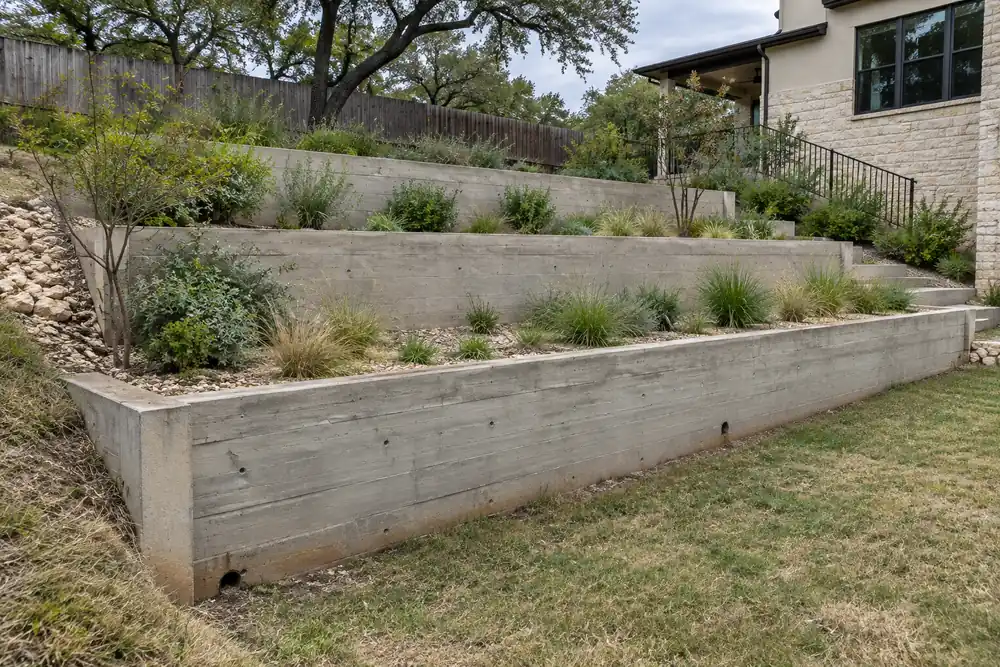
Concrete Retaining Walls in Austin, TX
Heritage Concrete Austin builds concrete retaining walls in Austin, Texas: walls that terrace a sloping backyard, hold the cut beside a driveway or patio, or keep a clay bank in place. The National Weather Service puts the lowest ground inside the city limits at 400 feet, on the east side, and the highest a little over 1,000, in the northwest, and the City's code requires a permanent structure to stabilize any cut or fill finished steeper than 33 percent.
For a free estimate, phone us or use the form. We'll go over how tall the wall needs to be, what will sit on top of it, how water will drain out from behind it, and whether it needs a City permit or an engineer's design.
Call or request a free estimate any time, 24/7
No charge · answered 24/7
Get free estimates
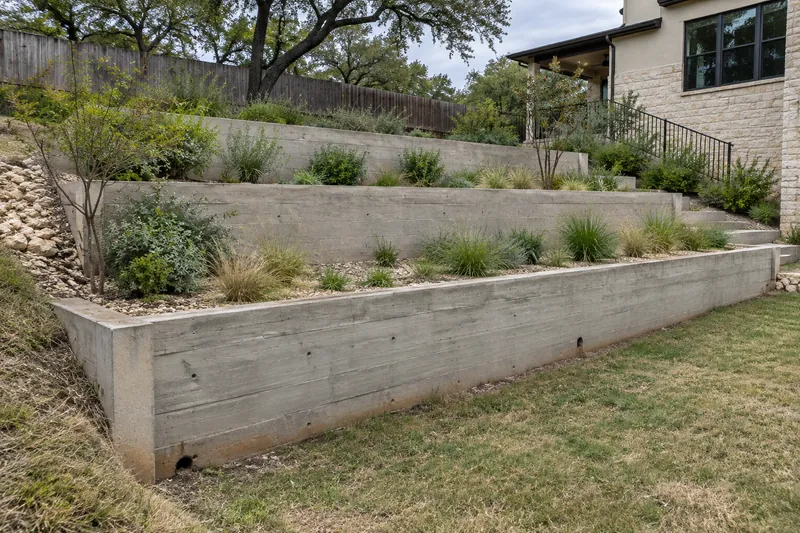
Drainage behind a concrete retaining wall
Backfill and weep holes
Behind a poured wall, granular backfill such as gravel drains well, compacts easily and adds resistance to sliding. Larger walls commonly get 4-inch weep holes through the face, and the drain line behind them is often perforated pipe in a geotextile wrap or set in a granular filter bed. Heritage Concrete Austin goes over the drainage behind your wall during the estimate.
Austin rain
Camp Mabry averages 11.0 days a year with an inch or more of rain, and May, the wettest month, normally brings 5.04 inches (1991–2020 normals). The City calls flooding the most serious hazard for the Austin area, a threat across the entire city year-round.
Clay that holds water
East-side clays such as Houston Black take in water fast while they're dry and cracked, then very slowly once they're moist. The Bureau of Economic Geology describes the area's clay units as weak, unstable, impermeable and corrosive, and says they generally need special engineering designs. At the foot of a terraced bed, concrete curbing extruded from a dry mix can follow the curve of the planting line in one continuous border.
Call or request a free estimate any time, 24/7.
(512) 588-2862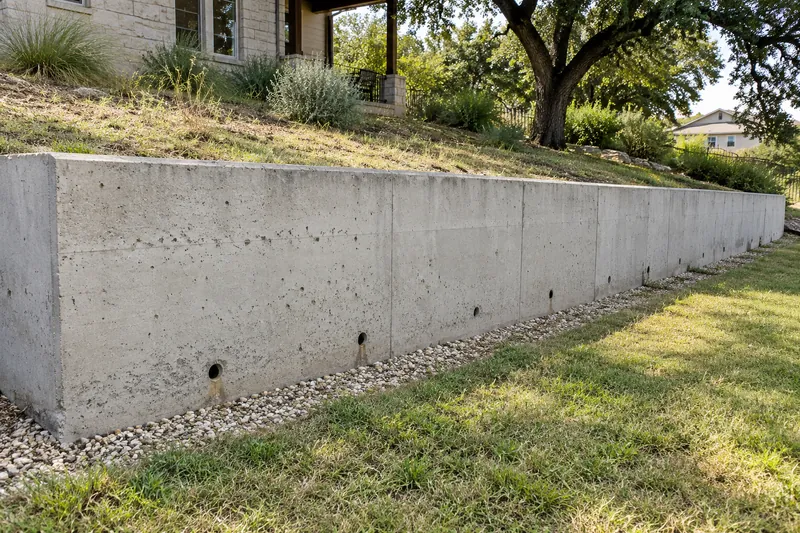
Building walls on Austin's limestone and clay
West of the escarpment: rock close to the surface
On the west side a footing trench can meet rock early. Brackett soils reach soft, fractured Glen Rose limestone 5 to 20 inches down, and Speck reaches hard limestone at 14 to 20 inches. USDA rates the area's limestone soils "Very limited" for trenches and holes up to 5 or 6 feet deep for that reason, and Eckrant adds large stones to the list.
East of the escarpment: trench walls that cave
On the Blackland Prairie the problem turns around. USDA rates Houston Black, Heiden and Ferris "Very limited" for shallow excavations because trench walls in these cracking clays have a high potential to cave in, and Travis County's hazard plan calls their shrink-swell a safety hazard in pits and trenches. Heiden opens cracks ½ to 3 inches wide in dry periods.
Slopes, cuts and fills
Austin's Land Development Code generally limits cuts and fills to 4 feet deep, with exceptions that include urban watersheds and building foundations, and it bars roadways and driveways from slopes over 15 percent unless they're needed for primary access. Where a wall creates two levels, concrete steps can connect them, and the level ground it holds can take a concrete patio. Our guide to how Austin clay and limestone affect concrete covers both kinds of ground.
Heritage Concrete Austin also builds concrete retaining walls in West Lake Hills, where the City caps any wall at 6 feet above natural grade and requires native materials or earth-tone colors.
Call or request a free estimate any time, 24/7.
(512) 588-2862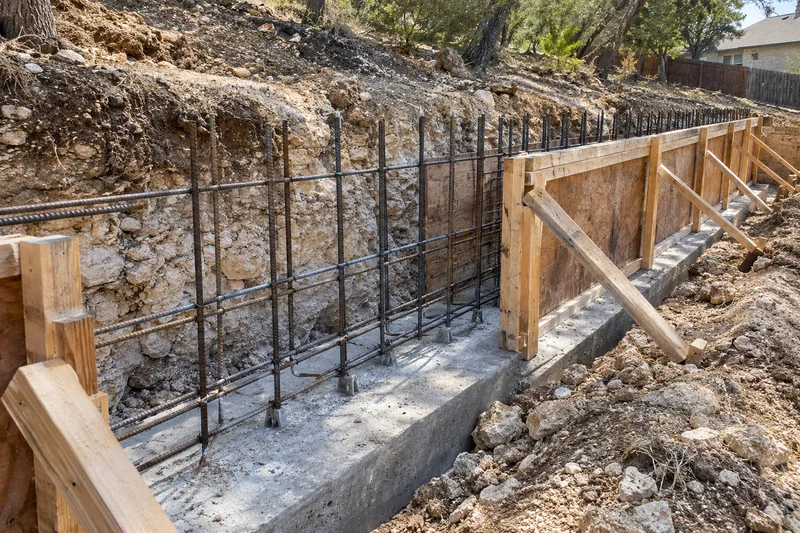
Retaining wall permits and protected land
The City's 4-foot line
Austin's list of work exempt from a building permit covers a retaining wall only up to 4 feet, counted from the base of the footing to the wall's top, and only when it carries no surcharge and stands outside a flood hazard area. A taller wall, or one with a surcharge, is not on the exempt list. Austin uses the 2024 International Residential Code.
Caves, springs and voids in the rock
Much of south and west Austin lies above the Edwards Aquifer, a karst layer of limestone riddled with passages. The code sets a 150-foot buffer around each critical environmental feature, such as a cave, sinkhole or spring, and 150 to 300 feet around a point recharge feature, one that can carry surface water underground; construction inside the buffer is prohibited. Blasting within 300 feet of such a feature is banned unless no feasible alternative exists. Under the City's Environmental Criteria Manual, if digging opens a void of a square foot or more, or one that blows air or takes water when it rains, all construction within 50 feet stops until Watershed Protection approves a fix.
Outside the city limits
In unincorporated Travis County, the County issues a residential retaining wall permit, with a site plan that shows the elevations of the top and bottom of the wall; over 5 feet tall, that plan must be sealed by a Texas licensed engineer. Heritage Concrete Austin also builds retaining walls in Steiner Ranch, where the master association's Architectural Controls Committee must approve any work on the outside of a home or lot.
Call or request a free estimate any time, 24/7.
(512) 588-2862Concrete retaining wall cost in Austin
Austin-area averages for 2026 put the typical retaining wall at $5,301, with low-end jobs near $2,000 and high-end ones near $11,000. Concrete runs $15 to $55 per square foot all-in, $35 on average. Slopes can push labor up by 50% or more, and limestone deposits mean extra excavation.
The extras are priced on their own: excavation at $60 to $70 per linear foot, drainage pipe at $1.20 to $2.00 per linear foot, rebar at $1.50 to $2.50 per square foot, waterproofing at $2 to $10 per square foot, and removal of an old wall at $20 to $30 per linear foot. A structural engineer bills $100 to $140 an hour. In City of Austin bids from 2022 through 2025, cast-in-place reinforced concrete walls drew a median of $1,350 per cubic yard of wall concrete.
These are published averages for budgeting, and none of them comes from Heritage Concrete Austin. The free estimate prices your wall from its height, length, soil and access.
- 10 ft of wall
- $1,020–$2,220
- 20 ft of wall
- $2,040–$4,440
- 30 ft of wall
- $3,060–$6,660
- 100 ft of wall
- $10,200–$22,200
Typical Austin-area prices, 2026: low end for 3-ft walls, high end for 6-ft walls. Not a quote.
Call or request a free estimate any time, 24/7.
(512) 588-2862Concrete retaining wall questions
What is the average cost of installing a retaining wall in Texas?
Our cost sources give no statewide average, so here are the nearest figures. In Austin, most walls land between $2,886 and $7,716 (2026). National figures for 2026 average $6,500 for a 50-foot concrete wall between 3 and 6 feet high, with most from $3,000 to $10,000, and put poured walls of those heights at $60 to $270 per linear foot.
What is a surcharge on a retaining wall?
Austin's residential code defines a surcharge as a vertical load on the retained soil that can push sideways on the wall on top of the soil's own pressure. The International Code Council's examples are cars parked above the wall and fences on its top that catch the wind. A wall holding a surcharge never qualifies for the City's permit exemption, however short it is.
Which retaining walls have to be engineered?
Section R404.4 of the International Residential Code covers two cases: a wall with no bracing at the top that retains over 48 inches of unbalanced fill, and a wall taller than 24 inches that resists loads beyond soil. Both must follow accepted engineering practice in their design, which needs a 1.5 safety factor against both sliding and overturning. In unincorporated Travis County, any wall over 5 feet needs an engineer-sealed site plan.
How deep should a retaining wall footing be?
As general practice for poured walls, the base slab's bottom is set 2 feet down or deeper, and the slab usually runs 50% to 70% of the wall's height in length. Walls taller than 4 feet should have their footings poured separately. Austin's design table for the residential code sets the frost line at 12 inches.
Can a retaining wall be built near a protected tree?
Only with care. Austin protects any tree whose trunk measures 19 inches or more across at 4½ feet above natural grade. For each inch of trunk, the critical root zone reaches a foot out; at least half of it must stay at natural grade, cut or fill is held to 4 inches in its inner half, and its inner quarter can take none. Bracing for wall forms and over-digging count as impacts, and disturbing that zone takes a Tree Ordinance Review Application, permit or no permit.
Get a free estimate on a concrete retaining wall
Call or send the form with the wall's rough length and height and what sits above it. Heritage Concrete Austin prices new walls and wall replacements free of charge, and calls are answered 24/7.