Concrete Repair in Austin, TX
Heritage Concrete Austin provides concrete repair in Austin, Texas, from sealing cracks in driveways, walks, patios and steps to cutting out spalled or broken sections and pouring them back. USDA rates about 42% of the city's mapped soil area "Very limited" for concrete driveways and sidewalks, mostly because of hard bedrock close to the surface in the west and swelling clay in the east.
Estimates are free; call or use the form. We'll look at how wide the cracks are, whether one side sits higher, and what the ground is doing under the slab before suggesting a repair, a lift or a replacement.
Call or request a free estimate any time, 24/7
No charge · answered 24/7
Get free estimates
Concrete crack repair
Reading the crack
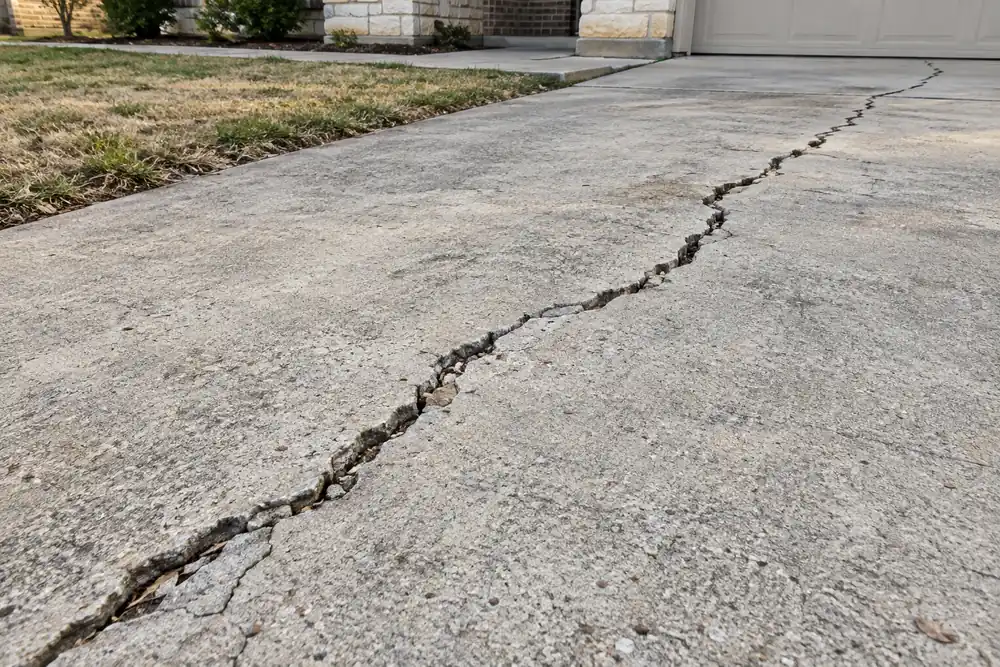
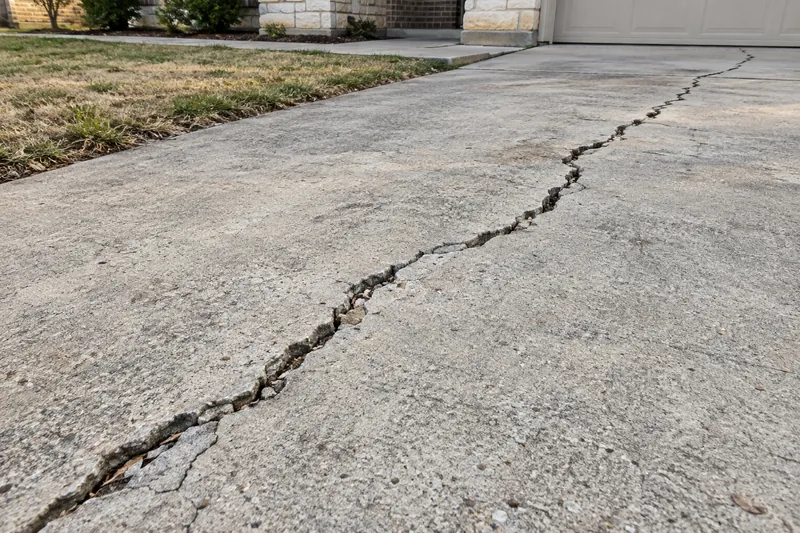
Some cracking comes with the material: NRMCA says nobody can produce concrete that never cracks, and the random cracks a young slab shows are mostly a looks problem rather than a threat to its strength or lifespan. Plastic shrinkage cracks stay shallow and tend to line up in parallel, a foot to three feet apart. When a slab cracks in its first few years, though, a wet mix or missing control joints are common culprits.
Filling, sealing and injecting
The method follows the width and whether the crack still moves. Epoxy filler suits residential cracks ⅛ inch wide or less; at ½ inch or more, a foam backer rod is pressed in before filling. For a crack expected to shift slightly, the Texas Department of Transportation's concrete repair manual cuts a V-groove along it, centered and normally around ⅜ inch deep, then fills it with sealant so water can't get in. When strength is the concern, injected epoxy bonds to concrete with more strength than the concrete itself has in tension, so ACI 224.1R credits it with bringing back structural integrity in cracks from 0.002 inch upward; it is a poor choice where rebar is corroding or more movement is coming.
When a crack points to the ground
A crack that is deep, broad or lengthening, particularly one with a raised edge, can mean the subgrade is unstable and the slab is settling; filler by itself won't hold there. An uneven crack more than an inch wide may be a sign of structural trouble below. Nationally, a structural engineer charges $100 to $200 an hour to inspect cracked concrete (2026). A slab that has sunk but is otherwise sound can often be raised; see concrete leveling.
Call or request a free estimate any time, 24/7.
(512) 588-2862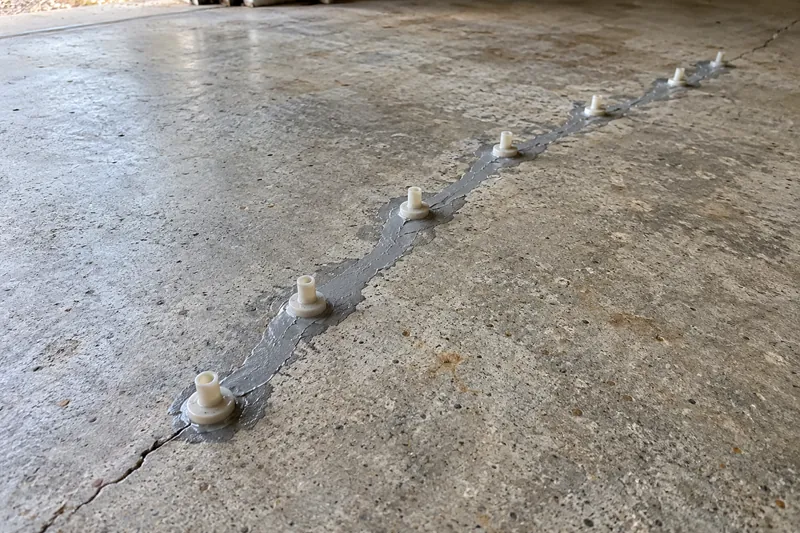
Slab repair for spalled, scaled and broken concrete
Partial-depth patches
Shallow damage gets a patch that replaces only the top of the slab. Partial-depth repairs, in the American Concrete Pavement Association's guidance, are for spalls reaching no more than a third to a half of the way down, with the steel still covered, and full-depth work takes over when the bad concrete nears half the thickness; the Federal Highway Administration's limit is the top third. No shallow patch can mend a crack that goes clear through.
Cutting out a broken section
Where a section is broken through, it is sawn out and poured back. Expect it to cost more than pouring fresh: there's demolition and disposal, plus the root, leak or other cause to fix before the new concrete goes in. New concrete is also hard to color-match to old. For drives, see concrete driveway repair.
Scaled and flaking surfaces
Spalling, where the top surface crumbles and pits, usually traces to deicing salt, bad finishing, an overly wet mix or poor curing. Austin's residential design table puts the city's weathering risk at "Negligible", the lowest of the code's three classes. Light to moderate scaling can take a thin bonded topping over sound concrete; for that, see concrete resurfacing. Extensive spalling usually means the slab has to be replaced.
Repairs in the right-of-way
Repairing a sidewalk, driveway approach, curb or gutter in the public right-of-way takes a City Driveway/Sidewalk permit, and the City accepts the application only from a licensed right-of-way contractor; a repair or replacement needs no further documents, while new work needs approved plans. The City repairs and maintains select sidewalks, but the property owner is responsible for maintaining and repairing the driveway.
For lots, walks and building slabs on business property, Heritage Concrete Austin handles commercial concrete repair.
Call or request a free estimate any time, 24/7.
(512) 588-2862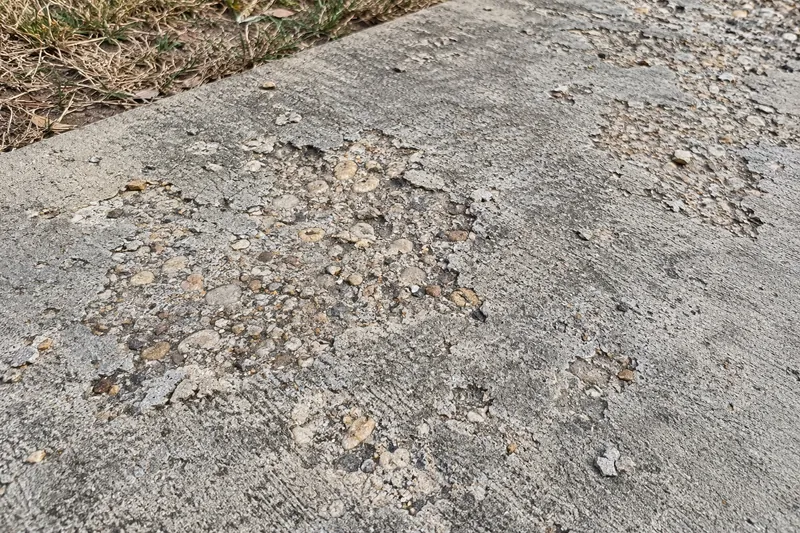
What Austin's clay, limestone and heat do to concrete
Swelling clay to the east
East of the Balcones Escarpment, the deep Blackland Prairie clays swell as they take on water and shrink as they dry. In the Travis County soil survey data, Houston Black's linear extensibility, the change in length as a clod dries, is 12 percent, against 2.8 to 5.1 percent for Eckrant. Travis County's hazard plan puts the worst of it in a wet spell followed by drought and then rain, and adds that leaking water and sewer lines cause damage too.
Shallow limestone to the west
West of the escarpment the problem is rock. Hard limestone lies just 4 to 20 inches under Eckrant, which is mapped across more of Austin than any other soil, and the Bureau of Economic Geology describes the limestone units as stable but difficult to excavate. In USDA's ratings for concrete driveways and sidewalks, Eckrant and Speck land in "Very limited" because of that bedrock, so any repair that means digging out and rebuilding the base takes more work. For more on both grounds, see concrete on Austin clay and limestone.
Summer heat on fresh patches
Repair concrete goes through the same summer as a new pour. Breezes above 5 mph, dry air and hot air or concrete all raise the odds of plastic shrinkage cracking, according to NRMCA, which also says not to add water once a load is more than 1½ hours old in hot weather and to keep curing for 3 days at least. On right-of-way sidewalks and approaches, the City's specification holds the mix to 90°F, or 100°F where a high-range water reducer is used.
Heritage Concrete Austin also handles concrete repair in San Leanna, the village on FM 1626 that began as a 1950s subdivision and requires a Village building permit to build or demolish a concrete foundation or retaining wall.
Call or request a free estimate any time, 24/7.
(512) 588-2862Concrete crack and slab repair questions
What is the average price to repair concrete cracks?
In typical Austin-area figures for 2026, minor crack filling costs $0.50 to $5 a linear foot, against $0.50 to $3 nationally. National figures for filling and sealing range from $50 to more than $800 per crack. For larger repairs, Austin labor for standard concrete work runs $2 to $3 per square foot, plus the 8.25% sales tax on materials.
Should hairline cracks in concrete be repaired?
Usually they're cosmetic: early random cracks rarely affect a slab's strength or service life, NRMCA says. Filling them helps keep water out, though any patch on a crack narrower than ¼ inch is a stopgap and isn't watertight. Keep an eye on them: a crack that widens, spreads or leaves one side higher than the other is a sign of movement in the ground and needs a closer look.
What is the cheapest way to fix a cracked concrete driveway?
Filling the cracks. Crack repair kits sold for the job cost $15 to $100 in Austin (2026), and a full Austin driveway repair averages $1,436, with most between $584 and $2,289. Any repair is temporary, though some last many years, and filling won't hold on a slab that is sinking or broken through. Heritage Concrete Austin looks at the driveway and prices the repair free.
How much does it cost to repair a concrete slab?
It depends on how much of the slab has to come out. Swapping out damaged slab sections costs $10 to $15 a square foot around Austin (2026 figures), compared with $6 to $14 nationally. On sidewalks, Austin patching runs $3 to $10 per square foot, a full repour $12 to $22, and replacing a small slab $500 to $1,500 or more.
Can a crack in concrete be repaired?
Yes, though the right repair depends on the crack. Epoxy injection can restore the structural integrity of a cracked slab where the concrete isn't expected to keep moving, and routing and sealing keeps water out of a crack that still moves a little. A crack running through the full thickness needs a full-depth repair rather than a surface patch, and if the ground under the slab is still shifting, the cause needs fixing too.
Get a free estimate for concrete repair
Call or send the form with what's cracked or broken, and roughly how big the area is. Heritage Concrete Austin prices crack and slab repairs free of charge, and answers 24/7.