Concrete Questions and Answers for Austin, TX Property Owners
Heritage Concrete Austin answers the concrete questions Austin, Texas property owners ask most, from the price of a yard of concrete and the cost of tearing out an old slab to parking pads, deed restrictions, sealers, repairs, weather and hiring.
Each answer rests on City of Austin rules, Texas law, industry bodies such as NRMCA and ACI, or published Austin-area and national prices, which are averages rather than quotes. Your own price comes from a free estimate; phone or use the contact page any hour.
Call or request a free estimate any time, 24/7
Concrete cost questions
How much is 1 yard of concrete in Texas?
The closest figures we have are Austin's. A 2025 Austin price guide puts ready-mix at $121 to $145 per cubic yard by strength: $121 to $127 for 3,000 psi, $129 to $136 for 4,000 psi and $138 to $145 for 5,000 psi. Delivery alone can add $110 to $240 per truckload, and short loads under 10 cubic yards and weekend deliveries push the price up. By type, a 2026 Austin driveway guide lists all-purpose concrete at $120 to $165 a yard and high-strength at $155 to $205.
Is concrete work cheaper in Austin than the national average?
Slightly, by most published figures. One national cost guide's Austin pages put the city's cost of living 4% below the national average on its patio page and in line with it on its sidewalk-repair page, and put new foundations 17% below the national figure (2026). A cost calculator set to downtown Austin's ZIP code came in under its own national figures on every concrete job checked (September 2026).
How much does it cost to remove old concrete?
Typical Austin-area figures for 2026 put removing and hauling an old driveway at $2 to $8 per square foot, and demolishing an old walkway at $3 to $6. The City's own bid records for 2022 to 2025 show a $4-per-square-foot median for removing concrete sidewalks and driveways. Small jobs cost more per foot: a calculator set to Austin prices jackhammering and hauling away a 120-square-foot slab at $9.03 to $11.10 per square foot. Heritage Concrete Austin quotes tear-out and haul-away with the new work; more on concrete removal.
What is the average cost to stain concrete?
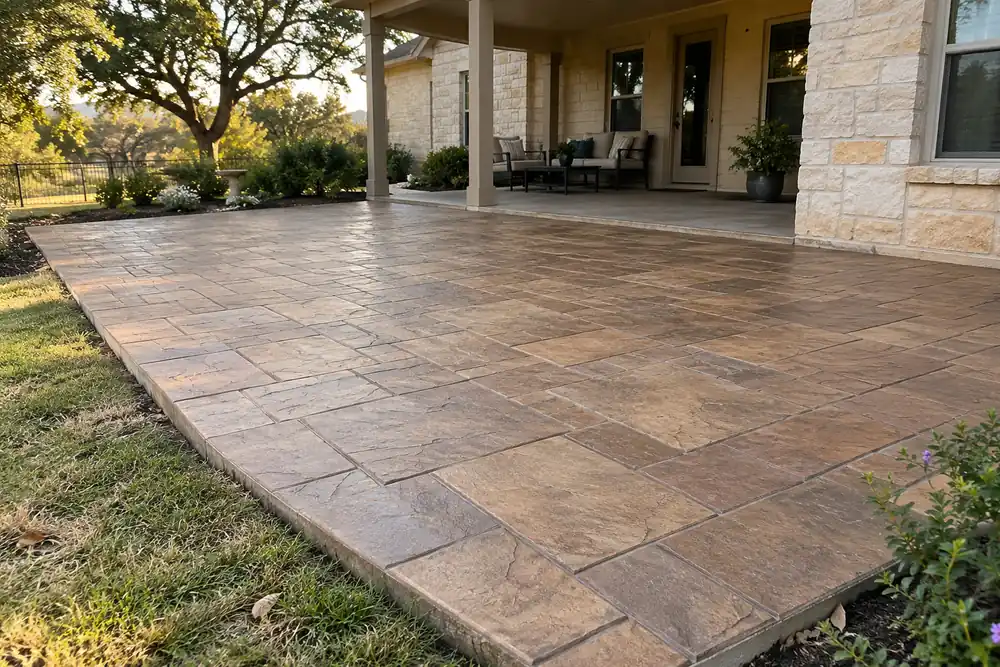
In typical Austin-area figures for slab finishes, staining runs $8 to $15 per square foot (2026), and a calculator set to Austin prices applying decorative stain to 125 square feet at $5.01 to $5.91 per square foot. Acid-stained walkways run $8 to $25 per square foot. One stain maker warns that stain won't hide discoloration, blemishes or cracks, and any patched or repaired spots will stain a different shade. See stained and decorative concrete.
Why do two concrete quotes for the same job differ?
Soil, site work and what each quote includes. The City's own bid data shows soil alone moving the price: Type II driveways drew a median bid of $18.25 a square foot where the soil was moderately to highly expansive, but $16.875 where it was low-expansive (2022–2024). Published calculator prices often leave out a general contractor's overhead and markup, which adds 13% to 22%, along with sales tax and permit or inspection fees; in Austin the 8.25% sales tax applies to materials.
Do you charge for an estimate?
No, estimates are free. Call or send the form any hour; Heritage Concrete Austin answers 24/7 and works across Austin and 30 nearby towns. The prices on this page are averages, and your own figure turns on the size of the job, the soil, any concrete that has to come out first and the permits involved.
Want a number for your own job? A free estimate is a phone call or a form away, day or night.
(512) 588-2862Driveway, parking and lot rules in Austin
Can I pour a parking pad in front of my house?
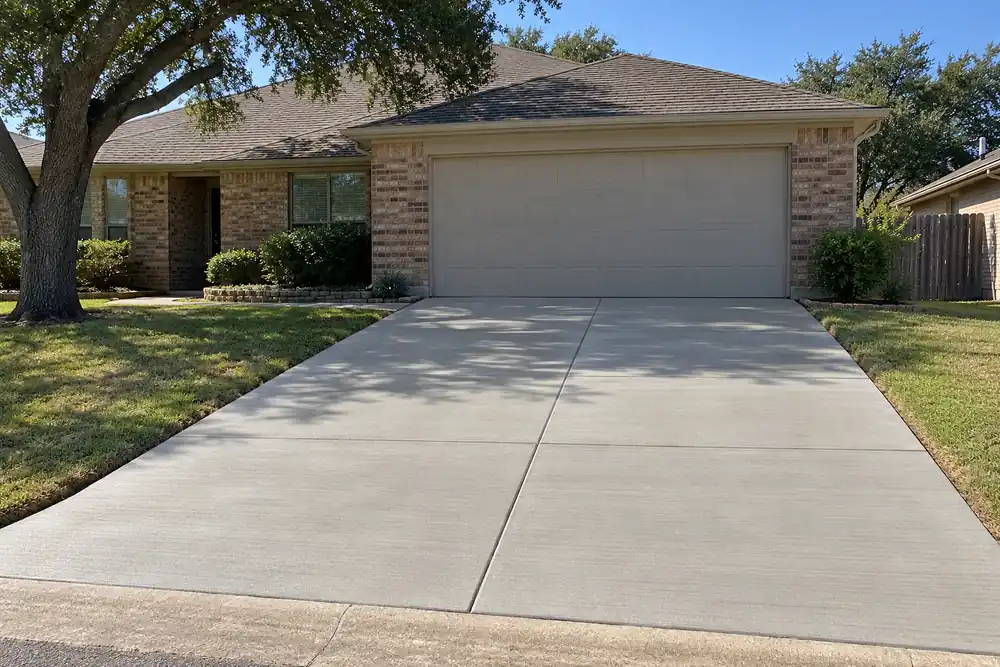
Not between the street and your property line: the City may not issue a driveway permit for a project that puts parking between the curb, or the pavement edge, and the property line. Behind that line the limits depend on the home. Duplex, two-unit and three-unit homes may cover no more than 40% of the front yard with impervious surfaces and park no more than four spaces in the front street yard, and on a HOME small lot, driveways and parking may take up at most half the front yard. For an ordinary single-family lot, confirm the zoning limits with the City. Heritage Concrete Austin checks the front-yard rules before pricing concrete pads.
Can I add a second driveway to my lot?
That turns on your street frontage. Under the City's Transportation Criteria Manual, lots with under 300 feet of street frontage get one driveway, lots with 300 to 600 feet two, and lots with more than 600 feet three. On a Level 1 street, a lot under 300 feet with at least two dwelling units may have two driveways at least 20 feet apart. Each driveway needs its own Driveway/Sidewalk permit, except a semi-circular drive, which is one permit. Heritage Concrete Austin goes over the frontage rules for concrete driveways at the estimate.
Can deed restrictions stop a project the City allows?
They can. The City must approve a permit that meets its Land Development Code even when the project conflicts with a deed restriction, but the parties named in a restriction, such as a property owners' association, can enforce it as a civil matter. A patio, pool deck or drive that clears the City can still run into the association, so it is worth checking before Heritage Concrete Austin or anyone else books the work; more on concrete patios.
Can a tree stop my concrete project?
It can change it. Any tree 19 inches or more in diameter, measured 4½ feet above natural grade, is protected in Austin, and work that disturbs its critical root zone needs a Tree Ordinance Review Application even when the concrete itself needs no permit. The root zone's radius in feet equals the trunk's diameter in inches; the inner half may take no more than 4 inches of cut or fill, and the inner quarter none. Heritage trees, 24 inches or more of listed species including all oaks and pecans, can be removed only by variance.
Do I need a permit for a shed or workshop slab?
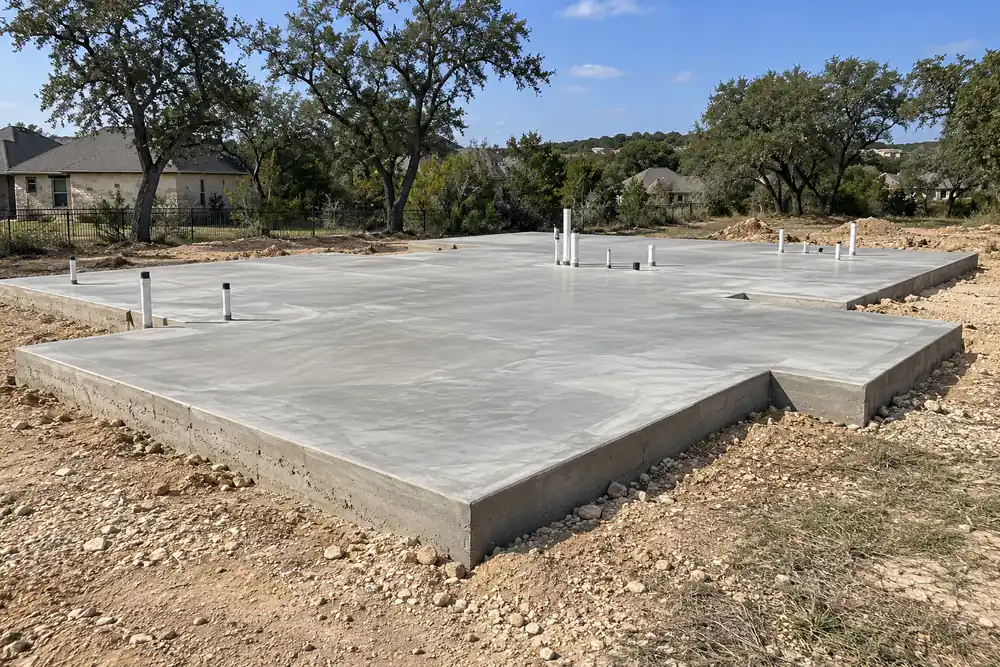
In Austin, flatwork that stays off the public right-of-way is exempt from a building permit, and what sits on the slab decides the rest. A one-story detached shed of no more than 200 square feet and 15 feet tall, with no plumbing and outside a flood hazard area, needs no building permit either. A detached garage or shed of up to 500 square feet, with no living space or plumbing, is exempt from the City's structural-drawing rule for its foundation, which the building inspector looks over on site instead. Otherwise, foundations on expansive soil need plans sealed by a Texas registered engineer. See concrete slabs and foundations.
Planning a drive, walk or slab? Ring us or use the form; estimates are free and the line is answered 24/7.
(512) 588-2862Concrete sealer and finish questions
Do sealers change the color of concrete?
Film-forming sealers can. Glossier sealers deepen color more, according to the American Society of Concrete Contractors, and solvent-based acrylics generally bring out color more than water-based ones; its gloss scale runs from flat (0 to 20) up through matte, semi-gloss and gloss to high gloss (80 to 100). Penetrating silanes and siloxanes add no gloss at all. Heritage Concrete Austin goes over the finish you want before any concrete sealing.
How long should new concrete cure before it is sealed?
About a month, by most guidance. The Ohio industry recommendation is not before 30 days after placement, and the Michigan Concrete Association says a penetrating sealer can go on 30 days after the pour and usually needs reapplying every three to five years. One siloxane water repellent is made for younger concrete, 14 to 28 days old. For stamped concrete, one decorative-concrete maker recommends a cure-and-seal coat straight after the pour, then the final sealer around day 28.
Why did my concrete sealer turn white?
Trapped moisture. The American Society of Concrete Contractors says whitening happens when water vapor or solvent is caught in the sealer layers, and that applying solvent-based sealers too thick causes most of their problems. Efflorescence showing up beneath a sealer is a separate problem; it is cured for good by stripping the sealer and washing the slab with diluted muriatic acid or an efflorescence remover.
What is a good sealer for concrete holes?
A sealer won't fill a hole. Holes and cracks are patched or filled first and sealed afterward: a crack or hole narrower than ¼ inch can take filler or a patch, but only as a stopgap, and one siloxane maker says plainly that its repellent can't seal cracks, defects or open joints. Fixing a pothole in an Austin driveway runs $100 to $395 each in typical 2026 figures. See concrete repair.
Worn, stained or pitted surface? Get a free estimate by phone or form, around the clock.
(512) 588-2862Concrete repair and leveling questions
Will a repair match the color of my old concrete?
Rarely exactly. When only a damaged section is replaced, new concrete is hard to color-match to the old, and NRMCA says repair material will not match the color and characteristics of the original concrete. For a cracked drive, concrete driveway repair weighs a section replacement against a full one.
Does insurance cover concrete lifting?
In most cases, no. Settling is generally treated as wear and tear, so homeowners policies typically exclude polyjacking; the exception is settling caused by an event the policy covers, such as a plumbing leak. Check your policy before booking concrete leveling.
When should cracked concrete be replaced instead of repaired?
When the damage is widespread, structural or old. National guidance treats resurfacing or replacement as the better value once damage covers more than a quarter of a driveway, suggests replacing drives over 25 years old or those showing multiple large cracks, buckling or poor drainage, and says extensive spalling usually means a new slab. Once a slab passes about 30 years, replacing the whole thing generally makes more sense. Heritage Concrete Austin prices both options at a free estimate.
Can sunken concrete steps be leveled?
Often, if the steps are sound. In national 2026 figures, leveling concrete steps runs $200 to $500, mudjacking a 40-square-foot set $300 to $500 and foam lifting $320 to $1,000. Steps whose edges are chipping or spalling are another matter, since mudjacking isn't appropriate where the surface is already damaged; weak concrete or poor curing can chip and spall step edges in the first place.
Cracked or sunken concrete? Pricing it costs nothing; phone any hour or use the form.
(512) 588-2862Concrete in Austin weather and soil
How long does concrete take to cure?
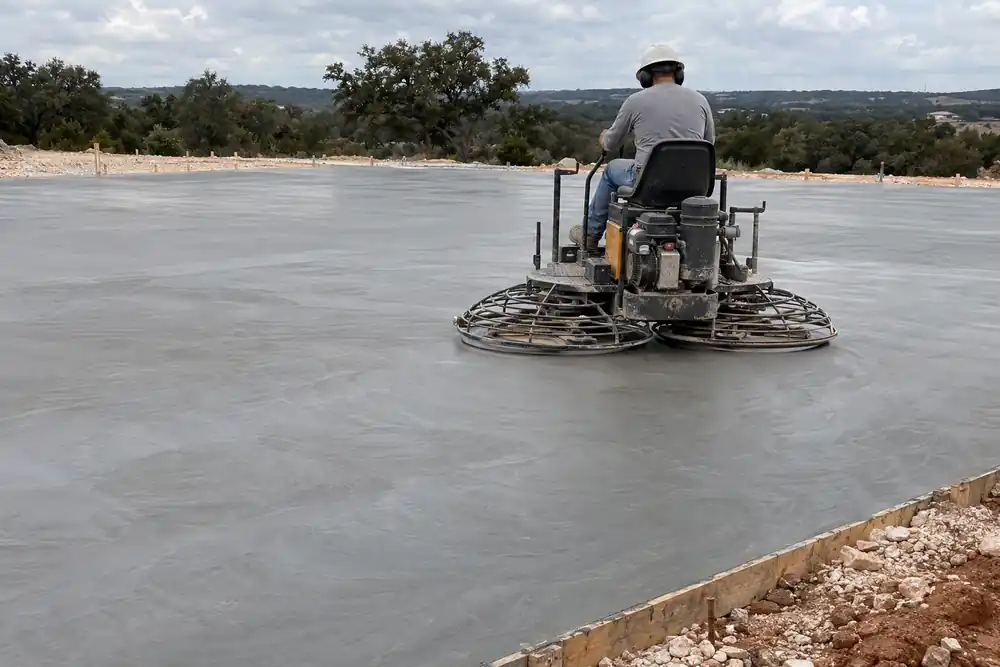
NRMCA says curing begins as soon as the concrete is placed and finished and typically lasts 3 to 7 days, with the concrete held above 50°F; in hot weather, at least 3 days. Let it dry out early and it can forfeit up to half the strength moist curing would have given it. Full curing takes about 28 days, and RVs and large trucks should keep off a new drive for at least that long.
What time of year is best for pouring concrete in Austin?
The best curing weather is air between 50°F and 80°F. Here the normal daily high is above 90°F from May 26 to September 23, and January's normal lows sit in the low 40s, so the milder spring and fall weeks come closest to that range; May is also the wettest month, at 5.04 inches at Camp Mabry. Summer work follows hot-weather rules, and ACI's specification caps concrete at 95°F as it is discharged from the truck.
Can a freeze damage new concrete in Austin?
Yes, if it freezes before it gains strength. ACI 306R treats any protection period with air below 40°F as cold weather, and NRMCA wants fresh concrete shielded until it reaches 500 psi. Austin's design table sets a 12-inch frost line, and Camp Mabry averages 11.9 freezing nights a year (1991–2020); in February 2021 it stayed at or below freezing for 144 straight hours, the longest such run in the National Weather Service's unofficial records back to 1948.
Is my lot on clay or limestone?
That depends on which side of the Balcones Escarpment it sits on. The City's Urban Forest Plan describes shallow clay soils over limestone bedrock in the west and fertile black soils in the east, where the Blackland Prairie covers the city's eastern portion. Counting every mapped soil, three shallow limestone soils (Eckrant, Brackett and Speck) cover about 26% of Austin and three deep clays (Houston Black, Heiden and Ferris) about 16%. Heritage Concrete Austin looks at the ground on your lot during the free estimate.
Does the Edwards Aquifer affect concrete work?
It can in south and west Austin, much of which sits over the aquifer's karst limestone. In the watersheds that drain to Barton Springs, the Save Our Springs ordinance caps impervious cover at 15% in the recharge zone, 20% in the Barton Creek contributing zone and 25% elsewhere in the contributing zone; it doesn't apply to a single-family home on a single platted lot that existed on November 1, 1991. Under the City's Environmental Criteria Manual, finding a void in the rock stops construction within 50 feet until Watershed Protection approves a fix. Ask the City whether these rules reach your project.
Wondering what your ground or the season means for the job? Call 24/7; the estimate is free.
(512) 588-2862Hiring a concrete contractor in Texas
Should I pay for concrete work up front?
Not in full. The Texas Attorney General advises against paying in full until the work is finished and inspected, and warns that home-improvement scams often follow violent storms, with many scammers working door to door. For a homestead improvement costing more than $5,000, Texas law requires the contractor to deposit the owner's payments in a construction account at a financial institution.
Can an unpaid supplier put a lien on my home?
Yes. If the contractor doesn't pay subcontractors or suppliers, the homeowner is responsible, and the property can face a lien for the unpaid amount, according to the Attorney General. A homestead improvement contract must carry a specific lien warning, and a notary other than the salesperson must witness the signature on any document that creates a lien.
Who calls 811 before a concrete job?
Whoever is digging. Texas law requires anyone planning to excavate, meaning disturbing soil 16 inches or deeper with powered equipment, to notify the one-call center no earlier than 14 days and no later than 48 hours before digging, not counting weekends and legal holidays. Utility operators then have 48 hours to mark their lines. The Railroad Commission of Texas reminds homeowners that the rule applies even in their own backyard.
Which towns around Austin do you serve?
Heritage Concrete Austin works across Austin, Rollingwood, West Lake Hills, Lost Creek, Sunset Valley, Barton Creek, Steiner Ranch, Hornsby Bend, Wells Branch, Shady Hollow, San Leanna, Manchaca, Manor, Bee Cave, Hudson Bend, Garfield, Bear Creek, Pflugerville, Volente, Hays, The Hills, Lakeway, Brushy Creek, Cedar Park, Creedmoor, Belterra, Point Venture, Webberville, Buda, Jonestown and Round Rock. Austin anchors the five-county Austin-Round Rock-San Marcos metro area (Bastrop, Caldwell, Hays, Travis and Williamson counties), home to 2,620,945 people on July 1, 2025.
Have a concrete question we didn't answer?
Phone or use the form, day or night. There's no charge for an estimate, and questions about your own drive, walk, patio, slab or lot are welcome.