Heritage Concrete Austin: Driveways, Slab Foundations, Patios & Stamped Concrete, Residential & Commercial
Serving Austin, Texas
Heritage Concrete Austin pours concrete driveways, slab foundations, patios and stamped concrete across Austin, Texas, and builds parking lots, curb and gutter and building slabs for commercial properties. We also repair, level, resurface and seal concrete that is already in place. The Balcones Escarpment splits the city, with Hill Country to the west, where Eckrant, a shallow soil, gives way to hard limestone 4 to 20 inches down, and Blackland Prairie to the east, where the deep Houston Black soil is 40 to 60 percent clay.
The USDA soil survey rates the most common soils on both sides "Very limited" as ground for concrete driveways and sidewalks: the deep clays because of high shrink-swell, the shallow limestone soils because hard bedrock lies close to the surface. We'll go over the base, the steel and the joint layout your lot calls for before any price is set, and the estimate costs nothing. Phone calls and online requests get an answer any hour, any day.
Call or request a free estimate any time, 24/7
No charge · answered 24/7
Get free estimates
Why property owners pick Heritage Concrete Austin for residential and commercial concrete
What a call or an estimate request gets you, whether the job is a driveway, a foundation or a parking lot.
Free estimates, no obligation
Describe the job, its rough size and what is on the ground now. The estimate is free, and nothing is scheduled until you say so.
Answered around the clock
Calls and online requests get answered at any hour, seven days a week.
Residential and commercial work
Driveways, patios, foundations and stamped finishes for homeowners; parking lots, curb and gutter, building slabs and tilt-wall panels for businesses and apartment owners.
Plans for clay and for limestone
East-side clay swells and shrinks with moisture, and Eckrant, the most common soil mapped here, reaches hard limestone 4 to 20 inches down. We'll talk through the base and reinforcement for the ground under your job.
City rules, explained
An approach, sidewalk or curb in the street right-of-way needs a City Driveway/Sidewalk permit, and the applicant has to be a licensed right-of-way contractor. We'll point out which permits apply to your job.
Specs and prices with their sources
Thicknesses, strengths and standards on these pages come from the City, the building code and industry bodies. Prices are typical Austin-area figures, not quotes.
Call or request a free estimate any time, 24/7.
(512) 588-2862Commercial concrete for Austin businesses and property owners
The City of Austin issued 4,104 commercial building permits in 2025, 812 of them for new commercial buildings, by a count of its open permit records. For paving, slabs and right-of-way work on projects like these, see our commercial concrete contractor page.
Parking lots and drive lanes
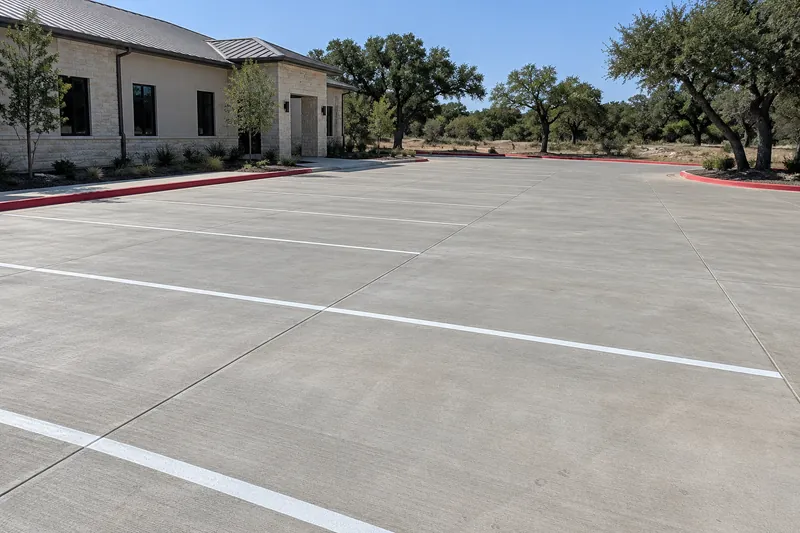
For most of the country, NRMCA rates a 4,000 psi mix as enough for parking areas. Cars and pickups usually get by on 4 inches of unreinforced pavement, while light-truck lanes may need 5 or 6, and the American Concrete Institute expects concrete lots to serve 20 years or more.
Tilt-wall buildings
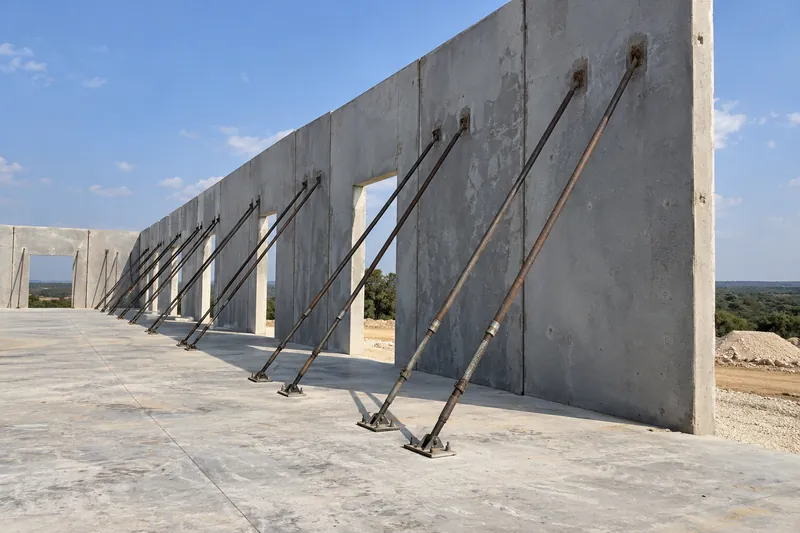
Tilt-wall panels are cast flat on a concrete slab-on-ground and lifted into place by crane once the concrete is strong enough. More than 10,000 buildings a year go up this way, by the Tilt-Up Concrete Association's count, and in Texas, as in California, warehouses, big-box stores and schools are commonly built tilt-up.
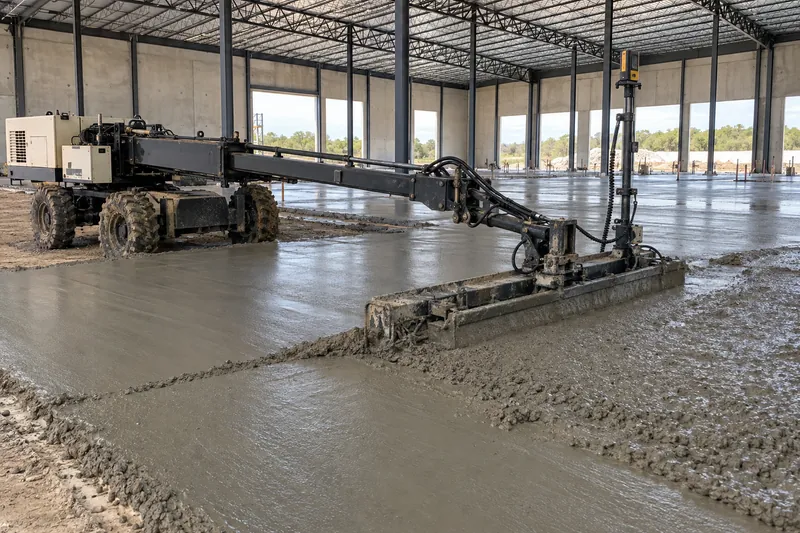
Industrial and warehouse floors
How level a warehouse floor is can cap the safe stacking height of its pallets. That is why industrial floors are specified by FF and FL numbers, for flatness and levelness, and the floor is tested no later than 72 hours after finishing, before curing has a chance to curl it.
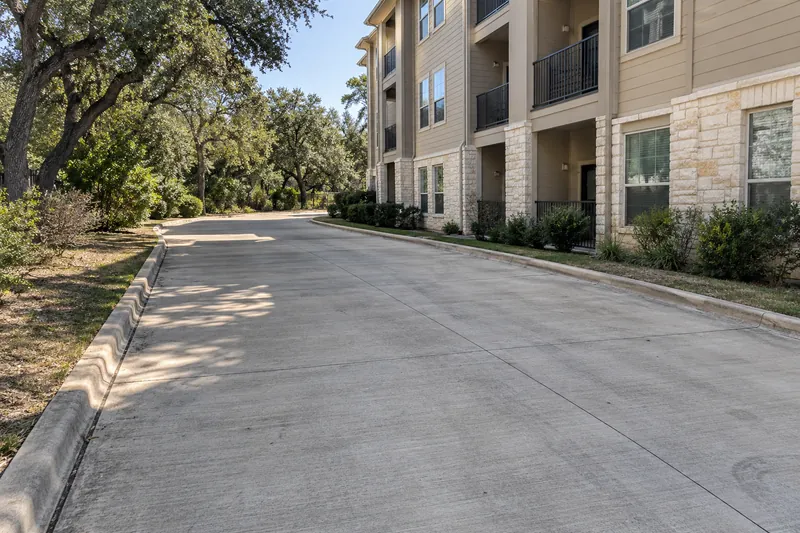
Apartments and multifamily
Of Austin's housing units, 208,961 (43.3%) are in buildings of five or more units (Census Bureau, 2020–2024). Multifamily projects are among the typical users of concrete lots, per the American Concrete Institute, and a driveway serving up to four apartments is built to the City's residential Type I standard.
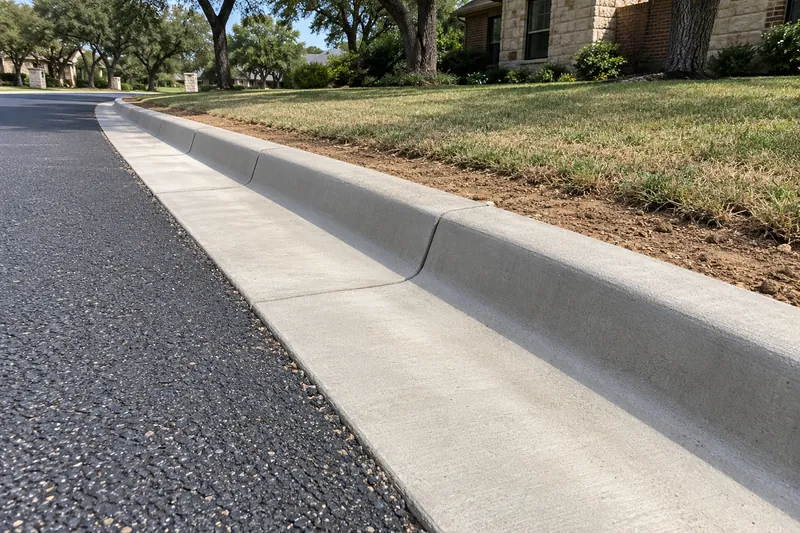
Curb and gutter
Curbs, gutters, sidewalks and driveways built to City standards use its Class A concrete, mixed with 5.0 sacks of cement or more per cubic yard and air-entrained, with a water-cement ratio of 0.6 or lower and a strength of 3,000 psi at 28 days. Any curb and gutter job inside the right-of-way calls for a Driveway/Sidewalk permit.
Call or request a free estimate any time, 24/7.
(512) 588-2862Concrete slabs and foundations
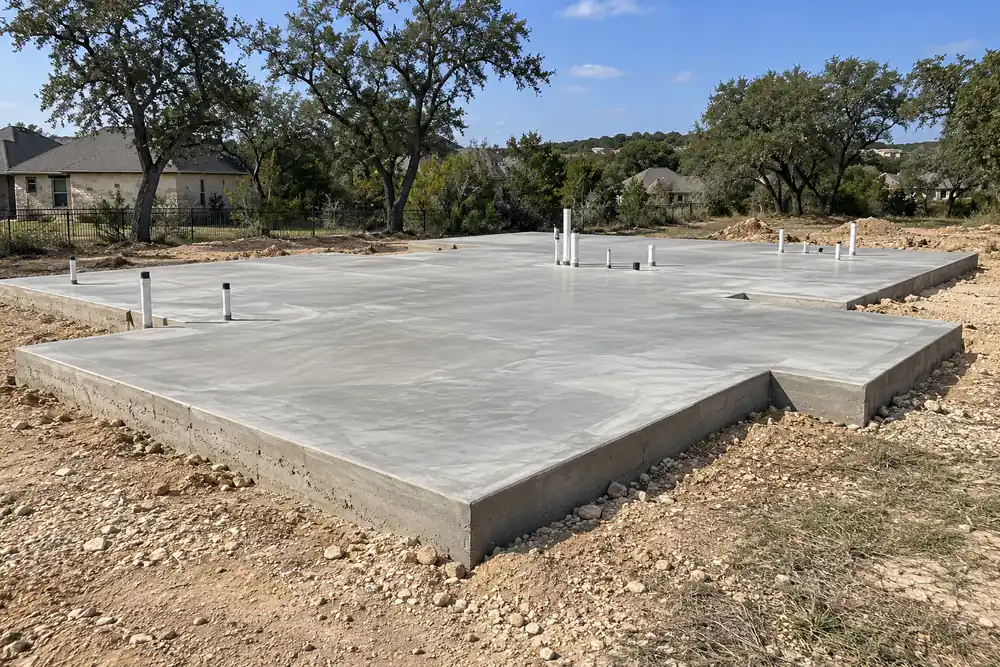
In 2025, Austin's building permits covered 2,079 new single-family homes and another 352 homes in two-unit buildings, by the Census Bureau's count. Our page on concrete slabs and foundations covers foundation design, ADU slabs, pads and cost in detail.
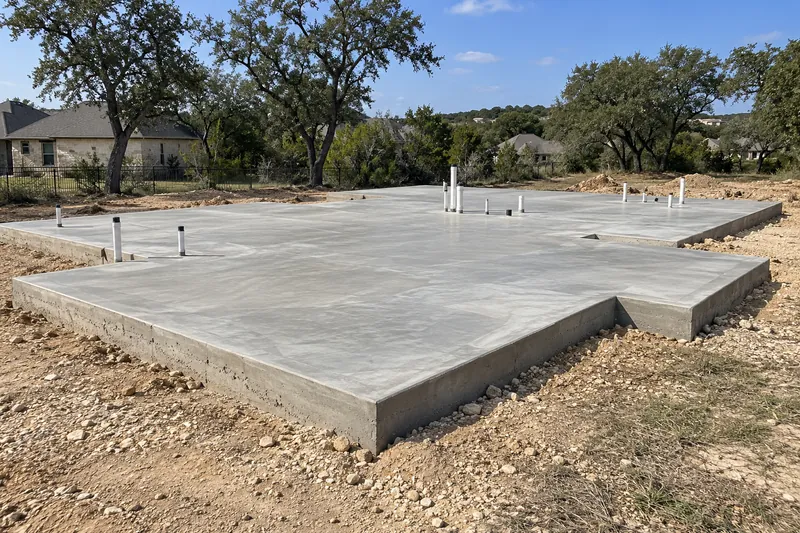
House foundations on expansive soil
On expansive soil, the City wants a Texas registered engineer to design and seal the foundation plans for a home or accessory building. City inspectors don't check the foundation itself; a report from a registered design professional confirms the work instead.
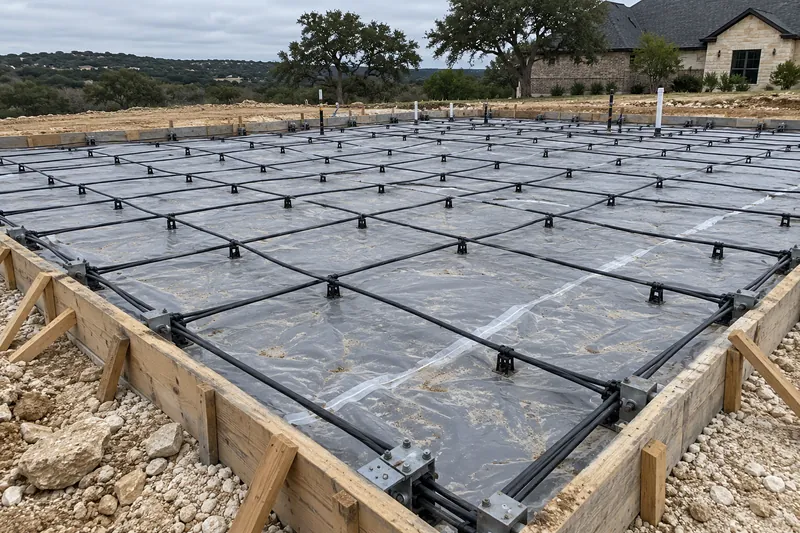
Post-tensioned slabs
Post-tensioned slabs suit shrink-swell ground. The Post-Tensioning Institute says the compression from the stressed tendons resists the tension that soil movement creates, often with less concrete and steel than a comparable rebar slab.
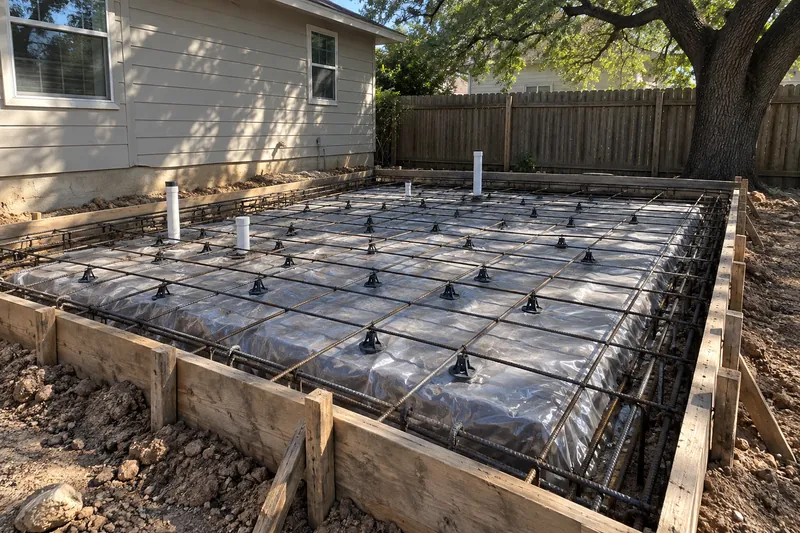
ADU and addition slabs
HOME Phase 1, adopted in December 2023, allows up to three homes, counting tiny homes, on lots in the SF-1, SF-2 and SF-3 zones. For an additional dwelling unit, the lot must measure 5,750 square feet or more, and the unit gets an address of its own.
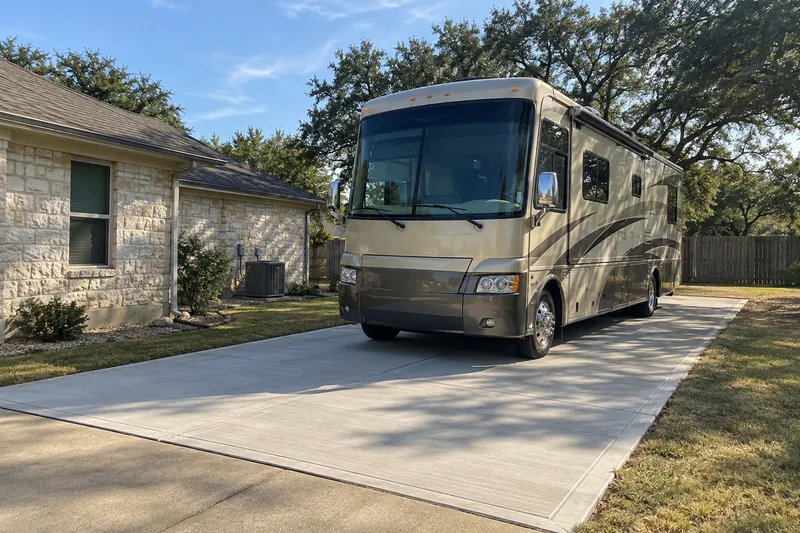
Pads, shop and garage slabs
An RV pad often needs more than a car slab: big RVs can top 12,000 pounds and may need 5 or 6 inches instead of 4. Austin waives the structural drawing for the foundation of a one-story detached garage or shed of 500 square feet or less that has no plumbing and no living space.
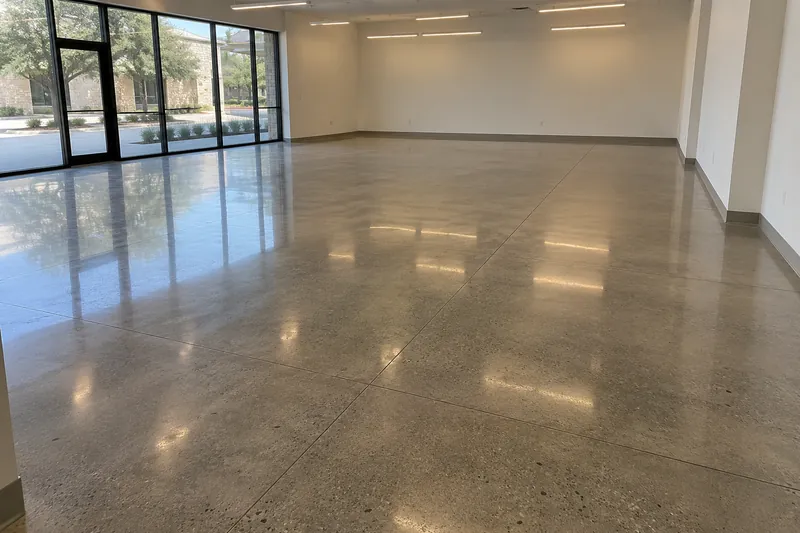
Polished concrete floors
The Concrete Polishing Council sorts polished floors into four levels by how clearly they reflect: Level 1, ground, rates 0 to 9, and Level 4, highly polished, rates over 70, a near-mirror finish.
Call or request a free estimate any time, 24/7.
(512) 588-2862Concrete driveways, replacements and approaches
The median year built for Austin's housing is 1994, and 136,580 of its 483,071 units date from before 1980 (Census Bureau, 2020–2024). Thickness, permits and cost each get a full section on our concrete driveway installation and replacement page.
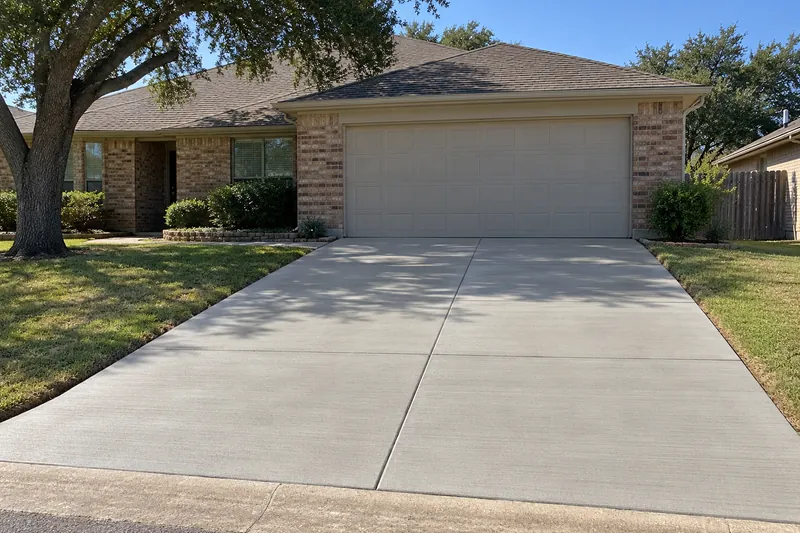
New driveways
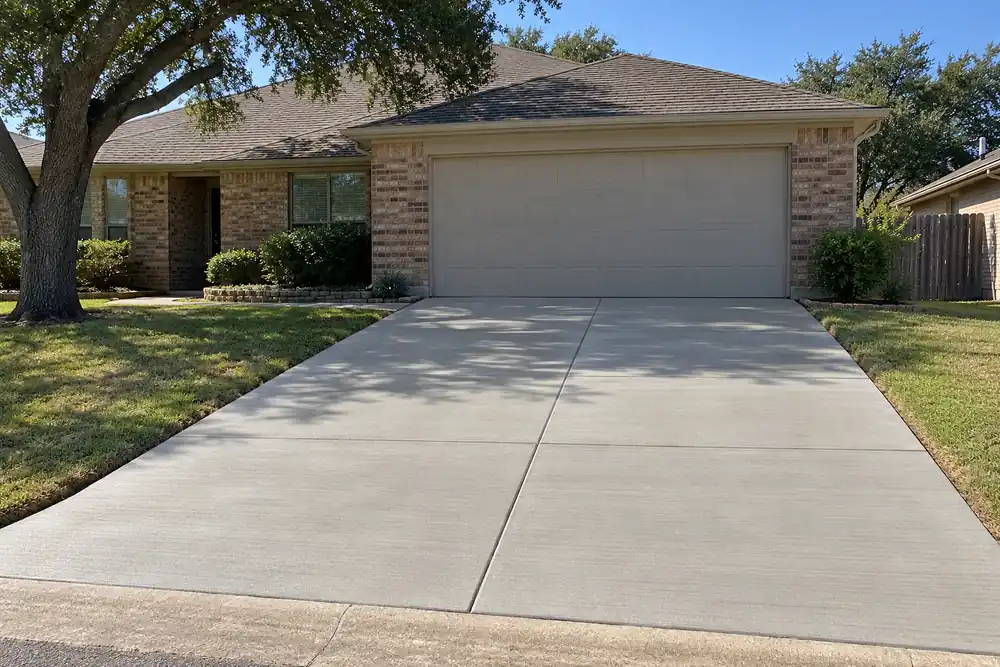
A 4-inch slab is the usual minimum for a home drive that sees cars and SUVs, and the width is planned at 10 feet or more for each vehicle. Built and kept up properly, a concrete drive should give 30 years or more; asphalt's service life is about 15.
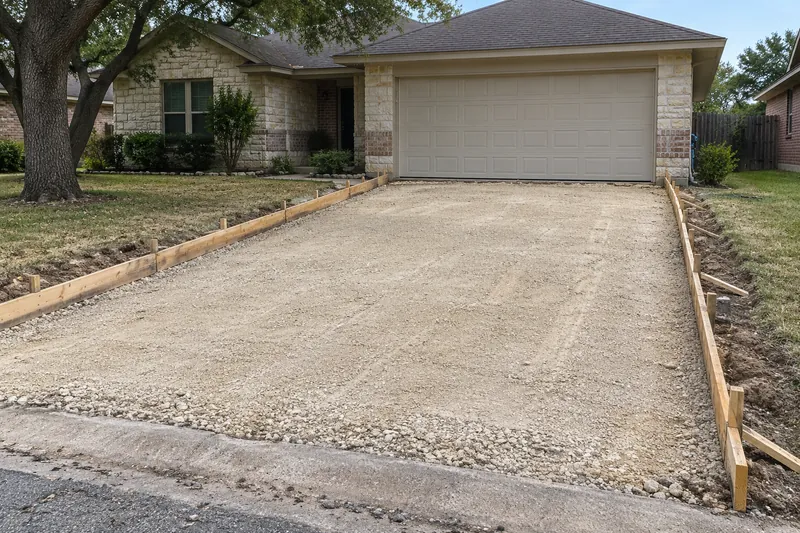
Driveway replacement
After the 30-year mark, replacing the whole drive is usually the most cost-effective route. A single damaged section can come out on its own, but fresh concrete seldom matches the old color. Tearing out and hauling away an old drive typically runs $2 to $8 per square foot in Austin (2026).
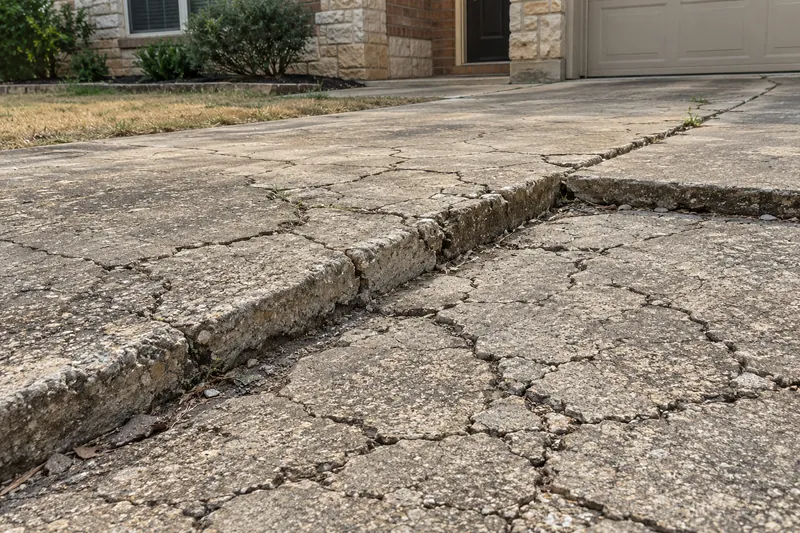
Driveway repair
Cracks and holes under ¼ inch can be patched, though patches aren't watertight and count as a temporary fix. A drive that has sunk in spots usually sits on poorly compacted fill or eroded soil, and slabjacking can sometimes lift it back.
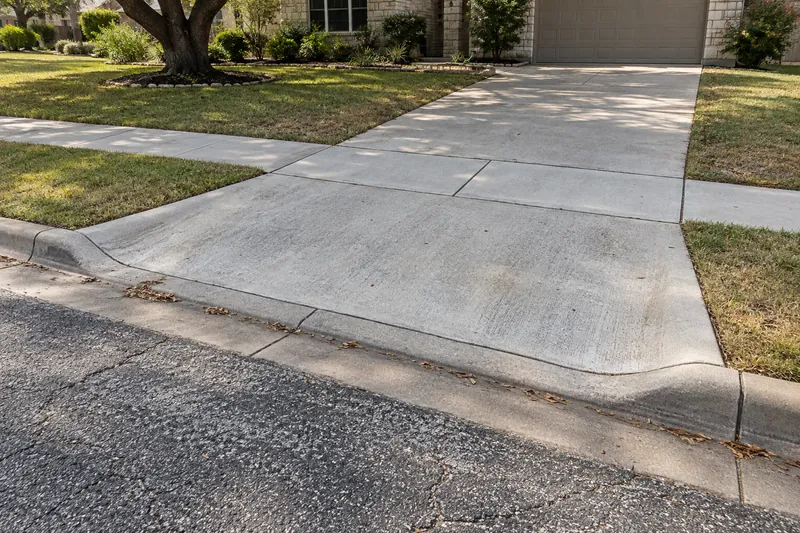
Approaches at the street
By City detail, a Type I residential approach is 10 to 20 feet wide: Class A concrete 5 inches thick or more, #3 bars spaced 18 inches apart, and a 2-inch bed of sand underneath. Building one takes a Driveway/Sidewalk permit, $345 for a new one (fees effective October 1, 2026).
Call or request a free estimate any time, 24/7.
(512) 588-2862Stamped concrete, patios, pool decks and retaining walls
Outside the right-of-way, concrete flatwork needs no City building permit. On a lot with a septic system, though, adding a patio, a pool or a garage triggers an on-site sewage facility review with Austin Water.
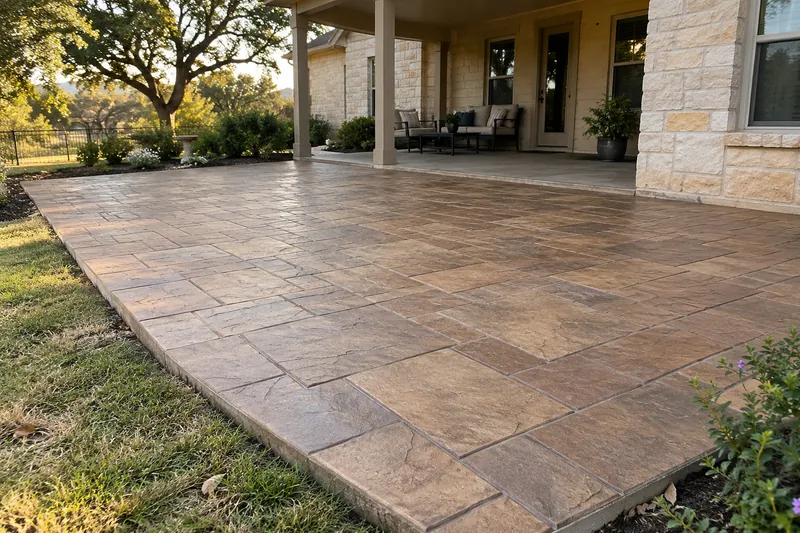
Stamped concrete
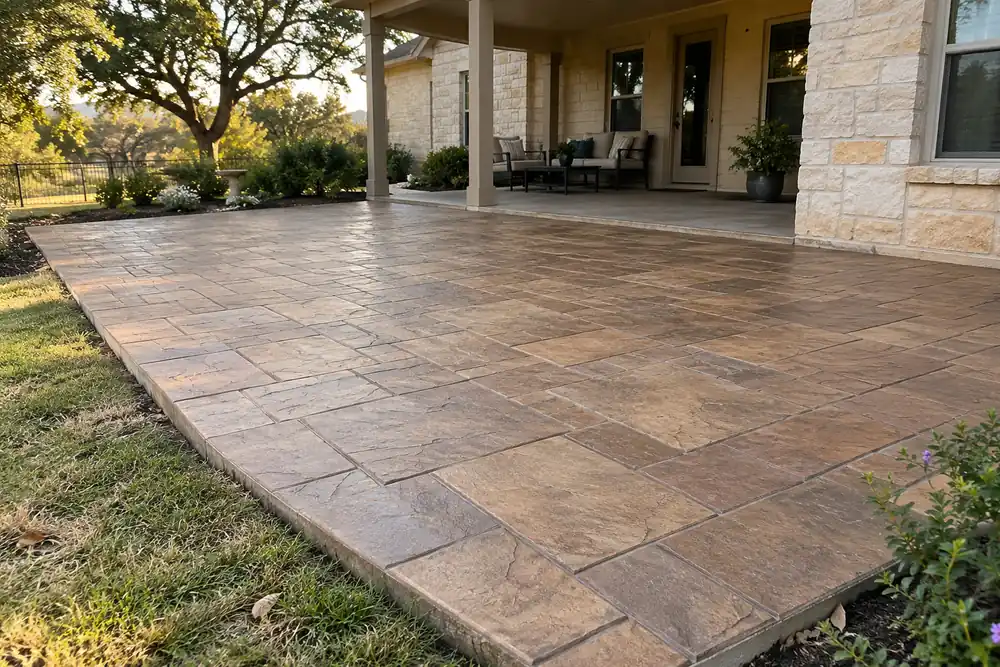
Stamped slabs get their color one of two ways: pigment mixed into the whole load, usually in earth tones and pastels, or a color hardener thrown onto the fresh surface, which gives deeper color and helps the stamps print sharply. Plan on resealing every 2 to 5 years.
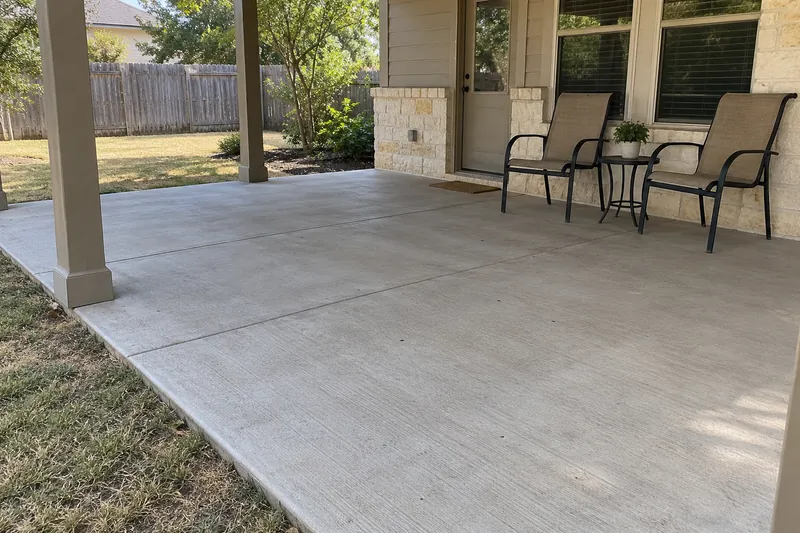
Patios and patio extensions
Four inches is the usual minimum for a patio; a hot tub or an outdoor fireplace on top can push that to 5 or 6. A slope of at least 2%, a quarter inch per foot, carries rain away from the house. In Austin, a patio also counts as impervious cover in the monthly drainage charge.
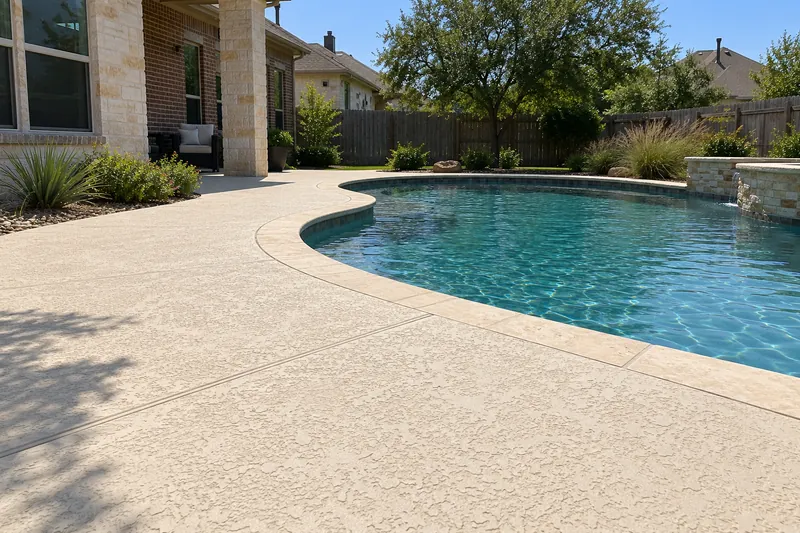
Pool decks
Normal summer highs at Camp Mabry are 96.6°F in July and 97.8°F in August (1991–2020), so pool decks are finished for grip and heat: a broom or rock-salt texture, exposed aggregate, which is highly slip resistant, or a decorative topping made to lower the surface temperature.
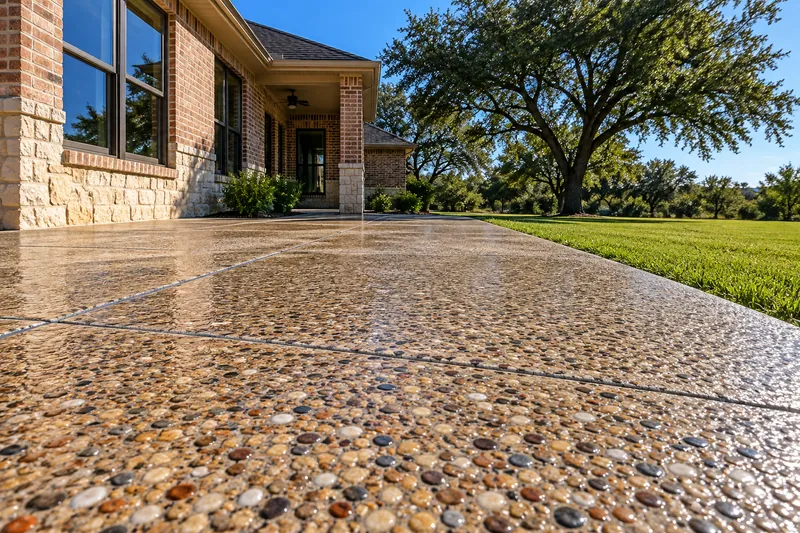
Stained and exposed aggregate
Acid stain colors concrete by reacting chemically with its lime and comes mostly in earth tones such as tans, browns and terra cottas; water-based stains skip the reaction and give more even color across dozens of standard colors. Exposed aggregate leaves a rugged, nonskid stone surface that needs little more than sealing and an occasional cleaning.
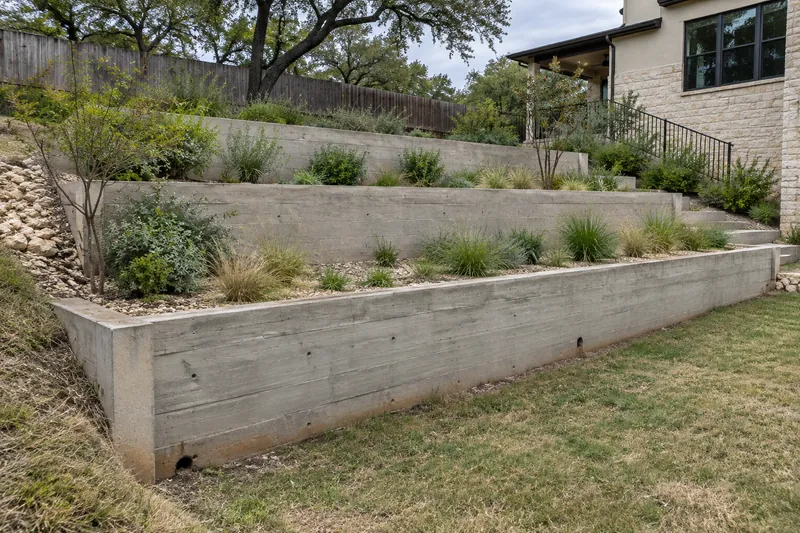
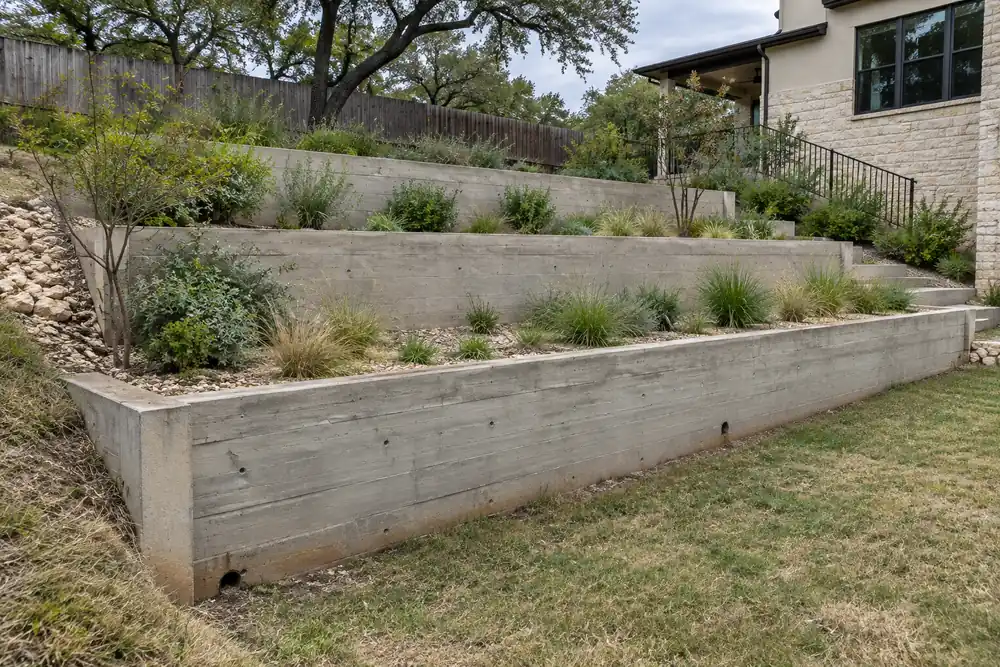
Retaining walls
In Austin, a retaining wall skips the building permit only if it stands no more than 4 feet from the bottom of its footing to the top, sits outside a flood hazard area, and holds no surcharge, meaning an added vertical load on the soil it retains.
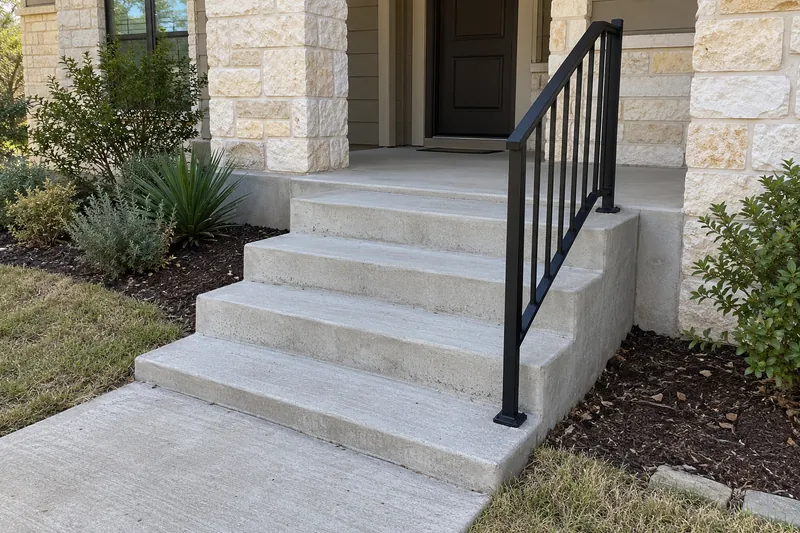
Steps and porches
Uneven steps trip people: HUD's Design Guide for Home Safety advises riser and tread differences in a flight of under 3/16 inch, and treads less than 9 inches wide account for the greatest number of trips, Cornell University found. Step edges chip and spall when the concrete is weak or badly cured.
Call or request a free estimate any time, 24/7.
(512) 588-2862How a concrete job runs, from estimate to first use
Driveway, patio, slab or parking lot, the work follows the same order, and each step has a code, a City rule or an industry standard behind it.
Free estimate
We check the size of the job, how trucks get in, where water drains and what sits there today, then go over thickness, steel and finish with you. There is no charge for the estimate.
Permits and utility locates
Approach, sidewalk and curb work needs a City Driveway/Sidewalk permit. Texas law requires notice to the 811 center 48 hours to 14 days ahead of any digging by powered equipment 16 inches down or deeper, weekends and legal holidays not counted.
Tear-out, subgrade and base
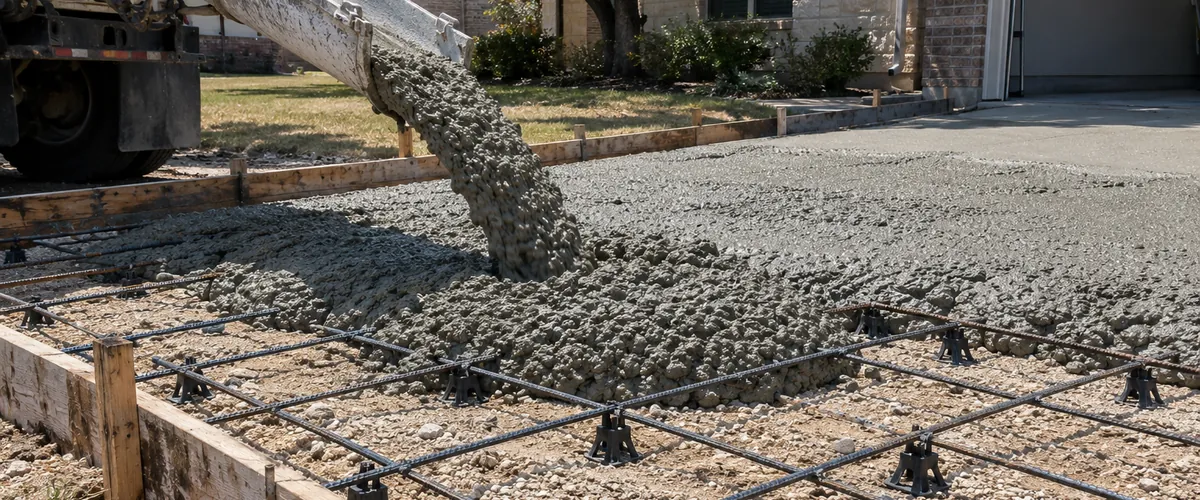
Any old concrete is broken up and hauled away, weak spots in the subgrade are dug out and refilled, and the base is compacted. On expansive soil the crushed-rock layer is typically 2 to 8 inches, with the deeper end where the ground moves more.
Steel and forms
Rebar or mesh sits on supports at or just above mid-depth, where it can do its job. The City's approach detail forbids steel lying on the subgrade or the sand.
Pour, finish and joints
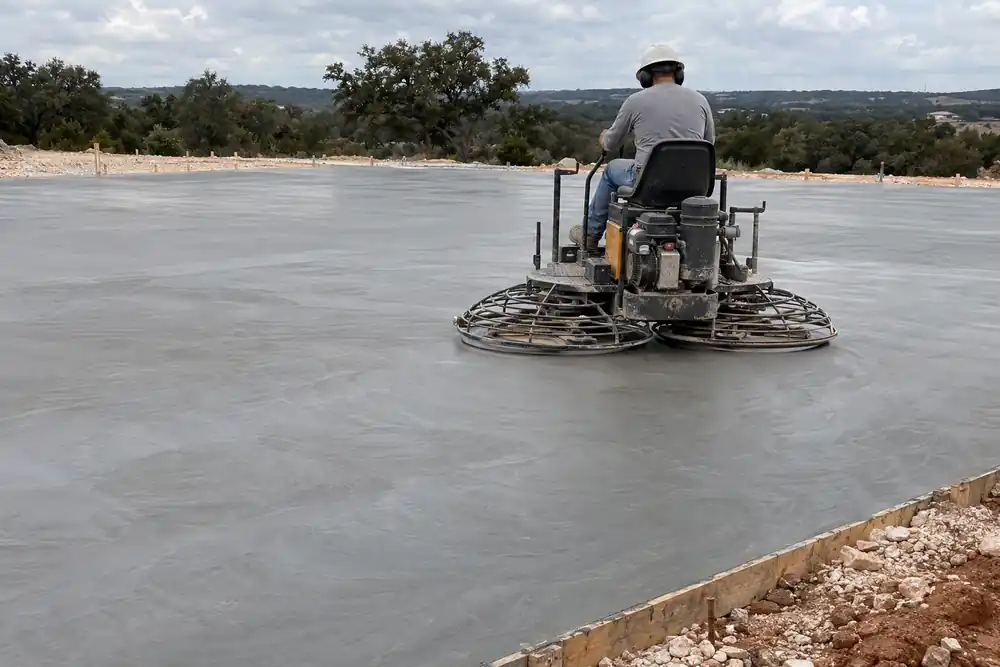
On its own jobs the City turns away concrete warmer than 90°F, or 100°F when the mix has a high-range water reducer. Outdoor slabs get a broom texture, and NRMCA times conventional saw-cut joints within 4 to 12 hours of finishing.
Curing and first use
NRMCA advises keeping concrete curing for 3 to 7 days. As a rule of thumb, foot traffic can start at 48 hours, cars at 7 to 10 days if they keep off the edges, and everything except heavy trucks at 30 days.
How long it takes. Pouring is quick; permits, weather and curing set the schedule. Concrete in the City right-of-way gets two inspections: one of line, grade, forms, steel, drainage and subgrade before the pour, and a final one afterward. A commercial parking lot usually needs 2 to 4 weeks of installation, by national figures.
Call or request a free estimate any time, 24/7.
(512) 588-2862Concrete strength, steel, joints and surface finishes
Mix and strength
The City of Austin pours its own sidewalks, driveways and curbs in Class A concrete, which has to reach 3,000 psi by day 28 and at least 70% of that by day 7. It is air-entrained, with a 2- to 4-inch slump for slabs on ground. Austin's residential design table lists weathering as "Negligible" and the frost line at 12 inches.
Rebar, mesh and fibers
Reinforcement doesn't stop cracking. NRMCA's point is that mesh holds cracks and joints tight, and it should be cut at contraction joints. As general practice, wire mesh suits slabs 4 to 5 inches thick, while slabs from 5 inches up get #4 rebar in a grid at roughly 12-inch spacing.
Joints
Control joints decide where a slab cracks. NRMCA keeps panels square or nearly so, their length capped at 1.5 times their width, and puts joints at roughly 10-foot spacing in a 4-inch slab. The City's approach detail adds a joint ¼ inch wide and ¾ inch deep down the middle of every driveway approach.
Surface finishes
Exterior flatwork gets a push-broom texture for grip, and finishers should never sprinkle water or cement on the surface to make it easier to work. Stamped, stained, exposed aggregate and polished finishes are covered above.
- Control joint cut to ¼ or more of the slab thickness (NRMCA)
- Broom texture for grip on outdoor slabs (NRMCA)
- 4-inch slab, the usual minimum for a home driveway
- Mesh or rebar on supports, at or just above mid-depth
- Compacted base, with 2–8 in. of crushed rock where clay is expansive
- Native soil: deep clay to the east, shallow limestone soils to the west (USDA)
Call or request a free estimate any time, 24/7.
(512) 588-2862How much does concrete cost in Austin?
These are typical Austin-area figures for 2026 and City of Austin bid prices, not our prices. The number moves with size, tear-out, access, finish and soil work, so pricing a job means seeing the site, and the estimate is free.
- Per square foot
- $9–$19
- Most projects
- $2,649–$14,225
- Average project
- $6,278
- 10 x 20 ft (200 sq ft)
- $1,570–$2,945
- 24 x 24 ft (576 sq ft)
- $4,510–$8,435
- Tear-out and haul-away
- $2–$8 / sq ft
Average Austin-area driveway costs, 2026. Not a quote.
- Stamped, per square foot
- $10–$20
- Average stamped project
- $6,450
- 500 sq ft stamped driveway
- $5,000–$10,000
- Concrete patio, per square foot
- $4–$10
- 16 x 20 ft patio
- $1,280–$3,200
Typical Austin-area prices, 2026. Averages, not a quote.
- Concrete slab
- $4–$10 / sq ft
- Retaining wall, 3 to 6 ft high
- $35–$40 / sq ft
- Driveway repair, typical range
- $584–$2,289
- Mudjacking
- $4–$8 / sq ft
- Sidewalk repair
- $3–$22 / sq ft
Typical Austin-area prices, 2026. Averages, not a quote.
- Concrete street pavement (City bids)
- $160 / sq yd
- Curb and gutter (City bids)
- $50 / linear ft
- New 4-in. sidewalk (City bids)
- $15 / sq ft
- Concrete parking lot, national
- $5–$10 / sq ft
- Tilt-up warehouse, national
- $40–$50 / sq ft
City of Austin median bids, 2022–2025; national averages, 2026 and 2025. Not a quote.
What moves the price
Soil: the City prices its own Type II driveways by the ground under them, with median bids of $16.875 per square foot on low-expansive soil and $18.25 on moderate-to-high expansive soil (2022–2024). Site work: once an old slab is out, heat and clay can mean digging deeper, regrading, and laying a thicker layer of gravel. Slope: on hilly lots, retaining-wall labor can rise 50% or more, and limestone takes extra work to dig. Tax: Austin's 8.25% sales tax applies to materials, not to installation labor.
Call or request a free estimate any time, 24/7.
(512) 588-2862Concrete repair and leveling, resurfacing, sidewalks and removal
Older concrete often needs fixing rather than replacing, and some jobs start by taking concrete out.
Crack repair
Cracks that appear in a slab's first few years can trace back to the installation: a mix with too much water, or not enough control joints. Cracks that still move are routed into a shallow V-groove, about ⅜ inch deep in TxDOT's method, and sealed to keep water out.
Leveling sunken slabs
A settled slab can be raised by pumping grout or foam beneath it, a process called slabjacking. Lifting foam weighs only 2 to 4 pounds per cubic foot, one maker says, against up to 100 for mudjacking grout. For a slab heaved by expansive soil, InterNACHI counts mudjacking as the wrong fix.
Resurfacing and sealing
A professional fine overlay of polymer-modified topping is applied 1/16 to 3/16 inch thick over concrete that has been roughened so it bonds, and the existing control joints are carried up through it. Over a slab that is badly cracked or still shifting, an overlay won't last.
Sidewalks and front walks
Austin's standard sidewalk detail calls for at least 5 feet of width, Class A concrete on a 2-inch sand cushion, with control joints every 5 feet and expansion joints no more than 40 feet apart. The City maintains select sidewalks in the right-of-way; the owner maintains the driveway.
Concrete removal
On City contracts bid from 2022 to 2025, removing concrete sidewalks and driveways had a median bid of $4 per square foot. Concrete was the biggest single share, 67.5 percent, of 2018's construction and demolition waste, which the EPA estimates at 600 million tons nationwide.
Call or request a free estimate any time, 24/7.
(512) 588-2862Austin's limestone, clay, weather and City rules
Before a slab is priced, it helps to know which side of the Balcones Escarpment the lot is on, what an Austin summer does to fresh concrete, and where the City's rules begin.
Limestone to the west, clay to the east
The Balcones Escarpment is a fault zone several miles wide that stands about 300 feet high near Austin, and the Bureau of Economic Geology says the city's east side dropped by as much as 700 feet along it. The soil mapped most often in Austin, Eckrant, is only 4 to 20 inches deep over hard limestone. East of the escarpment the deep clays take over: Houston Black, 40 to 60 percent clay, has its official USDA type location in Travis County east of Manor, and cracks ½ to 4 inches wide in dry spells; in most years the cracks remain open a cumulative 90 to 150 days. Many central Texas subgrades are highly expansive, the City's Transportation Criteria Manual warns.
Heat, flash floods and freezes
Camp Mabry, the City's official weather station, logs 100°F or more on about 29 days in an average year (1991–2020 normals), and in 2023 Austin had 45 straight days of 100-degree heat, from July 8 to August 21. ACI's hot-weather spec won't accept concrete warmer than 95°F as it comes off the truck. Austin also sits in Flash Flood Alley, where thunderstorms have dropped more than 5 inches of rain in several hours. Freezes are uncommon in town and less so at the airport: 11.9 nights a year at 32°F or colder at Camp Mabry against 33.0 at Austin-Bergstrom. Below roughly 25°F fresh concrete freezes, and frozen concrete can lose more than half its potential strength, so NRMCA says to protect it until it reaches 500 psi, roughly two days after the pour.
City permits and limits
Off the right-of-way, a driveway, walk or patio slab is exempt from a building permit, though it must still meet the City's codes; an approach inside the right-of-way requires both a Driveway/Sidewalk permit and a $525.01 residential approach inspection. In SF-2 and SF-3 zoning, impervious cover is capped at 45% of the lot, and in SF-1 at 40%. Work that disturbs the root zone of a protected tree, 19 inches or more in diameter, means a tree review, even for a slab that needs no permit. Right-of-way fees can change every October 1, so confirm them with the City first.
Neighborhoods and landmarks
Edwin Waller laid out the new capital as a grid fourteen blocks square between Waller Creek and Shoal Creek, split by Congress Avenue, where crowds lined the street for the Capitol's dedication in 1888. Hyde Park was platted in 1891 and filled with bungalows in its 1924–1935 building boom; Travis Heights followed in South Austin in 1913. Mueller has grown on just over 700 acres of the old Robert Mueller Municipal Airport. Of the city's 483,071 housing units, 209,772 are single-family detached homes, and the 2010s were the biggest building decade, with 103,591 of its homes still standing.
Service area. Our service area covers Austin, Rollingwood, West Lake Hills, Lost Creek, Sunset Valley, Barton Creek, Steiner Ranch, Hornsby Bend, Wells Branch, Shady Hollow, San Leanna, Manchaca, Manor, Bee Cave, Hudson Bend, Garfield, Bear Creek, Pflugerville, Volente, Hays, The Hills, Lakeway, Brushy Creek, Cedar Park, Creedmoor, Belterra, Point Venture, Webberville, Buda, Jonestown and Round Rock.
Call or request a free estimate any time, 24/7.
(512) 588-2862Questions about concrete work in Austin
Does a new driveway in Austin need a permit?
Not the part on your own lot. Concrete flatwork outside the public right-of-way, a driveway or sidewalk included, is exempt from a building permit, though it still has to meet the codes. The approach in the right-of-way is another matter: to install, move, remove or repair one, you need a Driveway/Sidewalk permit, and the City runs a transportation review. A new permit costs $345, only licensed right-of-way contractors may apply, and the fees change each October 1.
How soon can a car go on a new concrete driveway?
Most new drives can take a car after about seven days, when the concrete has reached roughly 70% of its strength; keep off the edges at first. Wait 48 hours before walking on it, at least three days before bikes and scooters, and at least 28 days before parking an RV or a large truck.
What is the average lifespan of a concrete driveway?
Thirty years or more is a fair expectation. Concrete drives can handle daily traffic "often for over 30 years," according to the Illinois Ready Mixed Concrete Association, and a well-built, well-kept drive should outlast asphalt, whose service life is about 15 years. A poorly prepared subgrade is one of the most common causes of early slab failure.
What is the downside of stamped concrete?
Upkeep and repairs. Stamped surfaces typically need resealing every 2 to 5 years, at roughly $1.20 to $2.50 a square foot each time in Austin (2026), and UV-resistant sealers are a common guard against sun fading. Rain drains off more slowly because it collects in the pattern, and a stamped slab is often harder and costlier to repair or replace than pavers.
How long will stamped concrete last?
With routine cleaning and resealing, 30 years or more. A stamped overlay laid over an existing slab is shorter-lived, about 10 to 20 years or more when it's applied properly, and it isn't an option over large cracks, heavy spalling or severe settlement.
How much would a 20x20 concrete patio cost?
A 20-by-20-foot patio (400 square feet) runs $1,600 to $4,000 at typical 2026 Austin-area prices, or $4 to $10 per square foot. The finish moves it most: a broom finish runs $6 to $12 per square foot and stamped $10 to $30. Taking out an old patio beforehand adds $550 to $1,700 on average.
How much would a 40x60 concrete slab cost?
A 2024 Austin cost guide puts a reinforced 40-by-60-foot slab at $20,600 to $35,200, at $6 to $10 per square foot, and says demolishing an old slab first costs $1.10 to $1.70 more for each square foot.
What is the average price per yard of concrete in Texas?
Austin figures are the closest we have. In 2026, local delivery pros charge $110 to $150 per cubic yard for standard material and transport, and a full truckload runs $1,100 to $1,440. By type, fast-setting 3,000 psi concrete runs $125 a yard, general-purpose 3,000 to 3,500 psi $130, and the 4,000 psi mixes used for driveways and foundations $150. A two-car driveway takes about 10 cubic yards.
How much should a concrete retaining wall cost?
Most Austin walls cost $35 to $40 per square foot at heights of 3 to 6 feet, and the typical project runs $2,886 to $7,716 (2026). Hilly lots can raise labor 50% or more, and limestone takes extra work to dig. A wall taller than 4 feet from the bottom of its footing, or one holding a surcharge, isn't exempt from a City building permit.
How much does it cost to have concrete leveled?
Mudjacking in Austin typically runs $4 to $8 per square foot; the average job is $1,352, and small jobs often carry a minimum charge around $400 (2026). By surface, a sidewalk runs $400 to $1,100 and a driveway $900 to $3,000. Polyurethane foam costs more for the material but gives a lighter, longer-lasting lift.
How long do cement sidewalks last?
Expect 20 to 40 years from a concrete sidewalk. Joints help it get there: NRMCA calls joints pre-planned cracks, and the City's standard walk has control joints every 5 feet and expansion joints no more than 40 feet apart.
What does concrete flatwork mean?
Flatwork is concrete placed flat on the ground: the sidewalks, patios and driveways NRMCA names as exterior flatwork. USDA's soil survey describes concrete driveways and sidewalks as poured slabs between 3 and 6 inches thick. In Austin, flatwork that stays outside the right-of-way doesn't need a building permit.
How much does it cost to hire a concrete contractor?
Concrete work is usually priced by the job or by the square foot. Typical Austin-area figures for 2026 have driveway labor at $4.50 to $13 per square foot, and patio labor at $4.50 to $6 per square foot or $50 to $100 an hour, which is 40% to 60% of a patio's total. An estimate from us is free.
How to find a good concrete contractor?
Start with the Texas Attorney General's checklist: written bids from at least two contractors, caution about a "low-ball" bid, and a contractor with an established physical address. Texas has no state general-contractor license, so check the local credentials instead: in Austin, a general contractor registers with the City before doing building-permit work, and a driveway or sidewalk permit can be pulled only by a licensed right-of-way contractor holding a $10,000 bond.
What is better for a parking lot, asphalt or concrete?
Concrete costs more to install and lasts longer: by national figures, it gives 30 to 40 years of service and asphalt 15 to 30 (2026). ACI adds two practical points: concrete lots stay cooler than asphalt, and oil and fuel drips barely affect them. At national prices, figure $5 to $10 a square foot, about $1,500 to $3,500 for each stall.
Request a free concrete estimate for your property
Send the size and location of the job, or call. Whether the job is a new drive, a foundation, a stamped patio or a parking lot, the estimate costs nothing, and someone answers at any hour.