Concrete Pumping in Austin, TX
Heritage Concrete Austin offers concrete pumping in Austin, Texas, with truck-mounted boom pumps and trailer-mounted line pumps that carry the mix from the ready-mix truck to forms it can't reach: backyards, tight lots, slopes and upper floors. Sloped lots are common in West Austin and the neighborhoods along the Hill Country, and the American Concrete Institute's pumping guide notes that a pump is useful wherever space for construction equipment is limited.
Pricing the pour is free; call, or put the details in the form. We'll talk through where the trucks can park, how far and how high the concrete has to travel, and how many yards the pour needs.
Call or request a free estimate any time, 24/7
No charge · answered 24/7
Get free estimates
Truck-mounted boom pumps and trailer line pumps
Boom pumps
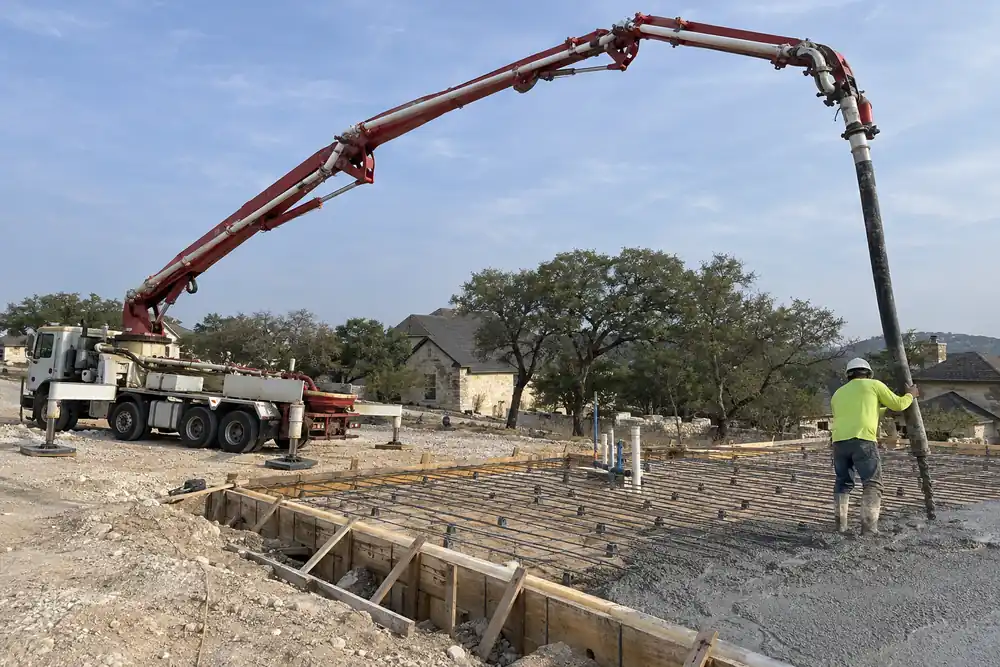
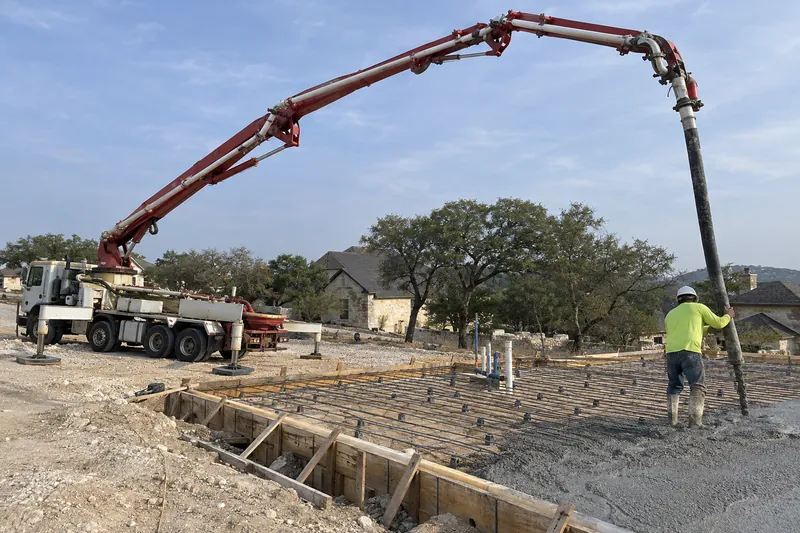
A boom pump carries its pipeline on a folding arm mounted to the truck. Common booms come in three or four sections and unfold from a height of about 16 feet, and five-part booms pass 200 feet of reach; Putzmeister's truck-mounted range runs from its 20Z-Meter to its 70Z-Meter model. With that much reach, a boom truck often stays in one place for the whole pour while the ready-mix trucks unload into its hopper. Boom pumps are the usual choice for high-volume work such as multi-story pours and large foundations, and the distance between where the trucks can park and the pour decides how big a boom the job needs.
Line pumps
A line pump is a portable unit, often trailer-mounted, that pushes concrete through a pipeline laid out to the forms. It suits low- to mid-volume work such as driveways, slabs and short distances, and it pumps more than structural concrete: grout, wet screeds, mortar, shotcrete and foamed concrete too.
Call or request a free estimate any time, 24/7.
(512) 588-2862When an Austin pour needs a pump
Backyards, slopes and tight lots
A pump also frees up the cranes and hoists on a building site, and ACI lists the pipe diameter, the vertical and horizontal distance, the mix and the air temperature among the things that change how a pump performs. Heritage Concrete Austin can bring a pump to slab and foundation pours on lots where the truck can't back up to the forms.
Trees, sidewalks and the street
Austin's Environmental Criteria Manual counts site access and material staging among the construction impacts on a protected tree's root zone, along with form bracing and over-excavation. In the street, the City requires a right-of-way permit for any work that uses part of the public right-of-way, and shutting a sidewalk or driveway while the work happens on private land requires the City's Temporary Use of Right of Way permit, so where the pump and trucks will stand is part of planning the pour.
Summer pours
From May 26 to September 23, Austin's normal daily high sits above 90°F, and Camp Mabry's 1991–2020 normals count 122.8 days a year at or above 90°F. A pumped mix still has to meet ACI's hot-weather limit of 95°F at discharge; cooling it with chilled mixing water can take off up to 10°F and ice up to 20°F. Once a load is over 1½ hours old in hot weather, adding water is out, and curing should last 3 days or more.
Call or request a free estimate any time, 24/7.
(512) 588-2862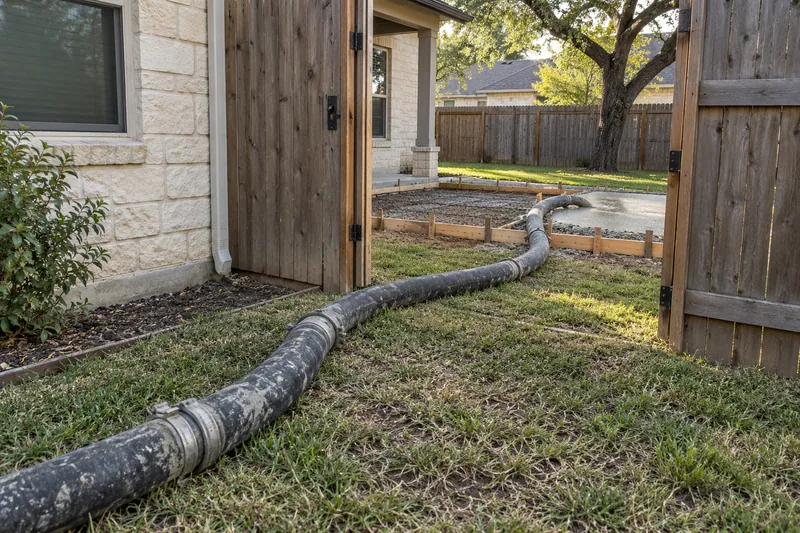
How a pumped concrete pour is set up
Size the pump
How far the farthest form sits from where the ready-mix trucks can park sets the boom size, or tells you a line pump will do.
Order the concrete
A 10-by-10-foot patio takes about 2 cubic yards and a two-car driveway about 10. In Austin, ordering under 10 cubic yards, a short load, or taking delivery on a weekend raises the price.
Set up
A boom pump needs at least an hour to set up, by national estimates, before the first truck discharges into the hopper.
Pump and place
The trucks unload one after another while the concrete is placed, consolidated and finished at the forms.
Clean out
Allow at least another hour after the pour to clean the boom pump.
Heritage Concrete Austin can price a pump into commercial concrete work such as building slabs and site paving. In tilt-wall construction, the wall panels are formed and poured lying flat on a slab, then raised by crane after the concrete gains enough strength, as the Tilt-Up Concrete Association describes the method.
Call or request a free estimate any time, 24/7.
(512) 588-2862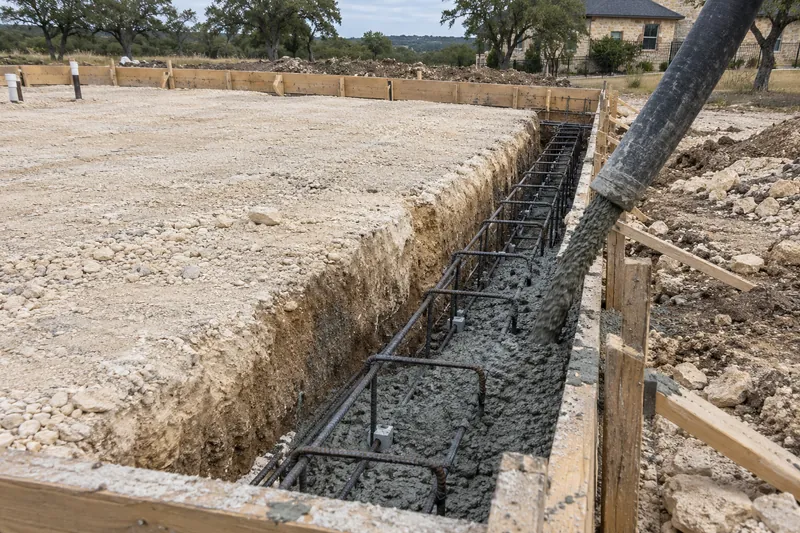
Concrete pump questions
How much do concrete pumpers charge?
About $1,200 on average nationally in 2026, and most residential jobs land between $800 and $1,800. By the hour, the same national figures put boom pumps at $200 to $250 with an $800 to $1,000 minimum, and line pumps at $150 to $200 with a $400 to $600 minimum.
What does a concrete boom pump cost per hour?
One national 2026 guide puts a 75- to 105-foot boom truck at $140 to $190 an hour with a typical 4- to 5-hour minimum, plus at least an hour each for setup and cleanup. Another 2026 guide gives $200 to $500 an hour for boom pumps on elevated or hard-to-reach pours.
What does a concrete pump cost for a day?
Pumps are usually hired by the hour with a minimum rather than by the day; most require 2 to 4 hours at least, by national figures. One Austin-area ready-mix seller lists line pumps at $850 to $1,300 per pour and 32- to 52-meter boom pumps at $1,600 to $3,200 per pour (2026). The concrete is separate: Austin delivery runs $110 to $150 per cubic yard.
How far can a pump push concrete?
That comes down to the boom. Schwing rates its S 36 X at 115 feet 3 inches of vertical reach and 100 feet 5 inches horizontally, and its larger S 51 SX at 164 feet 5 inches vertical and 147 feet 4 inches horizontal; the longest five-part booms go past 200 feet. At the small end, the Putzmeister 20Z has a vertical reach of 63 feet 10 inches and a horizontal reach of 53 feet 11 inches.
How much concrete can a pump place in an hour?
Trailer pumps move about 15 cubic yards an hour and boom trucks 70 to 90, by national estimates. Machines can do far more on paper: ACI notes pumps with a theoretical maximum above 250 cubic yards per hour, and some hydraulic line pumps have topped 150 cubic yards an hour of structural concrete. ACI dates the first piston pumps moving concrete through pipelines in the U.S. to Milwaukee, in 1933.
Get a free estimate on concrete pumping
Tell us the pour size, where the trucks can park and how far the concrete has to go, or call. Heritage Concrete Austin prices pumped pours at no cost, and someone picks up at any hour.