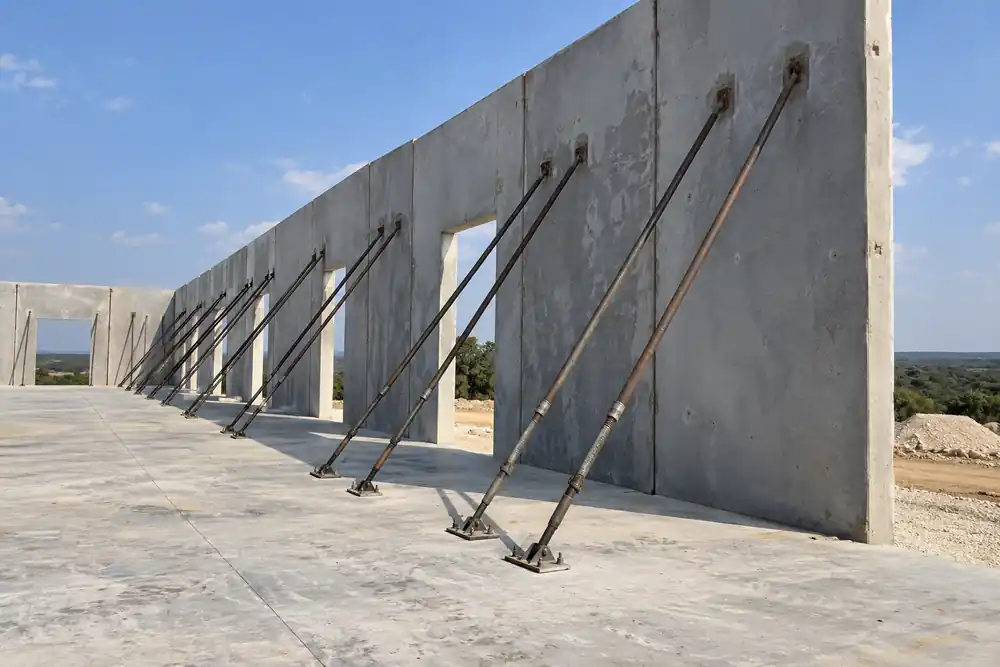
Tilt-Wall Construction in Austin, TX
Heritage Concrete Austin pours the concrete for tilt-wall construction in Austin, Texas: the slab the panels are cast on, the wall panels themselves, and the footings and paving around the finished building. The City issued 74 permits for commercial building shells in 2025, and by the Tilt-Up Concrete Association's count, upward of 10,000 tilt-up buildings rise each year nationwide, together enclosing more than 650 million square feet.
The drawings or a panel layout are enough for a free estimate. From there we'll go over the casting sequence, lift day and the bracing plan.
Call or request a free estimate any time, 24/7
No charge · answered 24/7
Get free estimates
How tilt-wall panels are cast and lifted
Tilt-up was conceived in the early 1900s, and since the mid-1940s it has become a preferred way to build many kinds of buildings, the Tilt-Up Concrete Association says. What sets it apart is where the casting happens: on the job site, with each panel poured lying down on a concrete slab-on-ground.
Forms and bond breaker
Side forms go on the casting slab, then a bond breaker. The bond breaker has to be right, because a clean lift depends on it.
Steel and hardware
Reinforcing steel goes into the forms, together with the embedded hardware for lifting and bracing.
Pour and gain strength
Concrete is placed and left until it reaches the strength needed to lift; only then are the rigging and braces attached.
Lift, brace and plumb
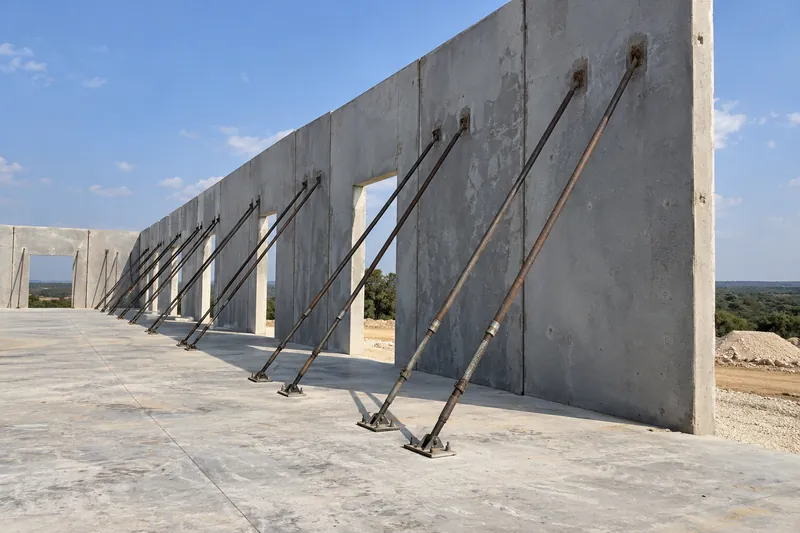
A mobile crane raises the panels in the proper sequence. Each panel is braced and plumbed once it stands.
Call or request a free estimate any time, 24/7.
(512) 588-2862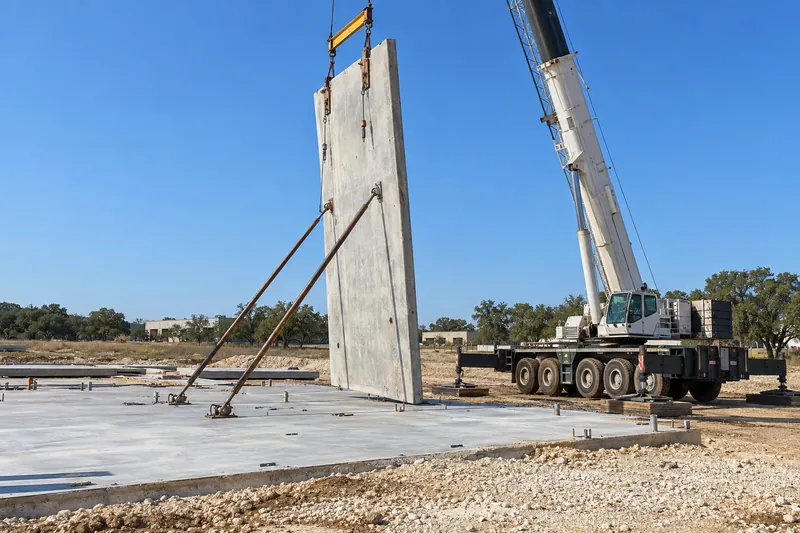
Crane lifts, bracing and Austin weather
Safety on a tilt-up job starts with equipment, in the Tilt-Up Concrete Association's guideline: a crane rated for the heaviest panel with its rigging added, and braces sized from a bracing manual for the wind loads the site can expect. Panels stay on the ground when the wind would make a lift unsafe.
Spring wind and hail
Spring, chiefly March to May, is Austin's severe weather season, and the National Weather Service says large hail and strong winds make up most of it.
Summer heat on panel pours
Camp Mabry sees about 29 days of 100°F or more in an average year (1991–2020 normals). Concrete that cures hot in its first days ends up weaker later on than the same mix cured near 70°F, NRMCA notes, and ACI 301 caps the concrete itself at 95°F at discharge.
Pumping the panels
On a crowded site, a pump keeps concrete moving without tying up the crane. ACI notes that pumping helps where space for equipment is limited and frees cranes and hoists for other work, and a boom truck can often stay in one spot for an entire pour. See concrete pumping.
Call or request a free estimate any time, 24/7.
(512) 588-2862Warehouses, schools and stores built tilt-up
TCA says the method shows up on nearly every kind of building: distribution centers, schools, churches, libraries, retail centers and offices. In a belt of states running from California through Texas to Florida, it is the usual pick for warehouses and big-box stores, as well as schools, low-rise offices, even churches. Demand for store space stays high in Austin: the City put retail occupancy at around 97% at the end of 2025.
The floor inside
Inside the walls, the slab is held to its own flatness, joint and finish specifications; see industrial concrete floors. Paving, curbs and site work around the building fall under Heritage Concrete Austin's wider commercial concrete work.
Pflugerville's industrial zones
Heritage Concrete Austin also handles tilt-wall construction in Pflugerville, where the City's Light Industrial and General Industrial zones allow distribution and logistics centers by right, and its Campus Industrial zone allows them with a specific use permit.
Call or request a free estimate any time, 24/7.
(512) 588-2862Tilt-wall construction questions
What is a tilt-up wall?
A wall of large concrete panels made right on the building site and stood up by crane, as the Tilt-Up Concrete Association defines it. Each panel is formed and poured lying flat on a concrete slab-on-ground, then tilted upright once the concrete is strong enough.
What are the disadvantages of tilt-wall construction?
The method asks for things a site has to provide. The panels need a concrete slab to be cast on, and they can't be lifted until the concrete is strong enough, usually in about 7 days. The crane has to be big enough for the heaviest panel and the rigging on it, each panel must be braced for the proper wind loads once it stands, and lifts stop when wind conditions would make them unsafe.
How much does tilt-wall construction cost?
National figures put tilt-up warehouse construction at $40 to $50 a square foot, not counting the land (2025). For warehouses of every build type, that guide's range is $25 to $65 per square foot, land excluded. No published Austin figure was found, so a real number comes from the drawings, and Heritage Concrete Austin prices the concrete work free.
How is a tilt-wall different from a precast wall?
On paper they belong to the same family: ACI 318 and the International Building Code each count tilt-up as one kind of precast. The difference is where the panel is made. A tilt-up panel is cast at the building site on a slab-on-ground and raised into position there by crane.
How thick are tilt-wall panels?
Most tilt-wall panels are 6 to 8 inches thick. The lifting rigging and the braces go on once the concrete has reached the strength it needs, which usually takes about 7 days.
Get a free estimate for tilt-wall concrete
Call, or send the drawings or a panel layout. Heritage Concrete Austin prices casting slabs, panels, footings and site paving free, and answers day or night.