Commercial Concrete Repair in Austin, TX
Heritage Concrete Austin handles commercial concrete repair in Austin, Texas: spalled slabs over rusting steel, broken parking-lot panels, failed joints, trip edges on walks and damaged curbs at stores, offices, warehouses and apartment properties. Travis County's hazard plan describes the Blackland soils as cracking clays whose high shrink-swell can seriously damage foundations, highways and other structures.
Photos and a rough size are enough to start a free estimate. The first talk covers what failed, whether the steel is involved and how traffic keeps moving while the work goes on.
Call or request a free estimate any time, 24/7
No charge · answered 24/7
Get free estimates
Spalled concrete and corroding steel
By NRMCA's account, steel begins to corrode once the concrete's pH at the bar drops under 9, and chloride attack, from sources such as deicing salt, is the more common trigger, ahead of carbonation. Two inches of cover or more helps keep salt and moisture off the bars. For concrete exposed to moisture and outside chlorides, ACI 318 sets a maximum water-cement ratio of 0.40 and a minimum strength of 5,000 psi.
How ACI's spall repair runs
RAP Bulletin 7, ACI's field guide to patching spalls on flat surfaces, is written for structural slabs, slabs on ground outdoors, balconies and interior floors. Once the hollow areas are found and outlined, the bad concrete comes out with 15- or 30-pound jackhammers; anything heavier than 30 pounds may damage the steel. The cleaned surface then gets either abrasive blasting or a water blast at 3,000 psi or higher. A ready-mix patch cures with wet burlap and a polyethylene sheet over it for no less than 7 days, and a pull-off test then measures how well it has bonded, against ACI's recommended target of more than 150 psi.
Call or request a free estimate any time, 24/7.
(512) 588-2862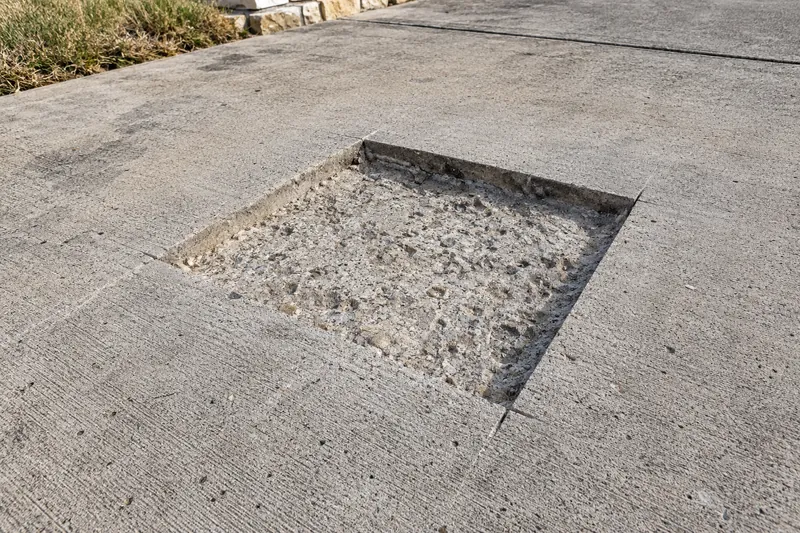
Parking lot, drive lane and slab repairs
The American Concrete Institute's parking-lot guide groups lot upkeep into four kinds of work: resealing joints and cracks, partial-depth repair, full-depth repair, and stabilizing or jacking slabs. The thickness, joint and drainage rules a rebuilt section should meet are the same ones that apply to new concrete parking lots.
Sawing out a full-depth section
Full-depth work starts with a saw. Flat saws with the largest blades reach about 25 inches, though most commercial slab cuts fall in the 6- to 12-inch range; they are the tool for removing pavement, cutting joints, sectioning slabs and opening utility trenches. Openings for doors, windows, elevators and mechanical equipment go to wall saws instead, which reach roughly 36 inches working from one face. Taking out old sidewalk or driveway concrete had a median City of Austin bid of $4 a square foot in 2022–2025, and pulling out old curb $14 a linear foot.
Cracks in commercial slabs
Not every crack is a repair job: most random cracks that appear early are a cosmetic problem and seldom touch the slab's strength or how long it lasts, NRMCA says. Those that need work get epoxy injection, routing and sealing, or a patch, chosen by the crack's width and whether it still moves; the methods are set out under concrete repair.
Call or request a free estimate any time, 24/7.
(512) 588-2862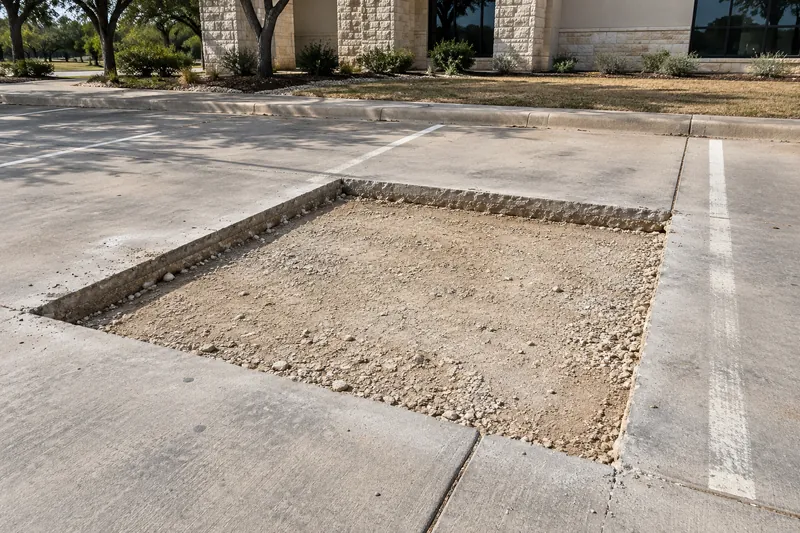
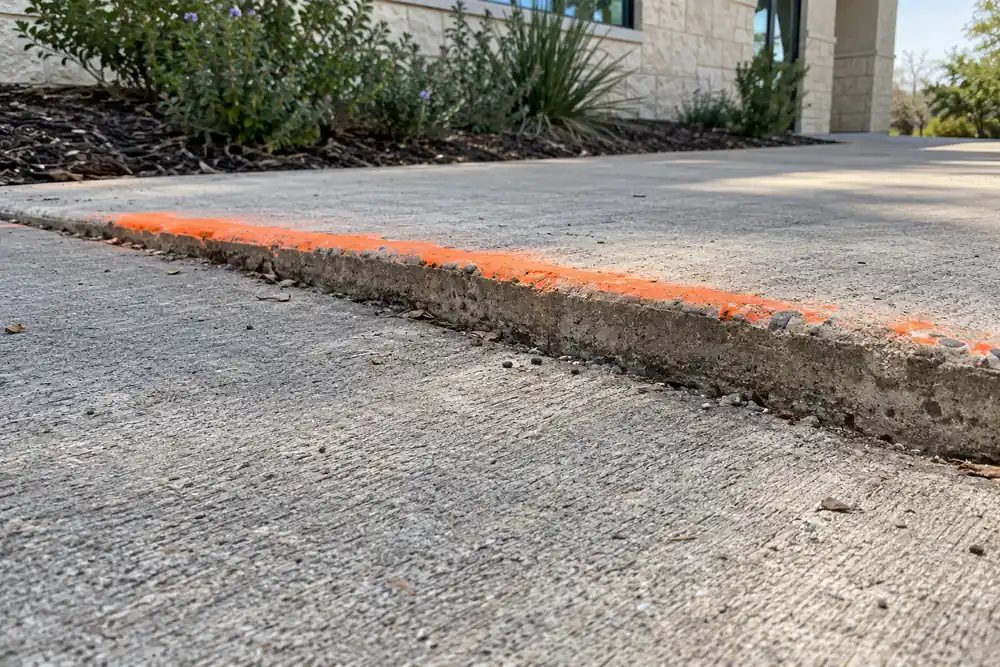
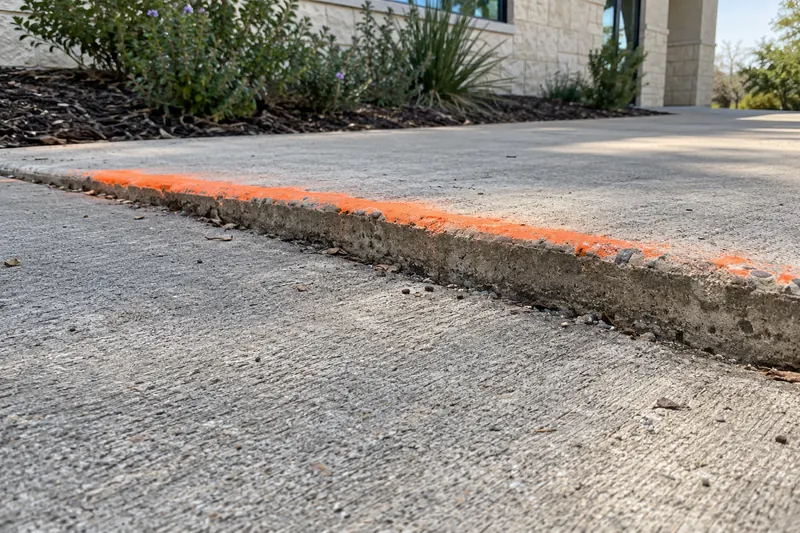
Trip edges and accessible walking surfaces
Those are the 2010 ADA Standards' limits for a change in level on a walking surface, and the combined change on a beveled edge may never exceed ½ inch. They are the yardstick for a sunken slab, a broken joint or a heaved panel on an accessible walking surface.
Grinding, patching or replacing
Grinding a raised edge down is treated as a temporary repair for an immediate safety concern, at $1 to $4 a square foot in national figures (2024). In typical Austin-area figures for 2026, sidewalk grinding runs $5 to $10 a square foot. When the City rebuilds a sidewalk to 4-inch thickness, removal of the old one included, the median bid on its 2022–2025 contracts was $24.50 a square foot.
For new lots, slabs and site paving, Heritage Concrete Austin works as a commercial concrete contractor across Austin as well.
Call or request a free estimate any time, 24/7.
(512) 588-2862Commercial concrete repair questions
How to hire a concrete contractor?
Start with what the job legally needs. Texas has no state license for general or concrete contractors, but in Austin a permit for right-of-way work can only be pulled by a City-licensed right-of-way contractor, and every subcontractor working there has to appear on that permit with a license of its own. Ask more than one contractor for a written bid, be wary of one far below the rest, and favor a contractor with an established physical address, the Texas Attorney General advises. The same office recommends holding back full payment until the work is complete and you have inspected it.
What does commercial concrete repair cost in Austin?
No cost guide prices commercial spall or joint repair on its own. The closest Austin figures are for sidewalks: repairs run $3 to $22 a square foot, and most projects cost $806 to $2,399, averaging $1,602 (2026). For bigger sections, City bids give a median of $24.50 a square foot to rebuild a 4-inch sidewalk with removal, and $4 a square foot just to remove old concrete. Heritage Concrete Austin prices commercial repairs free after a look at the damage.
Who should look at rusted rebar in a damaged slab?
A structural engineer, once corroded bars have lost cross-section, ACI's repair bulletin says. Corroding steel turns into rust that needs two to four times as much room as the original metal, which is what cracks off the cover in the first place. Where damage reaches toward half the slab's thickness, the repair becomes full-depth rather than a surface patch.
Does a sidewalk repair at a business need a City permit?
In the right-of-way, usually yes. Repairing a sidewalk, curb, gutter or approach there calls for a City right-of-way construction permit under the Land Development Code, with two exceptions: a repair the city manager judges minor, and work under an approved site plan. The Driveway/Sidewalk permit is the one the City uses for this work, and a new one costs $345 (fees effective October 1, 2026).
When can a repaired area take traffic again?
Not right away. Under ACI's RAP 7 bulletin, a ready-mix patch stays under wet curing for at least 7 days. For new lot pavement, NRMCA's waits are 3 days for cars and a week for trucks, shorter only if tests show the concrete is already strong enough, typically 3,000 psi.
Get a free estimate for commercial concrete repair
Call, or send photos and a rough size of the damaged area. Heritage Concrete Austin prices spall, panel, joint and trip-edge repairs free, and answers 24/7.