Industrial Concrete in Austin, TX
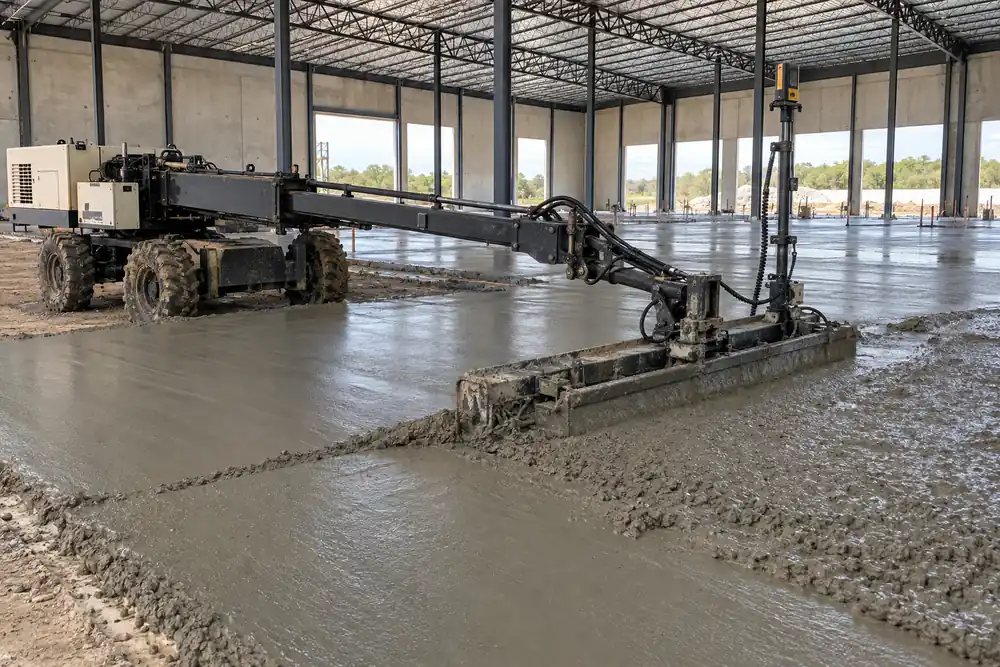
Heritage Concrete Austin pours industrial concrete in Austin, Texas, for warehouse and distribution floors, plant and shop slabs, and the heavy-duty paving around loading areas. The City reports that after a record 6.0 million square feet of industrial space was absorbed in 2024, absorption slowed to 2.3 million square feet in 2025, and new construction fell below 4 million square feet by year-end.
Drawings or a floor specification are enough to start, and the estimate is free. The conversation covers FF/FL targets, joint spacing, the finish and the loads the slab must carry.
Call or request a free estimate any time, 24/7
No charge · answered 24/7
Get free estimates
Warehouse floor flatness and levelness (FF and FL)
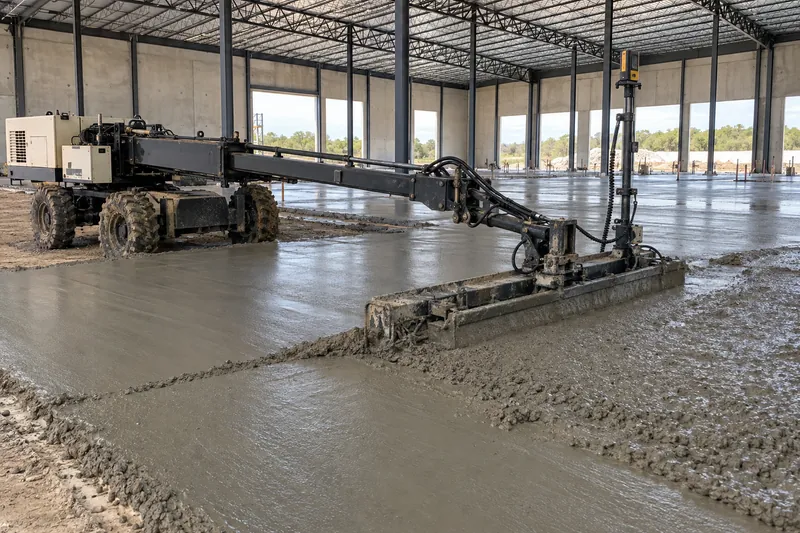
Two numbers define how flat an industrial floor has to be. FF tracks waviness, the small bumps and dips left by strike-off and finishing; FL tracks levelness, which depends on how true the forms were set. FF is measured as curvature across 2-foot spans of floor, FL across 10-foot spans.
Typical numbers by use
Those pairs are the typical values ACI 302.1R gives, as summarized in an American Concrete Institute floor-flatness report. The 35/25 row also covers floors that will receive thin-set flooring.
Racking height and levelness
The same ACI report ties levelness to storage: uneven levels in a warehouse floor can put a ceiling on safe pallet-stacking height. One engineering continuing-education course, based on its author's practice, puts forklift traffic without racks at about 25/17, racks around 20 feet tall at 35/25, and automated racking, or racking of 35 feet and up, at 50/35.
Call or request a free estimate any time, 24/7.
(512) 588-2862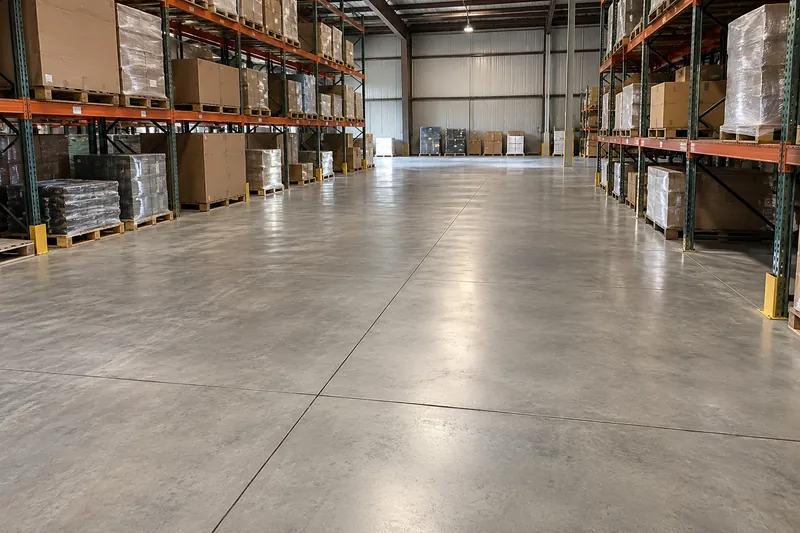
Joints, finish and curing for heavy-use slabs
Joints under forklift traffic
NRMCA wants the joints in heavy-traffic industrial floors filled with a material stiff enough to hold up the joint edges. It advises against keyed joints in these floors; where loads are heavy, it wants metal dowels across the joints. Saw timing counts as well: early-entry dry-cut saws typically go in 1 to 4 hours after the finish, conventional saws within 4 to 12. Edges that ravel under the blade mean it is still too soon, while sawing too late invites random cracks.
Hard-troweled and densified surfaces
Air-entrained concrete should not be specified for a slab that will get a hard-troweled finish, NRMCA says, and a troweled floor should carry no more than 3% air. A floor can then be treated with a silicate densifier, which, densifier makers explain, hardens the surface by turning calcium hydroxide in the concrete into CSH, the calcium silicate hydrate that holds concrete together. A densifier is also one step in the grinding and polishing sequence for polished concrete floors, which national 2026 figures put at $5 to $12 a square foot for a high-traffic commercial or retail floor.
Curing in Austin heat
Curing should begin as soon as finishing is done and typically continue 3 to 7 days; concrete that dries out can lose as much as half of its potential strength, NRMCA warns. Summer makes that harder here. Austin's longest run of 100-degree days lasted 45 days, from July 8 to August 21, 2023, and NRMCA lists the conditions that invite plastic shrinkage cracks: wind faster than 5 mph, low humidity, and high temperatures in the air or the mix.
Call or request a free estimate any time, 24/7.
(512) 588-2862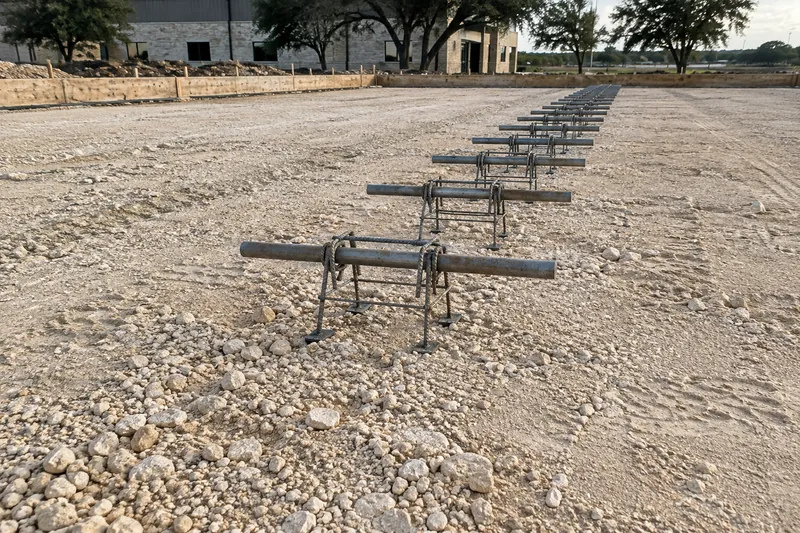
Industrial slabs on Austin clay and limestone
The ground under a plant or warehouse changes across the Balcones Escarpment. On its geologic map of the Austin West quadrangle, the Bureau of Economic Geology rates the limestone units generally stable and resistant but difficult to excavate, while the clay units are weak, unstable, impermeable and corrosive and generally need special engineering designs. Ferris clay, with a plasticity index of 45 to 46, lands in the very high band of the City's swell categories.
The base under the slab should be a granular material that compacts well, with 10 to 30% fines and free of clay, silt and organic matter, per ACI 302, and subbase plus base should add up to 4 inches or more.
Floors in tilt-wall buildings
In a tilt-up building the walls start on concrete too: the Tilt-Up Concrete Association describes wall panels poured on a slab-on-ground and lifted into place once they gain enough strength. See tilt-wall construction. Heritage Concrete Austin pours industrial floors as part of its commercial concrete work, alongside parking lots, site paving and building slabs.
Call or request a free estimate any time, 24/7.
(512) 588-2862Industrial concrete questions
How much does an industrial concrete floor cost in Austin?
No published guide gives an Austin price per square foot for a new industrial slab, so a real figure comes from the drawings and the specification. Two inputs are known: Austin concrete delivery pros charge $110 to $150 a cubic yard for standard material and transport (2026), and nationally a whole warehouse building runs $25 to $65 a square foot before land, or $250,000 to $650,000 for 10,000 square feet (2025). Heritage Concrete Austin prices industrial slabs free from plans.
Does an industrial slab need a vapor retarder under it?
Indoors, yes in NRMCA's view: it recommends a retarder of at least 10 mils beneath interior slabs and considers one sensible under every floor slab inside a building. Outdoor slabs on grade, such as loading aprons and yard paving, generally go without.
Why does the top layer of a troweled floor peel off?
That is delamination, where the top ⅛ to ¼ inch of the slab separates and breaks away. Air-entrained concrete under a hard-troweled finish raises the risk, which is why NRMCA keeps troweled floors to 3% air at most. Small areas are patched; when it is widespread, the floor is ground and a new surface laid over it.
What if a new floor misses its flatness numbers?
Measure it fast. The test belongs within 72 hours after finishing, since curing can curl the slab, and the local minimums are usually set at 60% of the overall FF/FL. If a floor falls short, the fixes run from grinding or planing to surface repair, retopping, or tearing out and replacing it.
How flat is a superflat floor?
Very flat by comparison. A driveway might measure an FF of about 10, while a superflat floor can reach as high as 125. In the ACI 302.1R table, film and TV studios sit above 50/50, the strictest typical use listed.
Get a free estimate for an industrial floor
Call, or send drawings or the FF/FL specification. Heritage Concrete Austin prices warehouse floors, plant slabs and loading-area paving free, and picks up day or night.