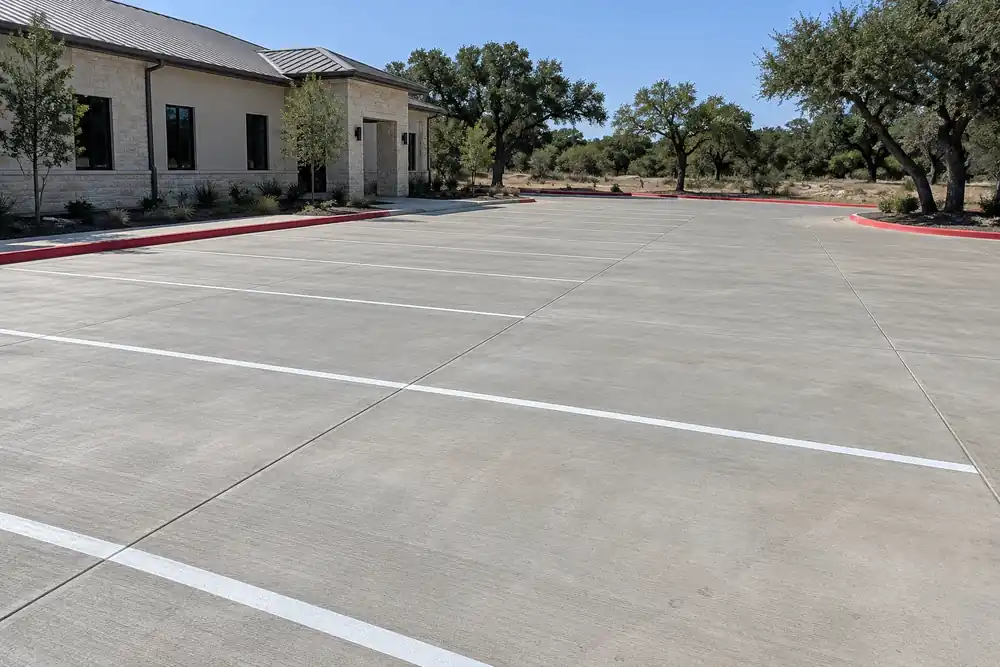
Concrete Parking Lots in Austin, TX
Heritage Concrete Austin paves concrete parking lots in Austin, Texas, for retail centers, offices, public buildings and apartment communities, from a new lot on open ground to an added row of stalls or a rebuilt drive lane. Austin's code counts every parking area as impervious cover, so the size of the lot, its slope and where its water goes belong in the plan from the start.
A site plan, a stall count or a rough sketch is enough to price the job, and the estimate is free. Expect to cover thickness for the traffic the lot will carry, the joint layout, drainage and how many accessible spaces the lot needs.
Call or request a free estimate any time, 24/7
No charge · answered 24/7
Get free estimates
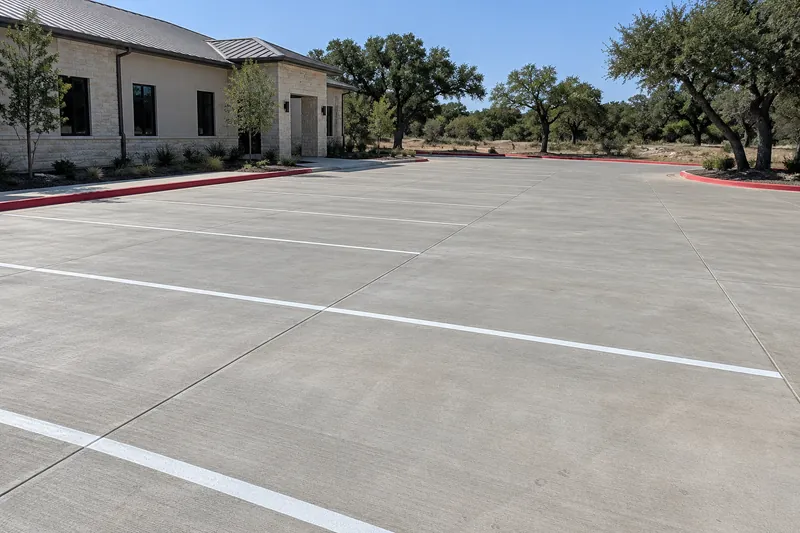
Thickness and mix for a concrete parking lot
The traffic decides the section. For a lot that only sees cars and pickups, NRMCA's parking-area guide rates 4 inches of plain concrete, with no reinforcement, as usually satisfactory, and it allows that stalls and drives used by light trucks may need 5 or 6. ACI's lot guide sorts traffic into categories; in its thickness table, car parking and access lanes (category A) take 4.0 inches, while entrance lanes for multiple-unit trucks (category D) take 8.0.
Strength, slump and finish
ACI 330.1, ACI's specification for lots built without reinforcement, requires 4,000 psi at 28 days. For placing, NRMCA suggests a slump of 3 to 5 inches and a bull-float pass followed by light brooming, which leaves a surface that wears well and resists skids. To cure it, NRMCA names a liquid membrane-forming compound as the most economical method in most cases.
Thickened edges and curbs
Outer slabs that carry wheel loads should get a thicker edge, and NRMCA notes that this edge usually takes the shape of an integral curb poured with the pavement. Where the lot meets a public street, the curb, gutter and drive approach are right-of-way work under a City permit; see concrete curb and gutter.
Call or request a free estimate any time, 24/7.
(512) 588-2862
Joints, drainage and the ground under the lot
Joint layout
NRMCA's parking guide keeps contraction joints within 24 to 30 pavement thicknesses of one another and never more than 15 feet apart, and an NRMCA parking-lot FAQ adds that ACI documents hold that 15-foot ceiling whatever the thickness. Each sawn joint should reach at least a quarter of the slab's depth. Full-depth isolation joints are for separating fixed objects only: ACI 330R-08 advises against regularly spaced expansion joints across a lot, and it calls round dowels impractical or even counterproductive in pavement 7 inches thick or less.
Slope and runoff
NRMCA sets the fall toward drainage points at 1%, which is ⅛ inch for every foot. Runoff has a cost in Austin too: the monthly drainage charge on each property's utility bill is worked out from its impervious square feet, a base rate ($0.00593 per square foot in fiscal year 2026) and an adjustment factor. In the watersheds draining to Barton Springs, impervious cover is held to 15% to 25% of a site under the Save Our Springs ordinance, depending on the zone.
Clay, limestone and lime
The City's Transportation Criteria Manual ranks subgrade swell by plasticity index, from low (under 20) to very high (45 or more); Houston Black, the deep prairie clay east of the escarpment, has an index of 44, near the top of the high band. For swelling ground, the manual's treatment list runs from lime and lime-cement to moisture conditioning, soil blending, replacement and geogrids. Cement alone is not normally recommended, and chemical injection has had "very mixed and sometimes poor results" in Central Texas clays. West of the escarpment the trouble is rock: USDA rates Eckrant and Speck soils "Very limited" for shallow excavations because hard bedrock lies so close to the surface.
Heritage Concrete Austin also paves concrete parking lots in Sunset Valley, where four shopping centers hold more than one hundred stores and restaurants and every property is limited to 18% impervious cover or less.
Call or request a free estimate any time, 24/7.
(512) 588-2862Accessible parking spaces and aisles
The 2010 ADA Standards tie the count of accessible spaces to the size of the lot: one for 1 to 25 spaces, two for 26 to 50, three for 51 to 75 and four for 76 to 100. Of the accessible spaces, at least one in every six, or fraction of six, has to be a van space.
A car space is 96 inches wide at minimum and a van space 132 inches, and each is served by an access aisle at least 60 inches wide. The aisle must sit at the same level as the spaces beside it, with no change in level allowed and no slope steeper than 1:48. Ordinary stalls, by national figures, run 8'6" to 8'9" wide.
Call or request a free estimate any time, 24/7.
(512) 588-2862Upkeep for a concrete lot
The American Concrete Institute's lot guide expects concrete parking lots to give 20 years of service or more. When a panel breaks, a joint opens or a slab settles, Heritage Concrete Austin handles commercial concrete repair on existing lots and drive lanes. New lots are one part of its wider commercial concrete work, along with building slabs, tilt-wall panels and site paving.
Call or request a free estimate any time, 24/7.
(512) 588-2862Concrete parking lot cost in Austin
No consumer cost guide publishes an Austin price for concrete parking lots, so the nearest local figures are the City's own bids. Across the City of Austin's 2022–2025 public-works bids, the middle half for concrete street pavement ran $120 to $246 a square yard, and 4-inch concrete medians and islands had a median of $18 a square foot. Nationally, a concrete lot runs $5 to $10 a square foot in 2026 figures.
None of these is a quote from Heritage Concrete Austin. The real price depends on thickness, traffic, access, grading and the number of stalls, and estimates cost nothing.
- Concrete lot, national (2026)
- $5–$10 / sq ft
- Per stall, national (2026)
- $1,500–$3,500
- City bids: street pavement, middle half
- $120–$246 / sq yd
- City bids: 4-in. medians and islands
- $18 / sq ft
- City bids: valley gutter
- $21 / sq ft
National averages, 2026; City of Austin median and middle-half bids, 2022–2025. Not a quote.
Call or request a free estimate any time, 24/7.
(512) 588-2862Concrete parking lot questions
What are the concrete pieces in a parking lot called?
Most are kinds of curb. The raised border along the outside of a lot is often an integral curb, formed from the pavement's thickened edge. The raised strips and planters between rows are islands and medians, the shallow paved channels at low points are valley gutters, and the sloped cuts that let wheelchairs and carts cross a curb are curb ramps. The City of Austin prices curb and gutter, islands, valley gutters and curb ramps as separate bid items on its public-works contracts.
Is a gravel base needed under a concrete parking lot?
Not for strength in most lots. NRMCA says no special subbase is required, provided the ground beneath has the same soil type, moisture and density from one end to the other. ACI 330R-08 adds that a lot seeing under 200 heavily loaded trucks daily isn't at risk from pumping, so it doesn't need a subbase for that reason. On swelling clay, the City's pavement manual points to treating the subgrade instead, with lime or lime-cement among its options.
Does a concrete parking lot need rebar?
Often not. NRMCA's guide finds 4 inches of concrete without steel usually satisfactory for car and pickup parking. Welded wire mesh doesn't make the pavement any stronger structurally; it only keeps cracks tight, and only when it sits where it should. At joints, ACI 330R-08 finds round dowels impractical in pavement 7 inches thick or less.
When can cars park on new concrete?
NRMCA's rule for parking areas is 3 days for cars and 7 days for trucks, unless strength tests prove the concrete got there sooner; the usual mark is 3,000 psi. Acceptance of the concrete itself rests on cylinders broken at 28 days, and 7-day breaks only give an early indication.
What does a concrete parking stall cost?
National 2026 figures put a concrete lot at $1,500 to $3,500 per stall. A second national guide prices concrete paving at $4 to $7 a square foot. Either way, the stall count drives the area, since a typical lot sets aside 300 to 350 square feet for each car.
Get a free estimate for your parking lot
Call, or send the site plan, stall count or a sketch. Heritage Concrete Austin prices new lots, added stalls and rebuilt drive lanes at no charge, and answers 24/7.