Austin Driveway Approach and Sidewalk Permits
Heritage Concrete Austin explains when Austin, Texas requires a driveway permit: concrete on your own lot needs none, but approach or sidewalk work in the public right-of-way, whether new, moved, repaired or torn out, goes through the City's Driveway/Sidewalk permit.
The City issued 1,310 of those permits in 2024 and 1,173 in 2025. The fees quoted here are the schedule that started on October 1, 2026; the City's right-of-way fees are subject to change every October 1, so check current figures and rules with Austin Transportation and Public Works before the pour.
Call or request a free estimate any time, 24/7
Where your lot ends and the right-of-way begins
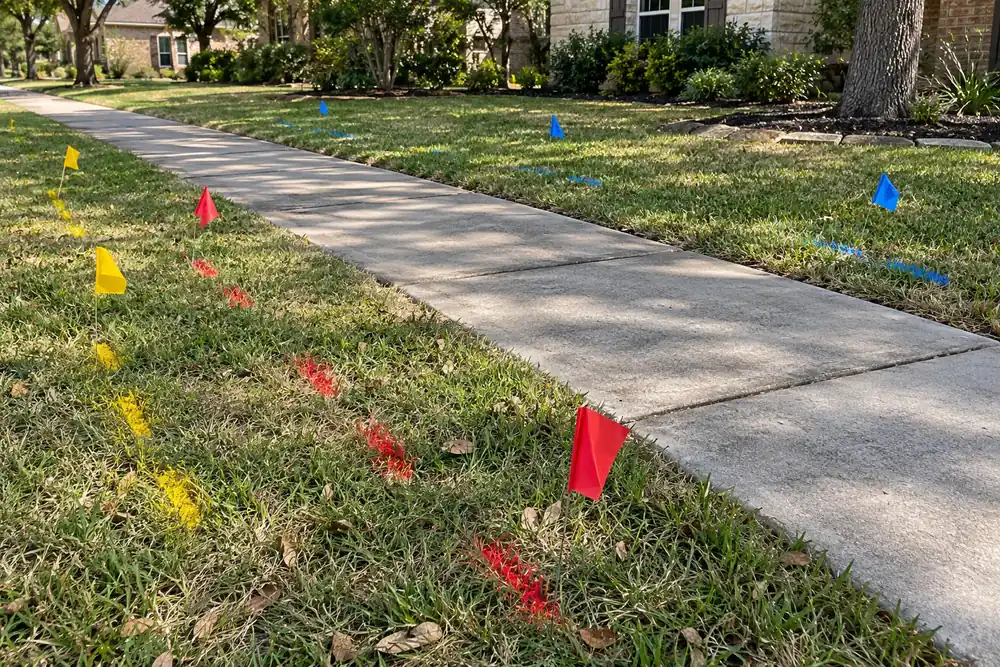
The right-of-way is the strip of public land along the street. The City says it usually runs about ten feet in from the edge of the street, but the distance varies widely across Austin, so the line on your own lot is worth finding before a drive or walk is planned.
Behind that line, a driveway, walkway or other concrete flatwork is exempt from a building permit and from the Driveway/Sidewalk permit; the building codes and City ordinances apply to it all the same. Any work in the right-of-way, or work that uses part of it, needs a right-of-way permit, and closing a sidewalk or drive to work on private property calls for a separate Temporary Use of Right of Way permit.
Not sure where your property line falls? Call any hour; the estimate is free.
(512) 588-2862
How a Driveway/Sidewalk permit works
Check that the work needs one
The permit covers installing, changing, repairing or removing sidewalks, driveway approaches, walkways, curbs and gutters in the right-of-way. The City answers eligibility questions at RightOfWay@austintexas.gov.
Use a licensed right-of-way contractor
Applications come only from contractors licensed for right-of-way construction. To hold that license, a contractor keeps four papers on file with the City: the $10,000 bond, proof of insurance, a resolution of authority and the form naming its authorized agents. Subcontractors who affect the right-of-way have to appear on the permit and carry their own license.
File the application
A project with a building permit gets its Driveway/Sidewalk permit automatically, under the same number; anything else is filed as a stand-alone permit through Austin Build + Connect. New residential work needs stamped, approved plans from Residential Review, while repairs and replacements need nothing more. Each lot, and each driveway, gets its own permit; a semi-circular drive counts as one.
Transportation and drainage reviews
The City reviews any approach being added, moved, taken out or fixed, even one that meets an unpaved street, a street with no curb and gutter, or an alley. A storm inlet sitting 10 feet or less from the curb cut brings a grading and drainage review as well, and a design off the City standard is worked out with the Land Development Engineering division, sometimes through a waiver or variance.
Phase 1 inspection, before the pour
Before any concrete is placed, the inspector looks over the subgrade, the forms and the reinforcing steel, along with drainage and the line and grade.
Phase 2, the final inspection
The last check covers the finished work, cleanup included.
Damage to utility equipment, a storm drainage facility or a tree in a pedestrian way, done without the owner's consent, suspends the permit automatically until the harm is paid for or the problem removed. Sidewalk jobs run through the same permit; the City's sidewalk standard is on our page about concrete sidewalks and walkways.
Call or request a free estimate any time, 24/7.
(512) 588-2862Driveway and sidewalk permit fees in Austin
The table shows the City's right-of-way fees effective October 1, 2026. Application fees are non-refundable, the right-of-way contractor's license itself costs $345, and commercial permits carry a further $6.05 per structure for every day of right-of-way use.
The $10,000 license bond does more than sit on file. The City's bond form commits the contractor to repair any damage or defect in the right-of-way caused by faulty materials or workmanship, and to warrant that work for one year after it's finished.
- New Driveway/Sidewalk permit
- $345
- Extension or revision
- $305
- Each additional residential driveway permit
- $265
- Residential approach inspection (Type I or III)
- $525.01
- Each additional driveway inspected
- $88.43
- Sidewalk or curb and gutter inspection
- $336.65 + $1.77 / ft
- Re-inspection
- $188.80 drive, $189.34 walk
City fee schedule in effect from October 1, 2026; the City can change it each October.
Call or request a free estimate any time, 24/7.
(512) 588-2862What the City looks for in a new approach
Approval is the default. The City grants an approach permit unless it concludes the drive would hurt vehicle or pedestrian traffic and public safety, judging things like how far drivers can see, how close other driveways are and the street's role. Spacing is one of the measurable tests: a residential driveway keeps 50 feet from the next one on a Level 1 street and 75 feet on a Level 2 street, counted from the inside edge of each drive or from the edge of the cross street's travel lanes.
What the permit brings with it
A new approach comes with clean-up duties. An unneeded curb opening or old approach on the same property has to come out, new curb, gutter or sidewalk must line up with what's already there, and any curb, gutter or sidewalk the City requires is built in the same job. On a street that has no curb and gutter yet, a temporary Type III approach can do for now; the permanent version falls due 60 days after the street is completed with its curb and gutter.
Design details, from the 10-to-20-foot width to the 5-inch minimum of Class A concrete, are on our page about concrete driveway approaches.
Call or request a free estimate any time, 24/7.
(512) 588-2862Trees and buried lines near permit work
Some City reviews apply even when no permit does. A tree measuring 19 inches or more across, measured 4½ feet above natural grade, is regulated, and digging within its critical root zone first needs a Tree Ordinance Review Application. Before site work begins, chain-link tree fencing at least 5 feet high goes up on steel T-posts set no more than 10 feet apart.
Buried lines have their own rule. Under Texas law, anyone using powered equipment to dig 16 inches or more must notify the one-call center through 811, at least 48 hours ahead and no more than 14 days before digging, weekends and legal holidays excluded.
Driveway permits outside Austin's city limits
Beyond the city limits, the road a driveway meets decides who issues the permit: the county for a county-maintained road, TxDOT for a state highway.
Travis County
A driveway onto a maintained Travis County road needs a County Driveway Permit, applied for online; the County issues none for driveways onto unmaintained or unaccepted roads. Approaches must be concrete or asphalt, never pavers or stone, at no more than a 15% grade and 2% where a sidewalk crosses, with at most two per street and 35 feet between them on curb-and-gutter streets. Along rural roads the County fits the approach to the roadside ditch, and wherever the ditch runs deeper than 12 inches it wants a culvert of corrugated metal pipe, 18 inches across or more, finished with concrete safety end treatments. Inspections come at framing, pre-pour and final. The County's permit desk at 700 Lavaca takes calls at (512) 854-4215, Monday to Thursday, 9 a.m. to 2 p.m.
Williamson County
Williamson County's Driveway Policy, effective December 7, 2021, requires a permit to build or change a driveway onto a county road. For a home, the County visits the site and sizes any culvert, which the owner buys and installs: at least 18 inches across inside and 24 feet long, with a concrete safety end treatment. Residential drives may be up to 24 feet wide, and the County inspects once forms are set, before the concrete is placed.
Hays County
Under its January 2026 fee schedule, Hays County charges $200 for a residential driveway permit and $300 for a commercial one, each including a $50 non-refundable review fee. Applications are taken online only, and a property that isn't platted and compliant can't get one.
Call or request a free estimate any time, 24/7.
(512) 588-2862Driveway permit questions
Do you need a permit to build a driveway in Texas?
That depends on who owns the road the driveway meets. In Austin, the part on your lot needs none, but the approach at the street does need the City's Driveway/Sidewalk permit. Travis and Williamson counties permit driveways onto county roads, Hays County charges $200 for a residential one, and a drive onto a state highway needs a TxDOT permit.
What happens if I build a driveway without a permit?
The counties spell it out. Hays County fines $50 for building a driveway without a permit. In Travis County, skipping the pre-pour inspection or straying from the approved plan can bring a notice to remove and replace the approach, and Williamson County counts a driveway as permitted only once it has passed inspection. On a state highway, no driveway work may begin until TxDOT's permit is fully executed and TxDOT has 24 hours' notice.
What is a TxDOT driveway permit?
It's the state's permission to build or change a driveway onto a state highway. The owner, or an authorized representative, contacts the local TxDOT district office and submits Form 1058, the Permit to Construct Access Driveway Facilities on Highway Right of Way, and a TxDOT inspector reviews the finished drive. A private home's driveway there may be no wider than 24 feet, needs at least a 15-foot radius where it meets the pavement and an angle of 75 to 90 degrees, and may not block drainage in the highway ditch.
Does replacing a cracked driveway approach need a permit?
In Austin, yes. Repairing or replacing an approach in the right-of-way falls under the Driveway/Sidewalk permit and its transportation review, though a repair needs no plans, only the permit. The residential approach inspection costs $525.01 and a driveway re-inspection $188.80 (fees effective October 1, 2026). The Land Development Code does leave room for a minor repair to go without a permit, if the city manager decides it qualifies.
Get a free estimate on approach and sidewalk work
Call or send the form any hour. Estimates are free, and we'll go over which permits your job needs and what the City inspects before and after the pour.