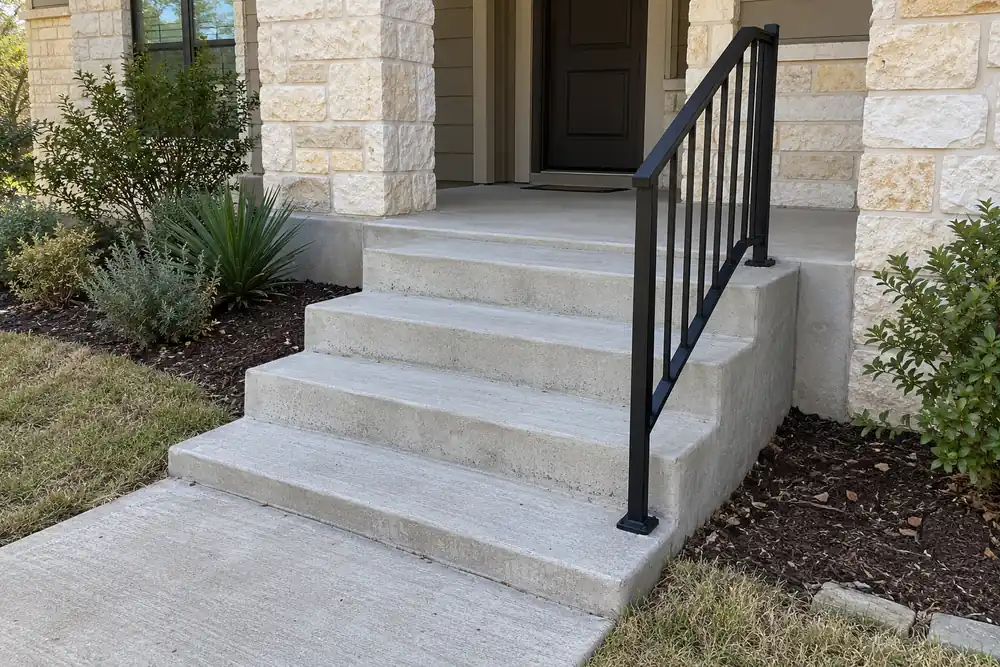
Concrete Steps and Porches in Austin, TX
Heritage Concrete Austin forms and pours concrete steps and porches in Austin, Texas, from a short rise at the front door to stairs that climb a sloped yard between terraces. Austin homeowners typically pay $145 to $875 per concrete step (2026), and expansive clay and the sloped lots of West Austin and the Hill Country are among the reasons prices run higher.
For a free estimate, phone or use the form. We'll measure the rise from the ground to the door, count the steps and landings it needs, and check whether railings or guards come into play.
Call or request a free estimate any time, 24/7
No charge · answered 24/7
Get free estimates
Concrete step sizes: treads, landings and railings
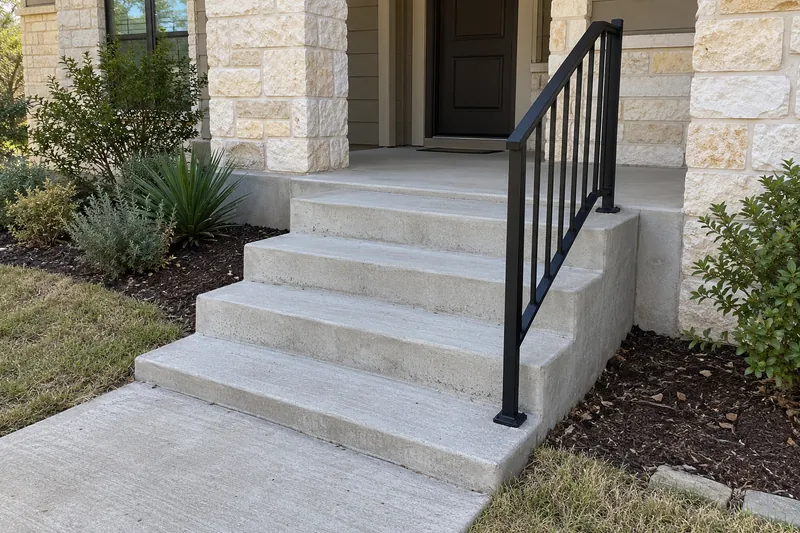
Most home steps join a door landing to a concrete patio or to a front walk; for the walk itself, see concrete sidewalks and walkways. The size rules below come from the 2015 edition of the International Residential Code. Austin now builds to the 2024 edition with local amendments (effective July 10, 2025), so confirm the current figures with the City before you build.
Treads and width
Treads must be at least 10 inches deep, with no more than ⅜ inch of difference between the deepest and shallowest in a flight. Stairways need a clear width of 36 inches or more, and the walking surface of treads and landings can't slope more than 2 percent. HUD's home-safety design guide sets a tighter target, keeping riser and tread differences across a flight below 3/16 inch, while research at Cornell University links the most tripping accidents to treads narrower than 9 inches.
Landings at the door
Outside every exterior door there must be a landing no narrower than the door and no less than 36 inches deep, measured in the direction of travel, with a slope of 2 percent or less. At the required exit door, that landing can drop as much as 7¾ inches below the threshold, provided the door doesn't swing out over it.
Handrails and guards
A handrail is required on one side or more of any flight that has four risers or more, set between 34 and 38 inches above the nosings. Open sides of porches, stairs and landings standing over 30 inches above the grade below need guards, 36 inches tall at minimum.
Steps at shops and offices
Stairs in public and commercial buildings follow the 2010 ADA Standards instead: uniform risers between 4 and 7 inches high and treads at least 11 inches deep. Heritage Concrete Austin goes over the code figures for your steps at the estimate.
Call or request a free estimate any time, 24/7.
(512) 588-2862How concrete steps are formed and poured
Measure the flight
The rise from grade to the landing is measured and divided into even steps. HUD's target is less than 3/16 inch of variation across a flight.
Separate the steps from fixed points
NRMCA calls for isolation joints that separate driveways and patios from sidewalks, stairs and other points of restraint, and slabs from walls and footings, so each part can move independently.
Mix for strong edges
Weak concrete or a poor cure leaves step edges prone to chipping and spalling, so exterior steps want a low water-cement ratio in the mix and enough entrained air. The 2015 code sets 2,500 psi at 28 days as the floor for weather-exposed steps in negligible-weathering areas, the class Austin's design table assigns the city.
Finish for grip
For a non-slip surface, NRMCA recommends brooming exterior walks, patios and drives, and anti-slip grit can be added to the protective sealer coat on steps.
Cure
Curing begins as soon as finishing ends and usually lasts 3 to 7 days. NRMCA warns that concrete allowed to dry out may lose up to half of its potential strength compared with moist-cured concrete.
Call or request a free estimate any time, 24/7.
(512) 588-2862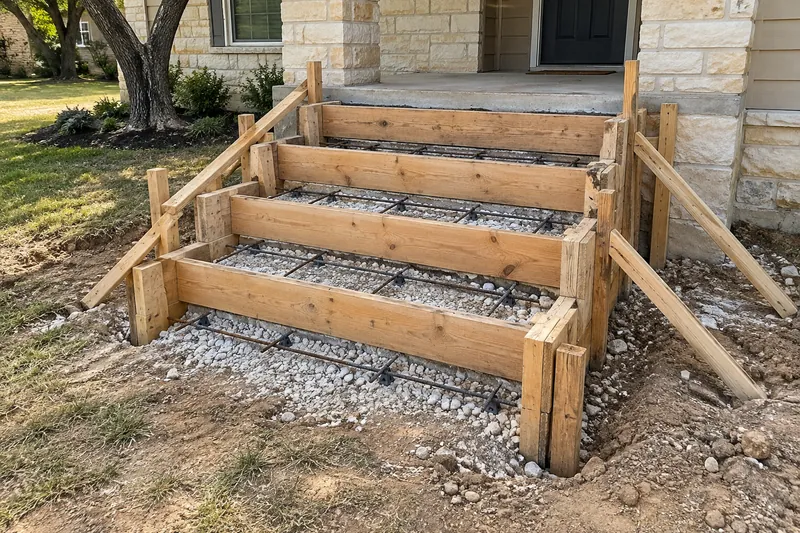
Steps and porches on Austin's sloped lots
Walls, cuts and fills
On a hillside, steps usually travel with terraces and walls. Under Austin's code, most cuts and fills can go no deeper than 4 feet, and walls up to 4 feet, measured footing bottom to wall top, are exempt from a building permit when they carry no surcharge and stay out of flood hazard areas. Wall design is covered under concrete retaining walls.
Porches
A concrete porch is a raised slab with its own steps, built to the same weather-exposure strength table. Inside the area covered by Austin's "McMansion" rules, porches and carports don't count toward a home's floor-area limit because they aren't enclosed, while garages do.
Lake Travis hillsides
Heritage Concrete Austin also builds concrete steps in Hudson Bend, where about 40% of the community's area is Lake Travis water and Travis County treats work on slopes steeper than 10% as a critical site improvement needing stronger erosion controls, and concrete steps and stairs in Volente, where the village's building permit covers patios, decks and driveways and its 2011 guide for builders bars construction on natural grades steeper than 25 percent.
Call or request a free estimate any time, 24/7.
(512) 588-2862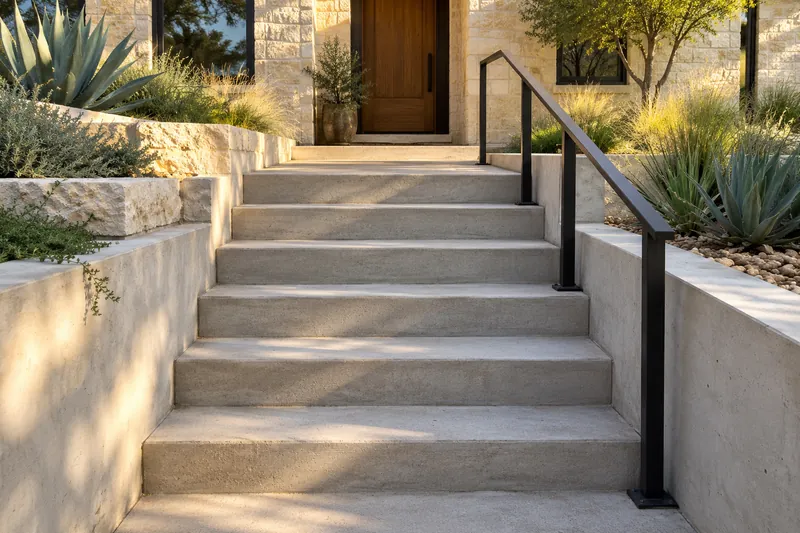
Concrete steps cost in Austin
A new set of steps averages around $3,434 in Austin-area figures for 2026, and most homeowners spend $589 to $4,905. Taking out old stairs adds $195 to $390, labor runs $50 to $150 an hour, and installation usually takes five to 15 hours, not counting curing. Where a permit is required, Austin-area permits typically cost $240 to $515. On City of Austin public-works bids (2022–2025), the City's step item had a median price of $60 per linear foot.
Published averages only, not Heritage Concrete Austin prices; your estimate costs nothing.
- 3 ft wide
- $150–$440 per step
- 4 ft wide
- $195–$590 per step
- 5 ft wide
- $245–$735 per step
- 6 ft wide
- $295–$880 per step
- Railings
- $295–$590
Austin-area figures for 2026; averages only, not a quote.
Call or request a free estimate any time, 24/7.
(512) 588-2862Questions about steps and porches
What is the average cost to install concrete steps?
Around Austin, about $3,434 for a typical project in 2026, with most falling between $589 and $4,905. National figures for 2026 put poured steps at $200 to $500 per step, or $1,000 to $5,000 for 5 to 10 steps, with a landing where one is needed. Width, railings, a sealer and any texture or decorative coating add to the total.
Can you buy concrete steps already made?
They can be bought precast. National 2026 figures put precast steps at $100 to $350 apiece, or $500 to $3,500 for an installed set, while steps poured on site run $200 to $500 each.
What are the common problems with concrete steps?
Chipped and spalled edges, usually from weak concrete or poor curing; risers and treads that vary in height or depth, which trips people; and cracks, where national repair guidance treats any crack wider than ¼ inch as a sign of a possible structural problem. Patching cracks or small sections of a step typically costs $300 to $800 nationally (2026).
Can old steps be resurfaced instead of replaced?
Often, if they are sound. National figures put resurfacing a set of steps at $150 to $500 depending on the damage, while removing existing steps before new ones are poured adds $250 to $500 on its own (2026).
How long do poured steps last?
Thirty to 40 years with proper care and upkeep, by national estimates (2026).
Get a free estimate for concrete steps
Call or send the form with roughly how many steps you need and where they go. Heritage Concrete Austin prices new steps, porches and replacements free of charge, 24/7.