Concrete Driveway Approaches and Aprons in Austin, TX
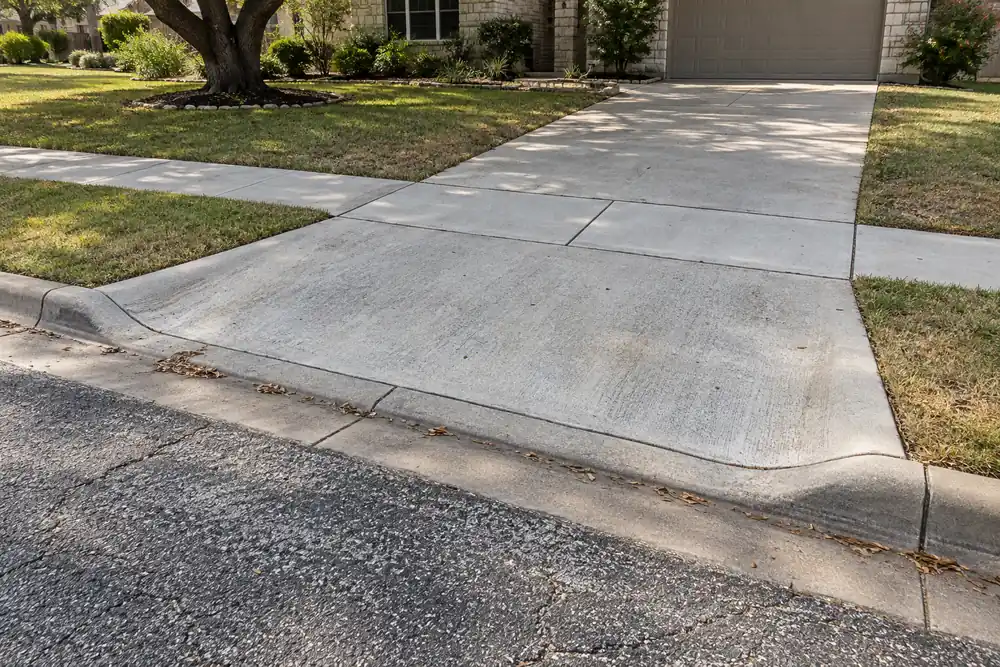
Heritage Concrete Austin constructs concrete driveway approaches and aprons in Austin, Texas, the stretch of drive between the street and the right-of-way line that the City permits, inspects and sets standards for. On City public-works contracts bid from 2022 to 2025, the flared Type I driveway drew a median bid of $25 per square foot.
Ring us or use the form for a free estimate. We'll measure your frontage, note where the curb, gutter, sidewalk and any storm inlet sit, and go over which City permit and inspections apply.
Call or request a free estimate any time, 24/7
No charge · answered 24/7
Get free estimates
What counts as a driveway approach in Austin
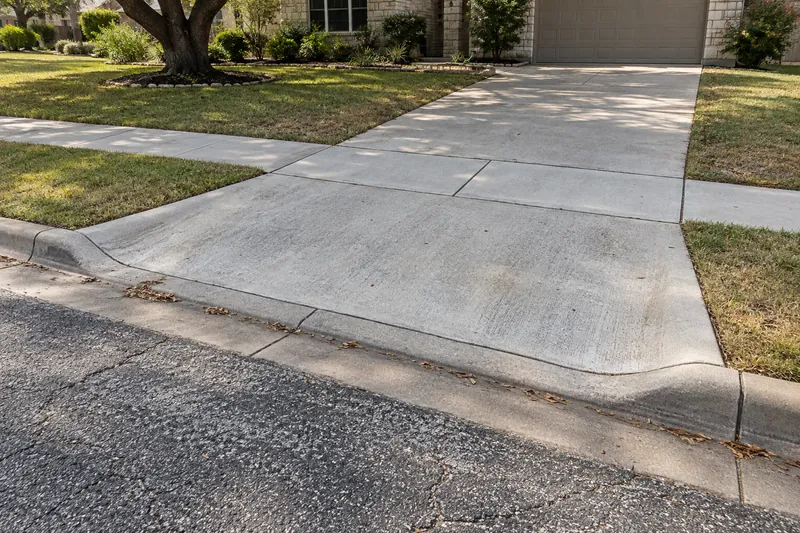
Austin's code names two kinds of concrete approach: a type 1 serves a one- or two-family home, and a type 2 serves every other use. Under the Transportation Criteria Manual, a minor driveway, serving a single-family home, a duplex or up to four multifamily units, is built to the Type I standard, and it can't connect to the City's bigger Level 3 and Level 4 streets.
Where the right-of-way ends
The City says its right-of-way typically reaches ten feet back from the edge of the street, though that varies widely. Past that line the drive is on your lot, where flatwork needs no building permit; for the slab itself, see concrete driveway installation.
Where the approach crosses the sidewalk
The sidewalk has to connect to the driveway wherever it sits, and the crossing keeps the sidewalk's own elevation, a raised crossing, with no more than 2% slope across it. The City's sidewalk specification calls for extra reinforcing in the walk where a driveway crosses it, and ¾-inch expansion joint material wherever new work meets an existing sidewalk or driveway. More on concrete sidewalks and walkways.
Call or request a free estimate any time, 24/7.
(512) 588-2862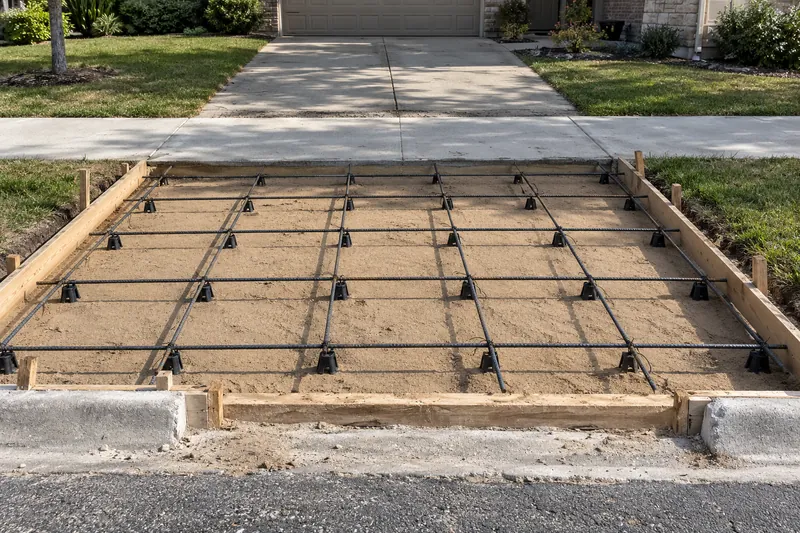
The City's Type I approach standard
Concrete, steel and cushion
Standard Detail 433S-1, adopted in April 2025, calls for Class A concrete no thinner than 5 inches, reinforced with #3 bars 18 inches on center or 6x6 W1.5xW1.5 welded wire, over 2 inches of sand bedding. The steel rides at mid-depth on supports and may never lie on the subgrade or the sand. Class A is the City's mix for drives, walks, curbs and gutters: 5.0 sacks of cement or more in each cubic yard, a 28-day strength of 3,000 psi, entrained air and a water-to-cement ratio capped at 0.6, placed at a slump of 2 to 4 inches with the mix no hotter than 90°F (or 100°F if a high-range water reducer is used).
Width, slope and height
Single-family approaches run between 10 and 20 feet in width, with curb radii of 5 to 10 feet. Each one slopes toward the street from the right-of-way line at no more than 10%, sits at least 6 inches above the street gutter at that line, meets the street at 90 degrees and stays inside the property's own frontage unless the neighbor agrees in writing.
Joints and a single pour
The whole approach goes in as one monolithic pour, with a center contraction joint ¾ inch deep and ¼ inch wide, and an expansion joint where the approach reaches the right-of-way line. The City's driveway specification puts weakened-plane joints on 10-foot centers over a compacted cushion of at least 2 inches, wetted, tamped and leveled.
What may not sit in an approach
Water meter boxes and wastewater cleanouts may not sit in a driveway, and no driveway may be built inside the curb return of an intersection. Keep 10 feet between a curb inlet and the driveway, and an inlet within 10 feet of the curb cut adds a grading and drainage review. Heritage Concrete Austin goes over the detail with you at the estimate.
- Expansion joint at the right-of-way line; ¾ in. joint material where new work meets old (City specification)
- Falls toward the street at 10% max; 2% max where the sidewalk crosses (Detail 433S-1)
- Class A: 5.0 sacks of cement a cubic yard, water-cement ratio 0.6 max, air-entrained (City Item 403)
- #3 bars at 18 in. on center or 6x6 W1.5xW1.5 welded wire, on supports at mid-depth
- Compacted cushion of 2 in. or more, wetted, tamped and leveled (City Item 433S)
- Subgrade, forms and steel checked at the Phase 1 inspection before the pour (City code)
Call or request a free estimate any time, 24/7.
(512) 588-2862Permits, licenses and inspections for an approach
Plans and review
Austin Transportation and Public Works reviews every approach in the right-of-way that is being installed, moved, taken out or repaired. New work also needs stamped, approved plans from Residential Review; for a repair or replacement, no further documents are needed.
The Driveway/Sidewalk permit
With a building permit, a DS permit is created automatically under the same number; without one, a stand-alone DS permit is applied for in the Austin Build + Connect portal. Each driveway needs its own permit, except a semi-circular drive. A new permit is $345, an extension or revision $305, and each additional residential driveway permit $265.
A licensed contractor files
Only a holder of the City's right-of-way construction license can file. That license is made up of four papers: an authorized agent form, a resolution of authority, insurance and a $10,000 bond. Subcontractors who affect the right-of-way must be licensed and named on the permit too.
Phase 1 inspection
Before any concrete goes in, the City's Phase 1 inspection looks at the line and grade, the forms, the steel, the drainage and the subgrade. The residential Type I approach inspection is $525.01, plus $88.43 for each additional driveway.
Phase 2 inspection
The final inspection covers the finished approach and the cleanup. A driveway re-inspection is $188.80. These fees took effect October 1, 2026, and the City warns they can change every October 1.
Under the City's license bond form, the licensed contractor must repair right-of-way defects caused by faulty materials or workmanship for one year after completion. Our guide to Austin driveway approach and sidewalk permits covers the paperwork in more depth.
Call or request a free estimate any time, 24/7.
(512) 588-2862Curb openings, TxDOT roads and county approaches
Curb, gutter and old openings
Whoever builds a new approach must take out any curb opening or approach the lot no longer needs, line up any new curb, gutter or sidewalk with the existing grade and alignment, and build any required new curb, gutter or sidewalk at the same time; see concrete curb and gutter.
TxDOT roads and county roads
For a driveway onto a TxDOT road inside Austin, TxDOT is consulted as part of the approval, and a right-of-way construction permit still has to be granted before anything is built. Outside the city limits, county rules apply. Heritage Concrete Austin also builds concrete driveway approaches in Manchaca, where Travis County's standard drawing calls for 12 to 25 feet of width and at least 5 inches of reinforced concrete on 2 inches of sand, its FY2026 schedule lists $165 per driveway application outside Austin's ETJ, and approaches onto FM 1626 or FM 2304 go to TxDOT.
Call or request a free estimate any time, 24/7.
(512) 588-2862Driveway approach cost in Austin
The ticket shows what contractors bid on City of Austin street contracts from 2022 to 2025, the middle of real bids rather than homeowner quotes. Soil shows up in them: Type II drives drew a higher median on moderate-to-high expansive soil ($18.25, 2022–2024) than on low-expansive soil ($16.875). City fees come on top: a new Driveway/Sidewalk permit is $345, and the inspection of a residential approach $525.01.
National cost guides put the average apron at $4,400 in 2026, with most projects between $1,300 and $7,800, or $8 to $18 per square foot installed; their usual permit allowance of $50 to $200 sits well below Austin's fees. Heritage Concrete Austin doesn't set any of these figures, and the estimate for your approach is free.
- Flared Type I driveway
- $25 / sq ft ($20–$45)
- Concrete driveway, item 433S-A
- $20 / sq ft ($15–$24.50)
- Type II driveway, 7 in. thick
- $19 / sq ft ($15–$27)
- Removing old drive or sidewalk
- $4 / sq ft ($3–$7.16)
Median City public-works bids, 2022–2025, with the middle half in brackets. Street-contract prices, not a quote.
Call or request a free estimate any time, 24/7.
(512) 588-2862Driveway approach questions
What is the difference between a driveway approach and an apron?
Mostly the name. Austin's code and standard details call the concrete between the street and the right-of-way line a driveway approach, with a type 1 approach serving a one- or two-family home. National cost guides call the same street-end piece an apron and point out that, because it crosses into public access areas, it needs a permit.
How wide does a driveway need to be in Texas?
Texas has no single width; it depends on who owns the road. Inside Austin a single-family approach measures 10 to 20 feet across. Travis County's drawings for unincorporated areas show 12 to 25 feet, and on a state highway TxDOT limits a private residential driveway to 24 feet plus its radii. On your own lot, give each vehicle 10 feet of width or more, and a single drive 12.
Can I pour my own driveway approach in Austin?
Not in the right-of-way. The City accepts a Driveway/Sidewalk permit application only from a contractor with a right-of-way construction license, and anyone pulling a permit for that contractor must be listed on its authorized agent form. On your side of the right-of-way line, flatwork is exempt from a building permit but must still satisfy the City's codes.
What if my street has no curb and gutter?
The approach still needs a transportation review; the City's rule covers approaches to unpaved streets, streets without curb and gutter, and alleys. A temporary Type III approach can serve such a street, but once the street gets its final line, grade and concrete curb and gutter, the approach has 60 days to be rebuilt to the permanent standard. In unincorporated Travis County the roadside ditch sets the type: no ditch means a straight tie-in, a ditch shallower than 12 inches takes a dip-style approach, and a deeper one needs a culvert.
Can I widen or move my driveway approach?
Within limits. A single-family approach tops out at 20 feet wide, and relocating one triggers a transportation review. The City approves the permit unless it finds the driveway would harm traffic or public safety, weighing sight distance, nearby driveways and the street's function, and it won't permit parking between the curb and the property line. Once the new approach is in, any old curb opening that is no longer needed has to come out.
Get a free driveway approach estimate
Phone or send the form with your address and the job: a new approach, a wider one, or a broken one to replace. Heritage Concrete Austin prices approach work for free, around the clock.