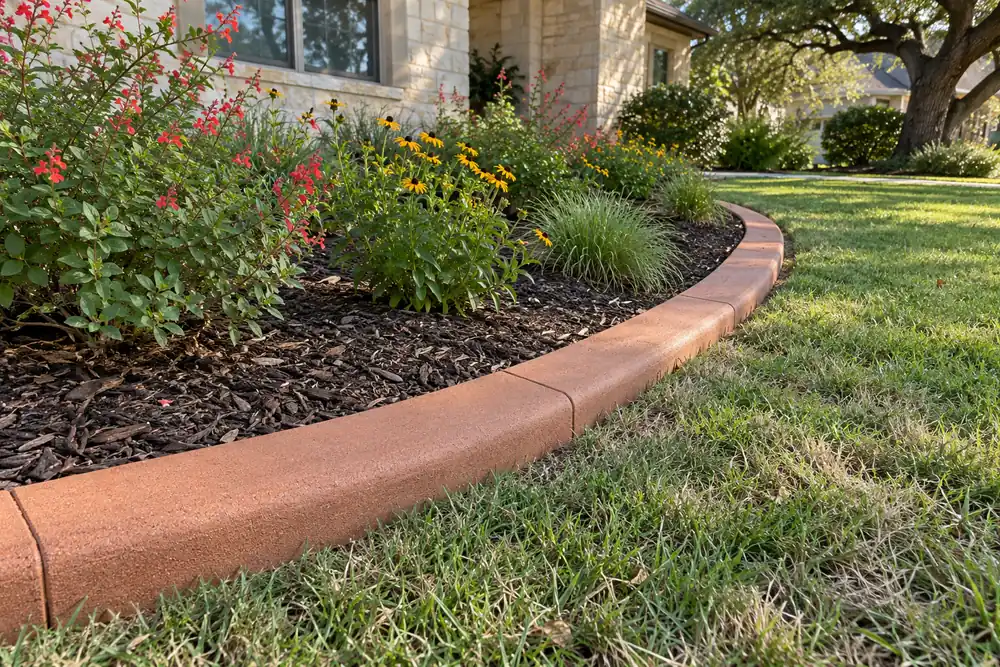
Concrete Curbing in Austin, TX
Heritage Concrete Austin installs concrete curbing in Austin, Texas: continuous landscape borders, extruded by machine, that edge flower beds, tree rings and the lawn along walks and drives. Where a border passes under a big tree, Austin's tree rules apply even to a small job, because a tree 19 inches or more across is regulated, and disturbing its critical root zone takes a Tree Ordinance Review Application.
There's no charge to price it: phone or use the form, and we'll measure the run in linear feet and go over the profile, the color and the line it should follow.
Call or request a free estimate any time, 24/7
No charge · answered 24/7
Get free estimates
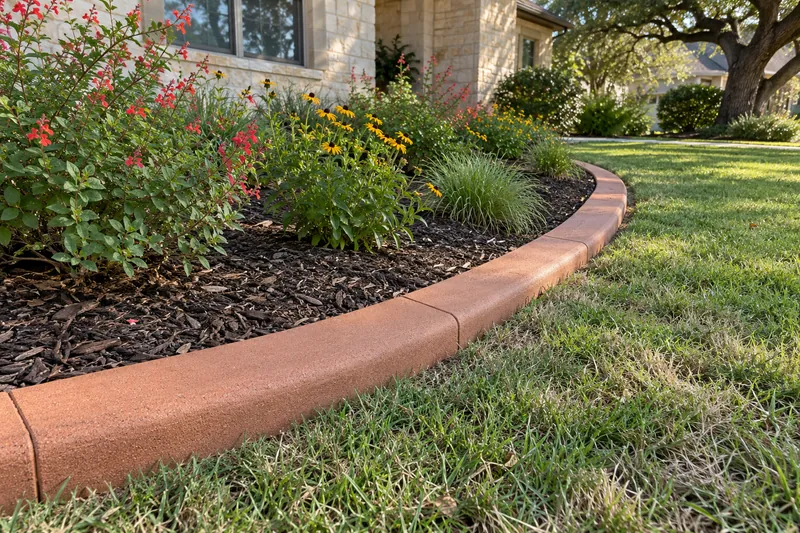
How landscape curbing is installed
Curbing goes in as one unbroken piece, and most jobs are finished in a single day. The steps below are general practice.
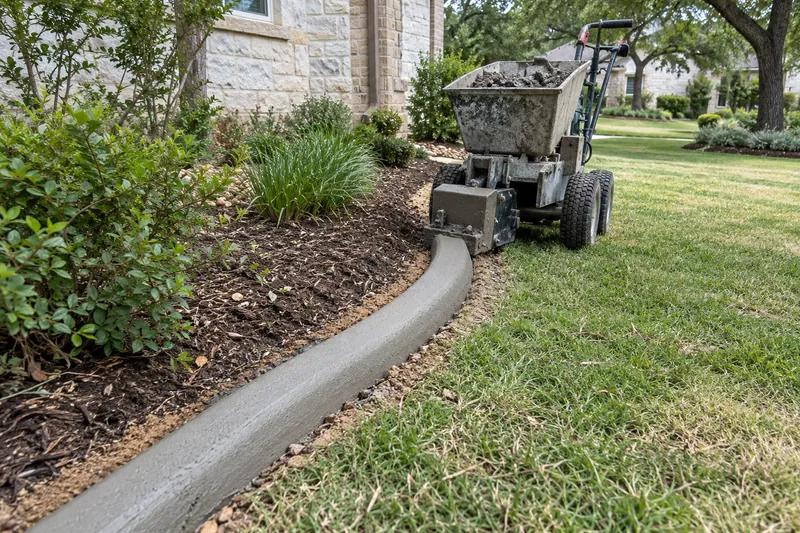
Remove a strip of sod
A strip of turf about 9 inches wide comes up along the outer edge of the bed, where the curb will sit.
Mix on the trailer
The concrete is blended dry on a self-contained trailer, with color measured in for the job; the dry mix resembles wet sand.
Run the curbing machine
The machine presses the mix out as one continuous border that can bend around any curve in the bed.
Cut control joints
Joints go about half an inch into the curb roughly every 12 to 18 inches, giving it planned places to crack.
Seal
A sealer goes on to protect the color from fading, and resealing from time to time is good maintenance.
Call or request a free estimate any time, 24/7.
(512) 588-2862Curbing shapes, color and strength
Profiles
The 4x6 mold is the usual choice for dividing flower beds from the lawn. A stampable mold takes a brick or stone texture while the concrete is fresh.
Color that holds
Color mixed into the concrete itself, rather than painted on, is what keeps curbing from fading, together with a sealer over the top.
Strength and mowing
Extruded curbing can reach about 3,000 psi (check the figure with the installer), strong enough for a mower to ride along its edge. Most mixes carry reinforcing fibers; in general concrete practice, adding 1 to 2 pounds of synthetic fiber to each cubic yard cuts down plastic shrinkage and settlement cracking.
Call or request a free estimate any time, 24/7.
(512) 588-2862Curbing in Austin yards
Around protected trees
The City defines a tree's critical root zone as a circle around the trunk with a radius, in feet, matching the trunk's diameter in inches. To keep a regulated tree, half or more of that zone has to stay at natural grade. Inside the inner half, cut or fill is limited to 4 inches; inside the inner quarter, none is allowed. The City counts everything needed to build what is drawn as an impact, and its own example is a curb drawn exactly on the half-zone line, which doesn't pass, since digging behind the curb would go past that line.
Clay and limestone
On the east side, Houston Black clay shrinks and swells with the weather; in dry spells, by USDA's description, it splits open in cracks ½ to 4 inches across. On the west side, Eckrant soil lies only 4 to 20 inches above hard limestone. Heritage Concrete Austin walks the line with you at the estimate and looks at the roots, rock and grade along it.
Call or request a free estimate any time, 24/7.
(512) 588-2862Landscape curbing, street curbs and walls
Street curb and gutter
A curb at the street is a different job. Street curbs and gutters sit in the public right-of-way and fall under the City's Driveway/Sidewalk permit, and only right-of-way-licensed contractors may build or repair them. City contracts bid from 2022 to 2025 had a median bid of $50 per linear foot on the main item for concrete curb and gutter.
When a border has to hold soil
Landscape curbing edges a bed; it isn't built to hold back a slope. Where the ground steps down, the edge becomes a wall, and Austin exempts a retaining wall from a building permit only if it is 4 feet or less from footing bottom to wall top, carries no surcharge and sits outside a flood hazard area. More on concrete retaining walls.
Along walks and drives
Where a lawn runs up to a path, the same extruded border can trace the bed on either side. Heritage Concrete Austin also pours concrete walkways for the path itself.
Call or request a free estimate any time, 24/7.
(512) 588-2862Concrete curbing cost
Typical figures for the Austin area (September 2026) price a short, 25-foot run of landscape curbing at $29.10 to $36.35 per linear foot, a little under the same source's national $32.07 to $39.98. National guide figures for 2025 come in far lower per foot, at $5 to $18 installed, with the material alone $2 to $7 per foot for plain poured concrete or $3.50 to $8.50 for stamped. Measured by area, one 2026 national guide puts poured curbing at $4 to $5 a square foot in materials plus $5 to $13 for labor.
The Austin figure is for a short 25-foot run and the guides don't agree, so the reliable number is a price on your own length. They are averages from published sources, not Heritage Concrete Austin prices, and estimates are free.
- Landscape curbing, Austin (25 ft)
- $29.10–$36.35
- Landscape curbing, installed
- $5–$18
- Poured garden edging
- $3.50–$17
- Concrete mow strip
- $3–$8
- Stamped curbing, material only
- $3.50–$8.50
Austin-area (2026) and national (2025) averages. Not a quote.
Call or request a free estimate any time, 24/7.
(512) 588-2862Landscape curbing questions
How much should I pay for concrete curbing?
Most jobs land between $400 and $2,200 on average in national figures (2025), at $5 to $18 per linear foot installed. For Austin, a 25-foot run comes to $728 to $909 (September 2026 figures).
Is concrete landscape curbing worth it?
Whether it pays off depends on what the edge has to do. The border comes out as one unbroken piece and can follow any curve, a mower can ride along it, the color is mixed into the concrete and sealed, and the job is usually done in a day. A concrete mow strip runs $3 to $8 per linear foot installed nationally (2025), against $5 to $18 for curbing.
Does landscape curbing need a permit in Austin?
Inside your own yard it is not right-of-way work. Austin's building-permit exemption covers concrete flatwork beyond the right-of-way, though landscape curbing isn't named on the City's pages and the codes still apply. Disturbing the root zone of a regulated tree still requires a Tree Ordinance Review Application, and an owners' association may want a say.
Will concrete curbing crack?
No concrete is completely crack-free. The joints, cut about half an inch deep every 12 to 18 inches, are where cracks are meant to form, and most curbing mixes add reinforcing fibers.
How long does new curbing take to cure?
Concrete edging takes under an hour to pour, dries in 1 to 2 days and reaches full cure in about 4 weeks, by general practice. A sealer protects the color.
Get a free estimate on concrete curbing
Call or send the form with the beds you want edged and a rough length in feet. Heritage Concrete Austin prices landscape curbing at no charge and answers 24/7.