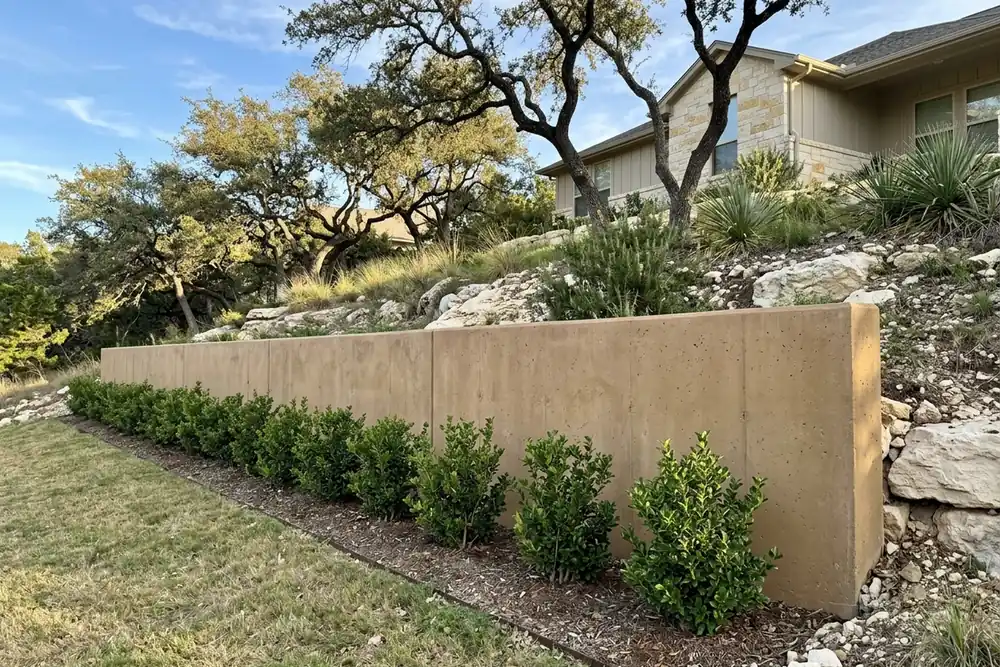
Concrete Retaining Walls in West Lake Hills, Texas
Heritage Concrete Austin pours concrete retaining walls in West Lake Hills, Texas: terraces for sloping backyards, walls that hold the cut beside a driveway, and level ground for a patio or a play area. The City's code defines a retaining wall as one that holds a mass of earth in place, as at the edge of a terrace or excavation, and no wall in the city may rise more than 6 feet above natural grade.
Most people here just say Westlake. The city sits on Farm Road 2244 on the west side of Lake Austin, at the edge of the Edwards Plateau and six miles west of downtown Austin, and the Emmett Shelton Bridge links it with Austin. It is the only city lying completely inside the Eanes Independent School District, and its students are zoned to Westlake High School. Send the wall's rough length and height through the form, or call, and we'll price it at no cost.
Call or request a free estimate any time, 24/7
No charge · answered 24/7
Get free estimates
Wall height, color and planting rules
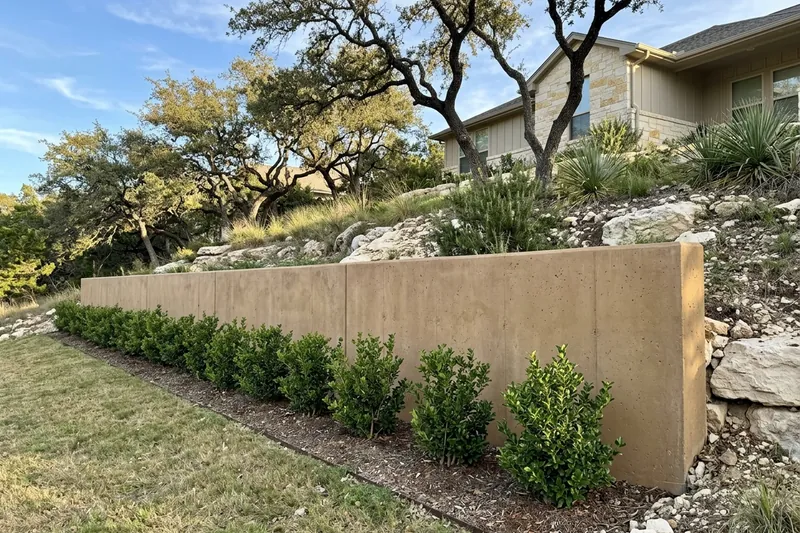
Three lines in the City's site-disturbance rules shape nearly every wall in town. The 6-foot ceiling is measured from natural grade. Walls have to be built of native materials or finished in earth-tone colors matching the native soils. And a wall 3 feet tall or more needs shrubs or vines planted in front of it, at least 2 feet tall at planting and kept as a continuous screen that grows to at least the height of the wall.
Setbacks: the 18-inch limit for concrete
Inside a required setback, cut or fill can't go more than 18 inches from natural grade, or 30 inches where a stone retaining wall holds the grading. The code is specific about stone: natural stone such as limestone, sandstone or fieldstone counts, while concrete, concrete block, brick and manufactured stone veneer do not. A poured wall inside a setback works to the 18-inch figure. A natural stone wall allowed under that rule, unless it is built with a permitted driveway, can sit no closer to the street than the edge of the City right-of-way or 10 feet from the street edge, whichever is greater. The setbacks themselves vary by zoning district and lot size under Article 22.03, Division 8.
Cut slopes and the natural terrain
Grading has to disturb natural slopes as little as possible. A finished open cut can be no steeper than 1.5 horizontal to 1 vertical in undisturbed earth, or 2 to 1 in earth fill. One small exemption exists: digging or filling under six cubic yards needs no permit when it is clearly incidental to improving the property and the area is regraded and revegetated.
Call or request a free estimate any time, 24/7.
(512) 588-2862Earth-tone concrete for a hillside wall
With earth tones written into the code, the color of a poured wall gets settled early, alongside its height and its footing. There are two common ways to get there.
Integral color and pigment dose
Integral color is added to the entire batch, so the color runs through the full depth of the wall, and most of its options are earth tones and pastels. ASTM's standard for concrete pigments allows no more than 10 percent pigment by weight of cement, and good pigments usually hit their full shade at around 5 or 6 pounds for each sack of cement. Colored or plain, concrete is a natural material, so some mottling and color variation should be expected.
Stain on a cured wall
Acid stain is the second route. It soaks into the surface and reacts with the concrete's lime, and its colors are few: soft blue-greens, terra cottas, browns and tans. We'll go over color samples with you during the estimate.
Call or request a free estimate any time, 24/7.
(512) 588-2862Footings for walls up to the 6-foot cap
Industry guidance for poured walls puts the underside of the footing slab no less than two feet deep, and that slab's length usually comes to between 50% and 70% of the wall's height. Once a wall passes four feet, its footing should be a separate pour, which covers the upper part of the range the City allows.
Walls that hold up a steep driveway
A driveway here may be no steeper than 20% at any point, and no part of it may stand more than 6 feet above the natural ground directly below. On lots too steep for the normal cut-and-fill limits to give a safe drive, the code allows an engineer-sealed alternative: no more than a 10% grade in the first 20 feet from the pavement edge, no cut or fill over 6 feet, and every retaining wall built for the driveway held to the same wall rules. Residential driveways must be at least 12 feet wide, and an entrance can be no wider than 20 feet.
Call or request a free estimate any time, 24/7.
(512) 588-2862Permits, site plans and drainage review
The City wants a permit before any site clearance, excavation, grading or fill begins, and a building permit before any structure is built or altered; the two can be rolled into one building permit. Site work other than buildings, which the code calls horizontal infrastructure, also needs an approved site plan, and the code's own examples include retaining walls over four feet in length.
Drainage plans are filed with the building permit application and reviewed by the City Engineer's office, with the detail set by whether the project falls under Type I, II or III. The Type III checklist asks for proposed fill, retaining walls, levees, channel changes and detention, along with existing and proposed impervious cover as a percentage. Single-family lots of half an acre or more are held to 25% impervious cover. Applications go through the MGO Connect portal, the City aims to send a full set of comments within three to four weeks, and permit fees are paid up front. Water comes from Travis County Water District 10, and fire review is done by Travis County Emergency Services District 9.
We found no separate height trigger for a wall permit, or for an engineer, in the code sections on walls and grading, so confirm with the City what your wall needs before plans are drawn.
Call or request a free estimate any time, 24/7.
(512) 588-2862Hill Country rain and the homes behind the walls
The Bureau of Economic Geology ties the Austin area's floods to the Hill Country, where high rainfall rates and fast runoff produce flash floods among the worst in the United States. On October 30-31, 2013, during the Halloween flood, a rain gauge 6 miles north of West Lake Hills caught 8.98 inches. Behind a poured wall, gravel backfill, weep holes and a perforated drain line are the usual ways to let that water out.
Incorporated in 1953, the city grew up as a home for people working in Austin, from 714 residents in 1960 to 3,116 in 2000; the 2020 Census counted 3,444, and a Census Bureau estimate puts it at 3,229 on July 1, 2025. In the early 1960s, residents paid by voluntary contribution for the city's fire engine. By the Census Bureau's survey for 2020-2024, about half the city's homes were built before 1992 and half after; about 31% predate 1980 and about 36% date from 2000 or later, figures that carry wide margins in a city this size. About 87% are single-family detached houses, and an owner-occupied home's median value in that survey is $1,664,500.
Call or request a free estimate any time, 24/7.
(512) 588-2862More concrete work in Westlake
A wall is often one piece of a larger hillside job. We also pour concrete steps between terraced levels, patios on the ground a wall levels out, driveways and their aprons, walkways and landscape curbing, and we repair and resurface older flatwork. Nearby, Heritage Concrete Austin lays stamped concrete patios in Rollingwood and offers concrete driveway replacement in Lost Creek as well.
Call or request a free estimate any time, 24/7.
(512) 588-2862How a wall project runs here
The steps below are general practice. The City's review decides the details for each lot.
Grade and setback check
We note where natural grade sits, how tall the wall has to be, what it will hold and whether any part falls inside a setback, where concrete is held to 18 inches of cut or fill.
Plans to the City
The grading, the wall and the drainage plan go in together through MGO Connect, with fees paid up front, and the City aims to return comments within three to four weeks.
Footing
The footing trench goes at least two feet down, and a wall over four feet gets its footing as a separate pour.
Colored pour and drainage
The wall is poured in the earth tone chosen at the estimate, then backfilled with gravel over a drain line or weep holes so water can get out.
Planting screen
Any wall 3 feet or taller gets the screen of shrubs or vines the code requires, at least 2 feet tall at planting.
Call or request a free estimate any time, 24/7.
(512) 588-2862Retaining wall questions from West Lake Hills owners
What does a poured retaining wall cost in the Austin area?
Typical Austin-area figures for 2026 put the average wall at $5,301, with most between $2,886 and $7,716, and walls 3 to 6 feet tall at $35 to $40 per square foot. For comparison, a 2026 Austin estimate prices a dry-stacked block wall up to 3 feet tall at $34.71 to $48.20 per square foot, though block doesn't count as stone under the City's setback rule. Treat them as published averages rather than our prices. Your own figure comes from the wall's height, length and access, and the estimate is free.
Does a concrete wall count as stone inside a setback?
No. For the setback allowance, the City's code counts only natural stone such as limestone, sandstone and fieldstone, and it names concrete, concrete block, brick and manufactured stone veneer as not counting. So a concrete wall inside a setback works to 18 inches of cut or fill from natural grade, and only a natural stone wall reaches 30.
Do I need a permit for a small wall in West Lake Hills?
The code calls for a permit before any excavation, grading or fill, and a building permit before any structure goes up. The one carve-out we found covers digging or fill under six cubic yards that is incidental to improving the property, with the area regraded and revegetated afterward. Ask the City about your wall before work starts.
Ask for a free retaining wall estimate
Tell us how long the wall runs, how high it stands above natural grade and what sits behind it. Heritage Concrete Austin picks up calls and form requests 24/7.