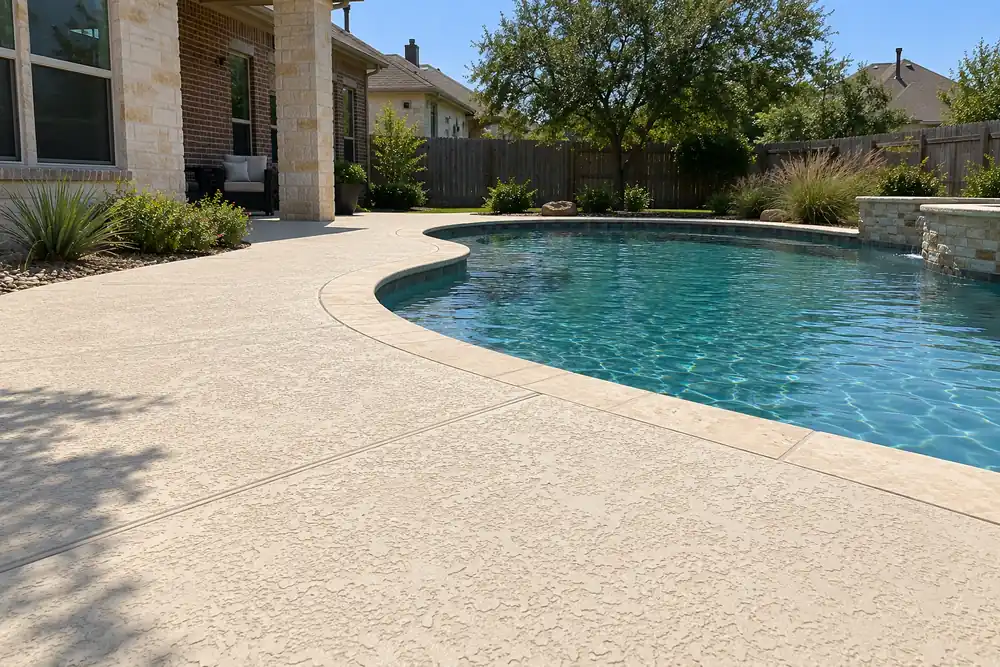
Concrete Pool Decks in Austin, TX
Heritage Concrete Austin builds and refinishes concrete pool decks in Austin, Texas, from new broom-finished or exposed aggregate decks around an inground pool to overlays and cooling toppings on a deck that has faded or cracked. Austin's official weather station at Camp Mabry records about 29 days a year at or above 100°F (1991–2020 normals); Gulf moisture, the National Weather Service notes, can push the heat index past 110, so grip and surface heat get as much thought as the slab itself.
A deck estimate is free. Call, or send the form, and we'll go through the finish, how the deck should shed water, and whether an older deck can take a new surface or needs replacing.
Call or request a free estimate any time, 24/7
No charge · answered 24/7
Get free estimates
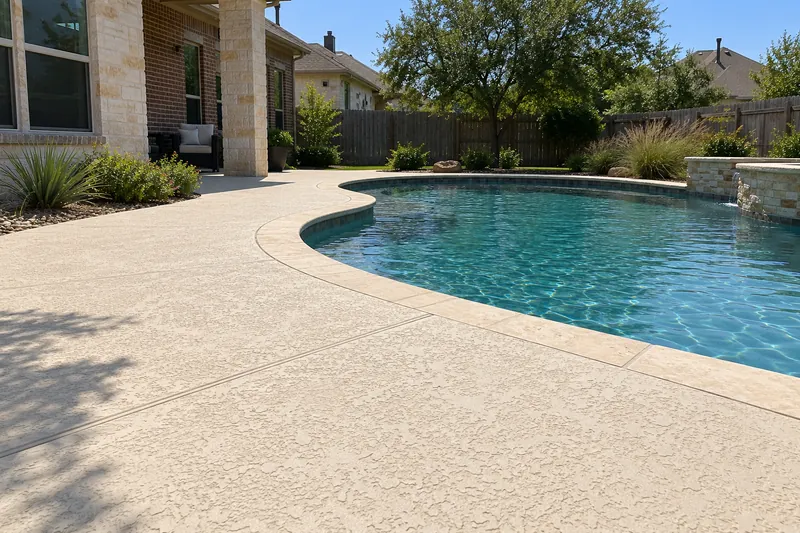
Deck textures and cool toppings
Broom and rock salt
A broom drawn across the fresh surface leaves a slip-resistant texture, the plainest way to give a wet deck some grip. A rock-salt finish is another low-cost method, adding a subtle texture and slip resistance to gray or colored concrete.
Exposed aggregate
Bringing the stone in the mix to the surface makes a pebbled finish, and its high slip resistance is why it suits pool surrounds so well. The stones range from 3/8 inch up to 2 inches and beyond; the bigger sizes can feel rough, and a smoother surface may suit the spots where lounge chairs get dragged. More on exposed aggregate concrete.
Stamped patterns
Stone, slate and plank impressions trap water in their texture, so a patterned deck drains more slowly than a smooth one. Traction comes back with clear grit mixed into the sealer or with a textured overlay. Patterns and colors are covered under stamped concrete.
Cool-deck toppings
Some decorative toppings exist to bring a slab's surface temperature down. Mortex, which brought out the original Keystone Kool Deck topping in 1962, claims a significant drop in the concrete's surface temperature and a non-skid texture. Its contractor brochure keeps the best surface to 1/8 inch thick or less, with roughly 40% of the finish smooth and 60% void, which the maker says prevents craze cracking, and a properly mixed unit covers 300 square feet or more. The maker publishes no figure for how many degrees it saves.
Call or request a free estimate any time, 24/7.
(512) 588-2862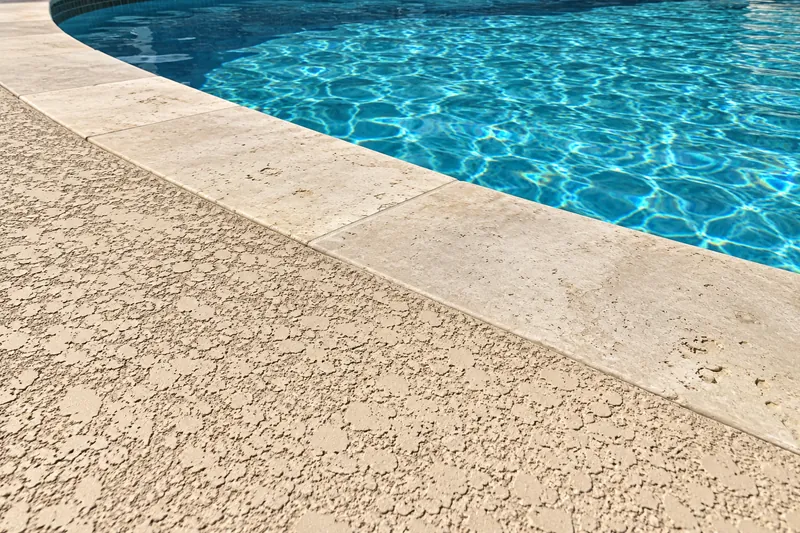
The slab under a new pool deck
Mix and thickness
For the base slab under its topping, the Mortex brochure calls for a five-bag mix ordered slightly rocky, adding that a six-bag mix cures faster and comes out stronger. Flat outdoor slabs such as concrete patios are generally poured at least 4 inches thick, and 5 to 6 inches where something heavy like a hot tub will sit.
Joints and runoff
Isolation joints let the deck move apart from the house, the steps and other fixed points. Outdoor slabs are commonly pitched at 2% or more, a quarter inch per foot, so water runs away from the house.
Clay and limestone under the deck
East of the escarpment, USDA describes Houston Black clay cracking ½ to 4 inches wide during dry spells, down to 12 inches or more, and in most years the gaps last 90 to 150 days. The standard remedies on shrink-swell clay are a well-compacted base and water kept moving away, or a slab built not to need the soil's support, structural or post-tensioned. To the west the problem flips: Eckrant, the soil mapped most widely in the city, lies just 4 to 20 inches above hard limestone. Cuts and fills are generally held to 4 feet under Austin's code, and excavation for a swimming pool is one of the listed exceptions. Heritage Concrete Austin looks at the ground and the drainage around the pool during the estimate.
Call or request a free estimate any time, 24/7.
(512) 588-2862Resurfacing an older pool deck
A tired deck can often take a new surface instead of a new slab. NRMCA allows that lightly or moderately scaled concrete can be repaired with a thin resurfacing bonded to the cleaned, sound slab. The new layer can be no stronger than the concrete underneath, and the color won't match what's there.
Spray-down coatings
One manufacturer limits its spray-down deck coating to ¼ inch, lets it dry a full day or longer before the seal coat, and allows a grip additive in that sealer; pool surrounds, walkways and patio decks are the uses it lists. Overlays for drives, patios and walks are explained under concrete resurfacing.
When the slab is the problem
Cracks that are deep, wide or spreading, above all where one side sits higher, usually mean the ground is settling, and a topping placed over concrete that is still moving won't hold for long. A sunken section can sometimes be lifted first: mudjacking a pool deck runs $900 to $3,200 in typical Austin-area figures (2026).
Call or request a free estimate any time, 24/7.
(512) 588-2862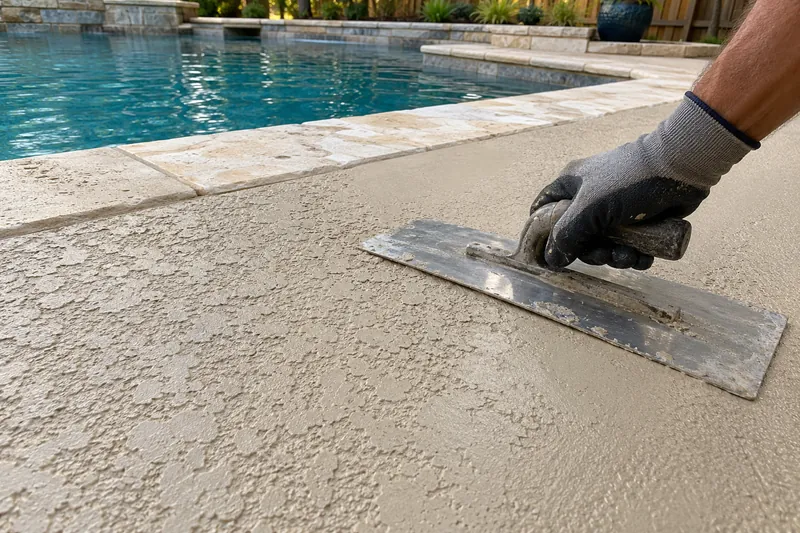
Permits and HOA review around the pool
Inside the City of Austin
Only a prefabricated pool shallower than 24 inches escapes a permit; others pass through a plan review the City calls "Swimming Pool/Uncovered Deck", listed at five business days, and the City builds to the 2024 Swimming Pool and Spa Code. The City's flatwork exemption from building permits covers work off the right-of-way, but its pages never name a pool deck, so a deck-only job is worth confirming with the City first. On a septic lot, adding a pool also sends the plans to Austin Water to review the on-site sewage facility.
Barton Creek
Heritage Concrete Austin also builds concrete pool decks in Barton Creek, where about 72% of homes date from 2000 or later (2020–2024 survey estimates). Outside city limits, Travis County issues the residential pool permit and wants every existing and planned improvement shown on the application, and its environmental review counts concrete patios as new impervious surface. In Barton Creek North, the Master Architectural Control Committee reviews every project, pools included, which typically takes 30 to 45 days once plans are in.
Lakeway
On the south shore of Lake Travis, Heritage Concrete Austin pours pool decks in Lakeway, where the City requires permits for pools, patios and flatwork. Its $1,050 pool/spa permit (fees in effect from August 1, 2020) covers only the pool or spa and its safety fence, so other pool work is permitted separately. Lakeway charges decking against a lot's impervious cover, capped at 50% of the net site area for single-family homes, and wants safety railings, or dense planting, along pool aprons standing more than 30 inches but under 6 feet above grade.
Call or request a free estimate any time, 24/7.
(512) 588-2862What a concrete pool deck costs
Priced new, a 120-square-foot deck comes to $9.34 to $11.48 per square foot at Austin-area rates (September 2026), a little below the national $10.38 to $12.74 from the same source. National figures for 2026 put a poured concrete pool patio at $5 to $15 a square foot, or $8 to $19 if stamped.
Resurfacing runs less. National figures (2025–2026) put it at $3 to $12 a square foot; whole jobs run $1,500 to $10,800, averaging $6,200, and a basic 750-square-foot deck costs $2,250 to $3,750. A cool-deck coat adds roughly $4 to $6 a square foot, and resurfacers often discount work booked for fall or winter. Treat them as published averages rather than a quote from Heritage Concrete Austin; pricing your own deck is free.
- New deck, Austin (120 sq ft)
- $9.34–$11.48 / sq ft
- Poured pool patio
- $5–$15 / sq ft
- Stamped pool patio
- $8–$19 / sq ft
- Basic resurfacing overlay
- $3–$6 / sq ft
- Decorative resurfacing
- $6–$12 / sq ft
- Lifting a sunken deck, Austin
- $900–$3,200
Austin-area and national averages, 2025–2026. Not a quote.
Call or request a free estimate any time, 24/7.
(512) 588-2862Concrete pool deck questions
How much does a concrete pool deck cost?
It depends most on size and on whether the slab is new. National resurfacing figures by area run $600 to $2,400 for 200 square feet, $1,500 to $6,000 for 500 and $2,700 to $10,800 for 900. A new 120-square-foot deck comes to $1,121 to $1,378 at Austin prices (September 2026). A free estimate prices your own deck.
What is the best material for pool decking?
Among concrete finishes, the choice comes down to grip and heat. Exposed aggregate is highly slip resistant, a broom or rock-salt texture adds grip for less money, and a cool-deck topping is made to lower the surface temperature. Coarse stone can feel rough and stamped textures shed water slowly, so the best fit depends on how the deck is used.
How often does a deck beside a pool need resealing?
Decorative sealers wear away by design, and sun-exposed, busy areas generally want resealing every 2 to 3 years. The American Society of Concrete Contractors says an anti-skid additive can go into the sealer, the sealer should satisfy ASTM 2047 for slip resistance, and sand is not a recommended substitute. Hold off if rain is expected within 12 hours, and keep furniture off for at least a day.
How soon can a new deck be used?
Bare concrete can usually take foot traffic after 24 hours and cures fully in about 28 days. A cool-deck topping laid on fresh concrete contains its own sealer and curing agents; Mortex's instruction is to keep people and furniture off it for approximately 21 days.
Does a pool deck count as impervious cover in Austin?
The deck does; the water doesn't. Concrete counts toward a lot's impervious cover in Austin, but the water surface of a ground-level pool is left out. SF-2 and SF-3 lots may be 45% impervious, SF-1 lots 40% and RR lots 25%, and the drainage charge on a City utility bill climbs with the impervious area.
Get a free estimate on a concrete pool deck
Call or send the form with the deck's rough size, whether it is new or existing, and the finish you want. Heritage Concrete Austin prices deck work at no charge and answers 24/7.