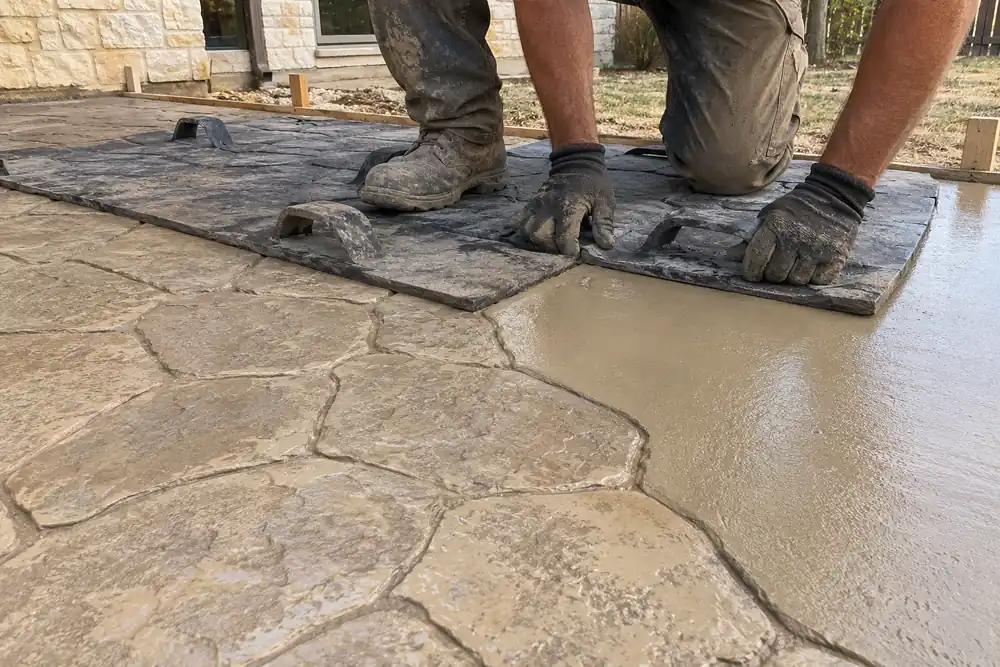
Stamped Concrete Patios in Rollingwood, Texas
Heritage Concrete Austin pours stamped concrete patios in Rollingwood, Texas, from a first backyard patio to an outdoor living area with a kitchen and grill, on house lots the City's zoning sets at no less than 15,000 square feet. The zoning code itself lists patio areas, outdoor kitchens and decorative paving among its examples of an amenity.
Rollingwood sits near Loop 360, six miles west of Austin in southwestern Travis County, with its commercial district along Bee Cave Road. Rollingwood Park, at 403 Nixon Drive, has a lower park by City Hall and an upper park along Rollingwood Drive with five athletic fields, leased to and run by the Western Hills Little League and the Western Hills Girls Softball League. Give us the patio's approximate footprint and a pattern you like over the phone or through the form, and we'll price the job free for your backyard in Rollingwood.
Call or request a free estimate any time, 24/7
No charge · answered 24/7
Get free estimates
Impervious cover and patio permits
A new patio counts as impervious cover here: the zoning code defines it as any area where site development stops the land from absorbing runoff. The code also bars anyone from building or altering a structure without a building permit, and its list of permit-free work covers interior finishes, fixtures and roofing without mentioning patios or flatwork. We found no City page that names a patio as a permit item outright, so confirm with the City while you plan. Its fee list prices a residential addition that adds impervious cover at $600 plus $0.25 per square foot of the project.
Engineer or not: the 250-square-foot line
Under the City's drainage rules, any development that adds impervious cover requires a drainage analysis, prepared by a professional engineer licensed in Texas. When the net increase stays under 250 square feet, someone other than an engineer may prepare the drainage plan. The City keeps separate application checklists for additions above and below 250 square feet, and applications are filed through MyGovernmentOnline.
Neighbor notice and the wait
Exterior work brings notice too. The City supplies forms for the applicant to send to property owners within 250 feet, and mailing them stretches the waiting period to 18 days. The building official then acts no sooner than 15 days and no later than 45 days after the application is filed, and a sign goes up in the yard.
The impervious cover table
Site plans carry a table of impervious cover by type, with sidewalks, driveways, decks and patios listed separately. Traditional board decks with gaps count at 50%, and the water surface of a pool doesn't count at all.
Call or request a free estimate any time, 24/7.
(512) 588-2862Sizing and sloping an outdoor living patio
Four inches is the usual minimum thickness for a concrete patio; under a hot tub, an outdoor fireplace or another heavy load, 5 to 6 inches is the norm. A 12-by-12-foot patio poured 4 inches thick takes roughly 1.78 cubic yards of ready-mix.
Slope matters too. Within 10 feet of the house, the Department of Energy's Building America guidance wants patios, porch slabs, walks and drives sloped away at 2%; ENERGY STAR's figure is a minimum of 0.25 inch per foot. Where a patio wraps a pool or a sport court, the zoning code keeps that deck or apron at least 5 feet from a side lot line and 10 feet from a rear one.
Clay under the slab
We have no soil survey figures for Rollingwood itself. Travis County's hazard mitigation plan counts its entire planning area as affected by expansive soils, with soil plasticity indexes ranging from 2 to 60, and says the trouble there typically comes with drought, when the soil shrinks and can take support from under buildings. Builders usually answer swelling clay with thorough compaction and good drainage, or with a structural or post-tensioned slab designed not to depend on the soil beneath it.
Call or request a free estimate any time, 24/7.
(512) 588-2862Patios at older homes
On paper, Rollingwood's homes are older than Austin's. Rollingwood's median home dates from 1984 in the Census Bureau's 2020-2024 survey, against 1994 for Austin; about 41% of its homes predate 1980 and about 28% are from 2000 or later, though the survey's margins of error are wide at this scale. Nearly every unit is a single-family detached house, owners live in about 91% of the occupied homes, and the median household income is $240,114. The survey's median home value falls in the Census Bureau's top bracket, $2 million or more.
Patios hold up a long time with care, 30 years or more without major repairs, and every 10 years or more, a new coat of stain or a stamped overlay can renew the surface. Stamping over a sound existing slab with a ¼- to ¾-inch overlay runs $7 to $15 per square foot by national 2026 figures.
Call or request a free estimate any time, 24/7.
(512) 588-2862From the Dellana ranch to Rollingwood Park
This land was once ranch country. In 1904 Condido Dellana, an Italian immigrant stonemason who had worked on the State Capitol, bought 1,800 acres running from Barton Creek to the Colorado River. In 1946 the brothers A. B. and George B. Hatley bought 300 acres of it at $300 an acre, and almost every street name in Rollingwood honors a Hatley family member or a friend. A. B. developed the land along the river around Stratford Drive, George the inner part, and the two split Rollingwood Drive between them.
The City dates the Village of Rollingwood to 1955, when it had only 28 homes; in May 1963 it incorporated as a municipality with a mayor-council government and made an agreement with Austin for water. City Hall, 3,500 square feet, went up in 1975 in 120 days for $50,000 without debt, and the Rollingwood Women's Club's fundraising paid $768 for its patio.
Call or request a free estimate any time, 24/7.
(512) 588-2862Stamped patio prices around Austin
Typical Austin-area figures for 2026 price a stamped patio finish at $10 to $30 per square foot, while broom-finished concrete runs $6 to $12, with labor taking 40% to 60% of a patio's total. Resealing stamped concrete every two to three years costs about $1.20 to $2.50 per square foot, often with a UV-resistant sealer against sun fading.
None of these are our prices, and the City's permit fee is separate. The free estimate starts from your patio's size, pattern and access.
- Stamped finish
- $10–$30 / sq ft
- Broom finish
- $6–$12 / sq ft
- Removing an old patio
- $550–$1,700
- Resealing stamped concrete
- $1.20–$2.50 / sq ft
Austin-area averages for 2026; the City's permit fee comes on top. Not a quote.
Call or request a free estimate any time, 24/7.
(512) 588-2862Other concrete work around Rollingwood
Patios often come with other work. We also pour walkways, pool decks, driveways and steps, build retaining walls, and repair or resurface older concrete. Outside the commercial district, a driveway must be permanently hard-topped and set at least 5 feet from a side lot line and 10 feet from a rear one. No retaining wall taller than 36 inches above street curb level may stand within 15 feet of a front lot line, with 12 more inches allowed for each further 5 feet back.
Close by, Heritage Concrete Austin handles concrete retaining walls in West Lake Hills and paves concrete parking lots in Sunset Valley.
Call or request a free estimate any time, 24/7.
(512) 588-2862How a stamped patio job runs
General practice, step by step; the City's permit sets the rest.
Size and added cover
We measure the patio and work out how much impervious cover it adds, since 250 square feet is where the drainage plan has to come from an engineer.
Notice and permit
Notices go to owners within 250 feet, plans go in through MyGovernmentOnline, and inspections, done for the City by ATS Engineers, are pre-paid before the permit issues.
Erosion controls and pour day
Silt fences go up before work starts and heavy trucks keep to the City's construction routes. Pours fall between 7 am and 7 pm on weekdays, because Saturday work is limited to quiet interior work that needs no cement trucks.
Color and pattern
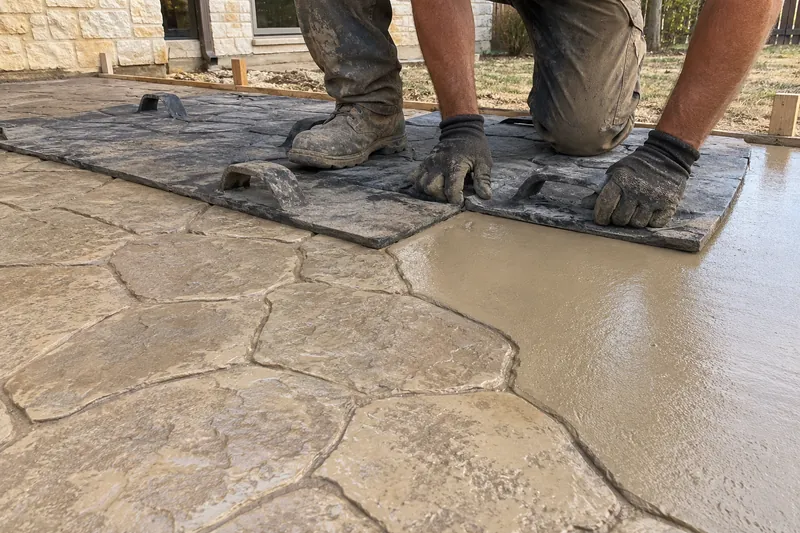
Base color is either mixed into the batch or scattered over the wet surface, and the pattern is pressed in while the slab can still take a clean imprint.
Curing and sealer
By one industry recommendation, the slab cures for seven days or more and gets no sealer until 30 days after placement.
Call or request a free estimate any time, 24/7.
(512) 588-2862Stamped patio questions
How long can a stamped patio last?
A properly maintained stamped surface typically lasts 30 years or more, and one national cost guide gives 25 to 50 years depending on resealing and upkeep. Austin-area guidance is to reseal every two to three years, often with a UV-resistant sealer to slow sun fading.
Does a new patio in Rollingwood need a permit?
Plan on one and confirm it. The City requires a building permit to build or alter any structure, charges a fee for residential additions that add impervious cover, and requires a drainage plan for any increase in impervious cover. We found no City rule naming a patio slab on its own, so ask the City before the pour is scheduled.
Plan a stamped concrete patio with a free estimate
Send a rough patio size and the look you want, and mention any outdoor kitchen or hot tub. Heritage Concrete Austin replies day or night, every day, and prices patios, walks and pool decks for free.