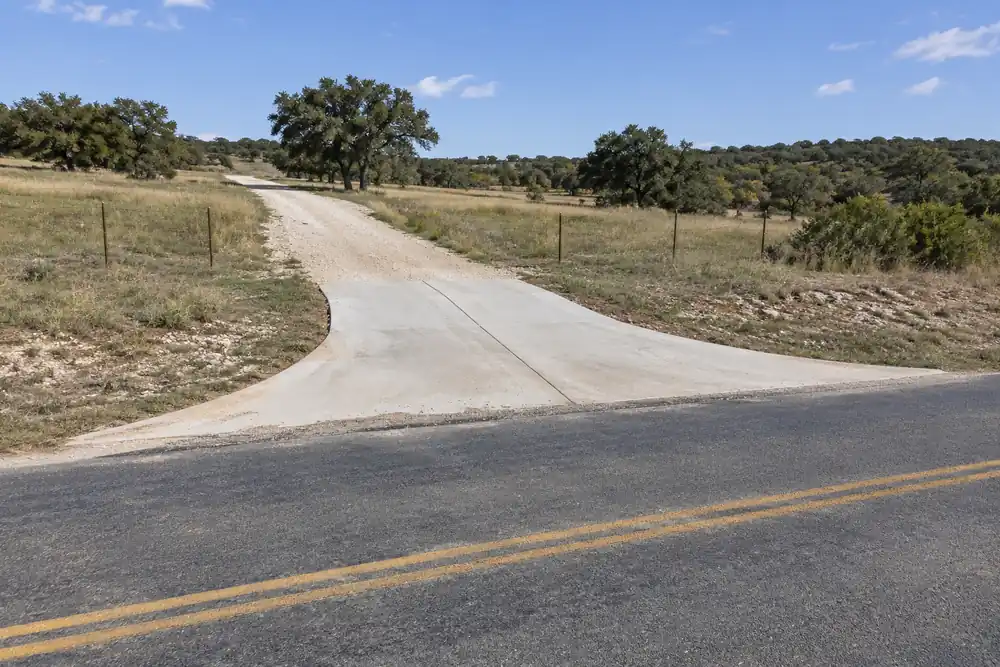
Concrete Driveway Approaches in Manchaca, Texas
Heritage Concrete Austin builds concrete driveway approaches in Manchaca, Texas: the paved connection between a lot and the road, poured to Travis County's drawings on county roads and to TxDOT's rules along FM 1626 and FM 2304. Manchaca has no city government, so the rules that count are the county's and the state's, plus Austin's extraterritorial jurisdiction on some lots.
Manchaca is an unincorporated community about ten miles southwest of Austin, named for nearby Manchaca Springs, where José Antonio Menchaca once camped. FM 1626 runs roughly west to east through it, and FM 2304 is known as Manchaca Road at its south end; Menchaca Elementary stands at 1218 West FM 1626, the post office at 780 West FM 1626, and Twin Creeks Road crosses Bear and Onion Creeks near where they meet. Describe the lot and the road it fronts in the form for a free estimate.
Call or request a free estimate any time, 24/7
No charge · answered 24/7
Get free estimates
From railroad stop to new subdivisions
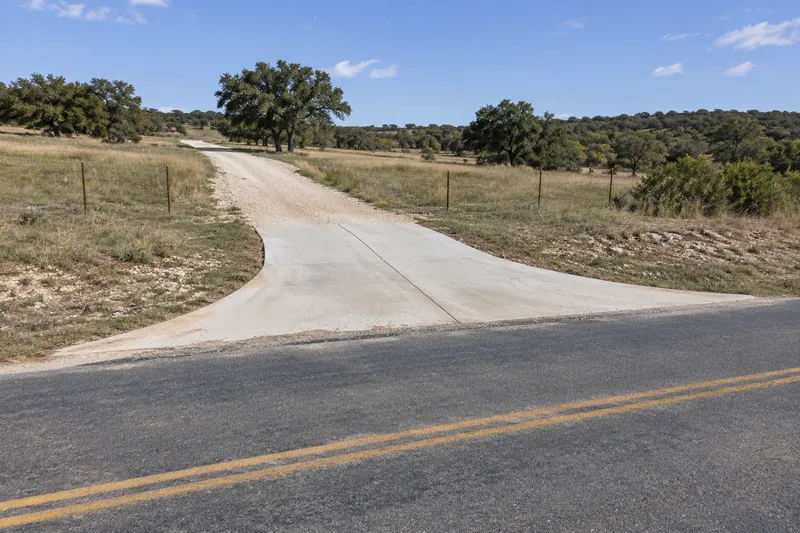
A post office called Manchac House opened two miles south of today's townsite in 1851 and closed a year later. The International-Great Northern Railroad arrived in 1881, bringing a third post office, now spelled Manchaca and pronounced “Manshack”, and by 1884 the town had 75 residents and shipped grain, cotton, posts and lumber. Its school district joined Oak Hill's in 1961 to form a rural high school district and became part of Austin ISD in 1967. Local development in the mid-1980s brought a growth spurt, to 4,700 people by 1990, before the count dropped to 2,259 by 2000 (historical figures, not Census counts for today's boundary).
Most homes are recent. The 2020 Census counted 2,266 residents and 883 housing units, and the Census Bureau's survey estimates for 2020–2024 give a median year built of 2014, with 548 homes built in 2010–2019 and 94 since 2020. Single-family detached houses make up about 87% and mobile homes about 10%, and about 77% are lived in by their owners. Under the county code, building any driveway that reaches a public road takes a permit.
Call or request a free estimate any time, 24/7.
(512) 588-2862Which road your driveway approach meets
The road decides the permit. On a county-maintained road, the approach takes a Travis County Driveway Permit. On a state road, it takes a TxDOT permit. On a road the County doesn't maintain, the County won't issue a driveway permit at all. FM 1626 and FM 2304 are state Farm-to-Market roads, so approaches onto them are TxDOT's. The County's Road and Bridge division looks after more than 1,250 centerline miles of road and 200 bridges, but confirm with the County who maintains your road before the approach is designed. The county code also requires a Basic Development Permit for residential and commercial construction outside incorporated areas.
ETJ status varies by parcel
On the City of Austin's jurisdiction map, Manchaca's Census center point sits inside Austin's extraterritorial jurisdiction, or ETJ: a band beyond the city limits where the City still has some say over growth. The same map marks many parcels inside the community as released from Austin's ETJ to Travis County, and a sliver inside the Village of San Leanna, so the status changes from lot to lot. Where land is in the ETJ, subdivisions fall under the joint Austin/Travis County rules, and the County notes that city ETJs and the County typically follow the same design standards for approaches on curb-and-gutter streets.
Call or request a free estimate any time, 24/7.
(512) 588-2862Rural approaches across a roadside ditch
Tie-in, dip or culvert
On rural county roads, the depth of the roadside ditch sets the approach type: none at all allows a straight tie-in, under 12 inches calls for a dip-style approach, and over 12 inches requires a culvert. However it is built, the grading and the drive must keep the ditch line draining along the whole property. That counts for more in the Austin area, which the City of Austin places in the heart of Flash Flood Alley; it calls flooding the area's most serious hazard.
Culvert pipe and safety end treatments
The County's driveway page allows only corrugated metal pipe in the right-of-way, at least 18 inches in diameter or a 15-by-21-inch oval. Its code drawing for culvert driveways allows corrugated metal or concrete pipe, round or arch-shaped, and recommends at least 12 inches of cover over it, so ask which applies before the pipe is ordered. Each culvert end gets a concrete safety end treatment: riprap a nominal 4 inches thick, with a minimum of 6x6 W1.5xW1.5 mesh inside.
Call or request a free estimate any time, 24/7.
(512) 588-2862What the county drawing asks of a concrete approach
Travis County's standard residential driveway drawings show an approach at least 12 feet and at most 25 feet wide, with radii of at least 5 feet. Built in concrete, the approach is reinforced concrete 5 inches thick or more, laid over 2 inches of sand (the asphalt version is 1½ inches of hot-mix on 6 inches of road base), with steel of #3 bars at 18 inches on center in both directions or welded wire mesh rated 6x6 W1.5xW1.5. It has to be concrete or asphalt and meet the road at roughly a right angle (about 90 degrees); its grade can't pass 15% without County approval, or 2% where a sidewalk crosses.
Where the approach can sit
No driveway may come closer to an intersecting right-of-way than 60% of the parcel's frontage or 50 feet, taking whichever of the two is closer. A lot may have 2 approaches per street at most, with 35 feet between their inside edges on curb-and-gutter streets or 100 feet center to center on other roads, and on curbed streets the drive keeps 10 feet from a curb inlet.
Inspections and the fee
For a rural-road approach the County inspects the site once the permit application is in, and rural approaches are inspected at framing, before the pour and at the end. Missing the pre-pour inspection, or building off the permit, can end with a County notice to tear out the approach and build it again. Travis County charges $165 per driveway permit application, curb-and-gutter or rural, under the 'Outside City of Austin ETJ' column of its FY2026 fee schedule, in effect from January 1, 2026; confirm the fee for a lot inside the ETJ with the County.
Call or request a free estimate any time, 24/7.
(512) 588-2862Approaches onto FM 1626 and FM 2304
A drive onto a state highway is TxDOT's: the owner, or someone the owner authorizes, applies to the local TxDOT district office on TxDOT's Form 1058. Nothing can be built until that permit has been fully executed, TxDOT wants 24 hours' notice before work begins, and a TxDOT inspector then reviews the finished drive.
On a state highway a private residential driveway may be no wider than 24 feet, plus its radii, and the radius joining it to the pavement must be at least 15 feet, meeting the highway at 75 to 90 degrees and within the owner's frontage. It must not block the highway ditch's drainage, any culvert needs a safety end treatment sloped 6:1 or flatter with concrete riprap, and the drive must be paved with a stabilized all-weather surface TxDOT accepts.
Call or request a free estimate any time, 24/7.
(512) 588-2862Other concrete work around Manchaca
Besides approaches, we pour new driveways and extensions, sidewalks and walkways, curb and gutter and concrete pads for shops and RVs, and we repair or replace drives that have failed. Next door, Heritage Concrete Austin handles concrete repair in San Leanna, and close by it offers concrete resurfacing in Hays.
Call or request a free estimate any time, 24/7.
(512) 588-2862How an approach job runs
General practice; the steps follow whichever road and permit apply to your lot.
Road and jurisdiction check
We find out who looks after the road (the County, the state on FM 1626 or FM 2304, or nobody) and whether the lot sits in Austin's ETJ.
Permit application
Travis County driveway applications are filed online; approaches onto FM roads go to the TxDOT district office on Form 1058.
Field check and layout
The County checks the site, and the approach is laid out for width, radii, ditch type and spacing from other drives and intersections.
Forms, steel and pre-pour inspection
Forms and reinforcement go in, and the inspection happens before any concrete is placed.
Pour, cure and final inspection
The approach is poured, finished and cured, then inspected once more at the end.
Call or request a free estimate any time, 24/7.
(512) 588-2862Questions about rural approaches
Can an approach be paved with pavers or stone?
Not on a Travis County road. The County allows driveway approaches of concrete or asphalt only and names pavers and stone as not allowed. On FM 1626 and FM 2304, TxDOT asks for a stabilized all-weather surface it accepts.
How much does a concrete driveway approach cost?
National 2026 figures put a concrete driveway apron at $1,530 to $4,320, and note that aprons may be tightly controlled by local rules. A culvert adds cost: national apron figures put a culvert replacement at about $4,500 and rebar at $2 to $3 per foot. Travis County's permit fee outside Austin's ETJ is $165 per application. These are published averages and fees, not our prices.
What happens if the approach is poured without an inspection?
On a Travis County road, skipping the required pre-pour inspection, or departing from the approved permit, risks a County order to take the approach out and pour it again. On FM 1626 or FM 2304, TxDOT allows no work until its permit is executed and it has had 24 hours' notice.
Get a free approach estimate
Heritage Concrete Austin prices concrete approaches on county roads and FM highways around Manchaca at no charge, and calls are picked up 24/7.