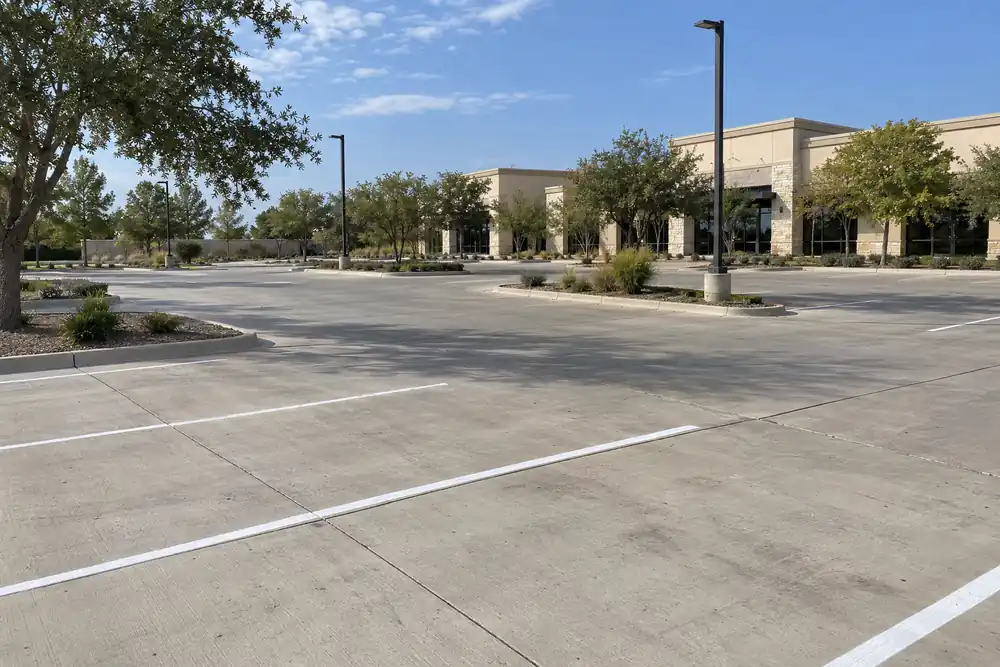
Concrete Parking Lots in Sunset Valley, Texas
Heritage Concrete Austin builds and rebuilds concrete parking lots in Sunset Valley, Texas, for the shopping centers, offices and other commercial properties of a city that relies solely on its sales tax revenue to fund its budget. Every property in town is limited to 18% impervious cover, and the code treats a parking area as fully impermeable.
Sunset Valley is an enclave, surrounded on all sides by the city of Austin, just off State Highway 71 in southwestern Travis County. The City counts over one hundred stores and restaurants in its four shopping centers: the Village, Homestead and MarketFair shopping centers and 4715 South Lamar. City Hall is at 3205 Jones Road and the Toney Burger Center at 3200 Jones Road. Send us the site plan or the number of stalls, or call, and we'll price the paving free for your center, office or store.
Call or request a free estimate any time, 24/7
No charge · answered 24/7
Get free estimates
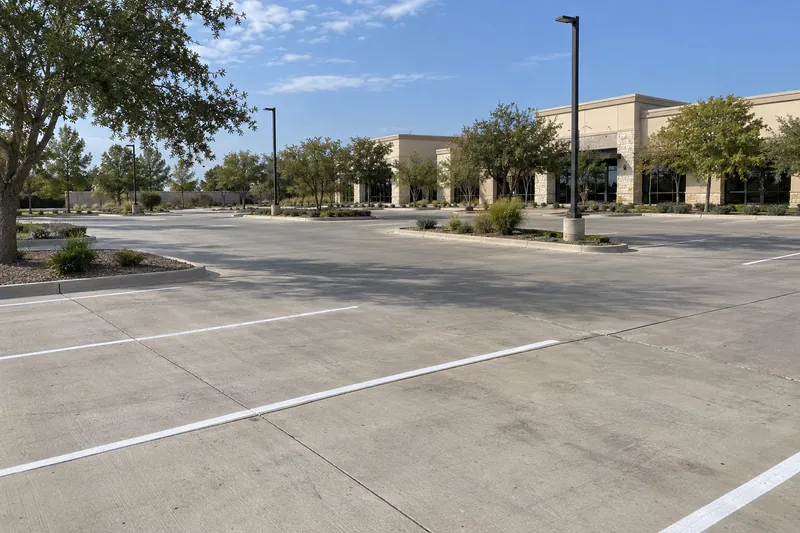
An 18 percent cap on impervious cover
The city holds every property to 18% impervious cover or less. The council set that figure in February 2003 across all categories of development in the Uplands Zone; under the 1996 code, commercial and multifamily sites had been allowed 40%, and up to 50% in some cases.
Parking areas, driveways, pavement and concrete all count toward the limit, and roads, parking areas and buildings are treated as 100% impermeable unless the City Council authorizes a specific alternative surface as less. Existing roofs and paving are charged against the allowance whenever a new project is calculated, so any added stall has to fit inside whatever allowance is left.
Pervious materials
The parking design standards let parking and loading areas be surfaced with asphalt, concrete or another permanent hard surface that keeps down mud and dust, and they say the materials may be pervious. The impervious cover rules, though, exempt pervious concrete only in trail areas prone to high erosion, so a pervious lot still counts in full unless the Council approves it as less.
Call or request a free estimate any time, 24/7.
(512) 588-2862Stall sizes, walkways and crossings
The City's code sets its own space sizes: at least 9 by 18.5 feet for a standard space, 7.5 by 15 feet for a compact space, and 13 by 18.5 feet for an accessible space, which must sit in an area sloped no more than 2%.
In the neighborhood office, neighborhood commercial and highway commercial districts, a lot for ten or more cars needs safe pedestrian routes, with sidewalks between parking bays. Those walks must be at least five and a half feet wide, or ADA width if that is greater, and allow 15 inches of car overhang on each side. Every lot needs safety barriers, protective bumpers or curbing and directional markers, plus crosswalk lines painted from the accessible spaces to the building.
Panel shape
For the pavement itself, the National Ready Mixed Concrete Association wants each panel square if the layout allows, its length no greater than 1.5 times its width. We'll go over the joint pattern against the stall layout during the estimate.
Call or request a free estimate any time, 24/7.
(512) 588-2862Drainage, erosion control and the aquifer district
Parking and loading areas must be graded with permanent storm drainage built to the City's construction specifications, and their surfacing, curbing and drainage have to keep water from running freely onto neighboring land or public streets.
All construction needs erosion and sedimentation controls. Development also needs a temporary erosion and sedimentation control plan and a water quality plan, both certified by a registered professional engineer and approved by the City Engineer, plus a dust control plan. The City sends each project's erosion and sedimentation measures to the Barton Springs/Edwards Aquifer Conservation District for review and comment.
The City Engineer inspects grading, drainage, detention and water-quality controls, and before final inspection and a certificate of occupancy the design engineer sends a letter confirming the work matches the plans. Along creeks, in the water quality transition zone, concrete private drives are among the few things allowed, and only to reach property with no other access. The City also keeps nearly 200 acres of greenspace and conservation land, from oak-juniper woodland to Indiangrass prairie.
Call or request a free estimate any time, 24/7.
(512) 588-2862Permits for paving work
A permit is required to build, alter, repair or remove any building or structure in the City's zoning jurisdiction, and additions such as sidewalks or new or extended driveways need a watershed development permit and a review of the impervious cover calculations. Applications go through the City's GovBuilt portal, and the City lists the 2015 International Building Code for commercial projects. A permit stays active for 180 days and expires on day 181 without an inspection showing progress.
The City's extraterritorial jurisdiction mainly covers properties along Country White Lane, the MAA Sunset Valley apartment complex and three properties at the end of Stearns Lane; development there needs City watershed and sign permits but no building permit. We found no rule on whether repaving an existing lot, with no new impervious cover, needs a watershed permit, and no published commercial fee figures, so ask the City early.
Call or request a free estimate any time, 24/7.
(512) 588-2862From a residential town to four shopping centers
The town began in the early 1950s, when the brothers Clarence and M. H. Flournoy bought land twelve miles outside Austin for a residential development, and the wooded valley among rolling hills gave it its name. It incorporated in September 1954 as a strictly residential community. Streets across the city were paved in the late 1960s and 1970s, and the first City Hall went up in 1977.
In 1990, when the population was 327, the city council approved a sixty-acre shopping center. A wastewater system and a public works department followed in 1993, and commercial development has kept growing since. The 2020 Census counted 683 residents in 257 housing units, and the population stood at 612 by the Census Bureau's mid-2025 estimate (July 1). Lots in the uplands zone must be at least one acre, and owner-occupied homes carry a median value of $917,500 in the Bureau's survey for 2020-2024.
Call or request a free estimate any time, 24/7.
(512) 588-2862Upkeep and national costs for a concrete parking lot
To keep a concrete lot in service, the American Concrete Institute's parking lot guide covers resealing joints, sealing cracks, partial-depth and full-depth repairs, and stabilizing and jacking slabs back into place.
For budgeting, a national 2026 average of $75,000 to pave a parking lot buys a lot of closer to 30,000 square feet, room for about 100 cars, and installation typically takes 2 to 4 weeks. Those are national averages and not our prices. The free estimate prices your lot from its size, thickness, access and grading.
- Average paving budget
- $75,000
- Lot that budget buys
- about 30,000 sq ft (about 100 cars)
- Install time
- 2–4 weeks
- Striping, standard stall
- $4–$5
- Striping, accessible stall
- $25–$40
National averages. City permits and engineering are separate. Not a quote.
Call or request a free estimate any time, 24/7.
(512) 588-2862Other commercial and site concrete
Lots seldom stand alone. We also pour curb and gutter, sidewalks and curb ramps, driveway approaches, and dumpster and equipment pads, and we repair commercial concrete on existing lots and drive lanes. For the city's homes on one-acre lots, we pour driveways and walks as well. Beyond the city, Heritage Concrete Austin installs stamped concrete patios in Rollingwood and puts in concrete retaining walls in West Lake Hills.
Call or request a free estimate any time, 24/7.
(512) 588-2862From survey to final inspection
General practice for a commercial lot here; the City Engineer's review sets the details.
Survey and cover tally
We read the site plan or survey and tally existing roofs and paving, since they count against the 18% allowance.
Engineered plans
A registered professional engineer certifies the erosion and sedimentation and water quality plans, and a dust control plan goes with them to the City Engineer.
Permits on GovBuilt
Building and watershed development permits are filed through GovBuilt and kept active with an inspection showing progress inside each 180-day window.
Subgrade, forms and pour
The section is set for the traffic the lot will carry, panels stay close to square, and storm drainage is built to the City's specifications.
Striping and final
Bumpers or curbing go in, crosswalks from the accessible spaces are painted, and the design engineer's concurrence letter goes to the City before final inspection.
Call or request a free estimate any time, 24/7.
(512) 588-2862Parking lot questions for Sunset Valley owners
Should a parking lot here be asphalt or concrete?
The City's code accepts either, along with other permanent hard surfaces. According to the American Concrete Institute, a concrete lot stays cooler than asphalt and leaking petroleum products have little effect on it, and one national cost guide gives concrete lots a life of 30 to 40 years and asphalt 15 to 30, though concrete costs more to put in. Heat matters here: Camp Mabry, Austin's official climate site, logs about 29 days of 100°F-plus heat in an average year (1991-2020 normals).
Do I need a permit to repave a lot in Sunset Valley?
Check first. The City requires a permit to build, alter, repair or remove any building or structure, and additions such as new or extended paving need a watershed development permit and an impervious cover review. We found no rule covering a repave with no new impervious cover, so ask the City before work is scheduled.
Get a free parking lot estimate
A sketch with rough dimensions is enough to start. Heritage Concrete Austin is on call every hour of every day and quotes new lots, rebuilt drive lanes and added walks without charge.