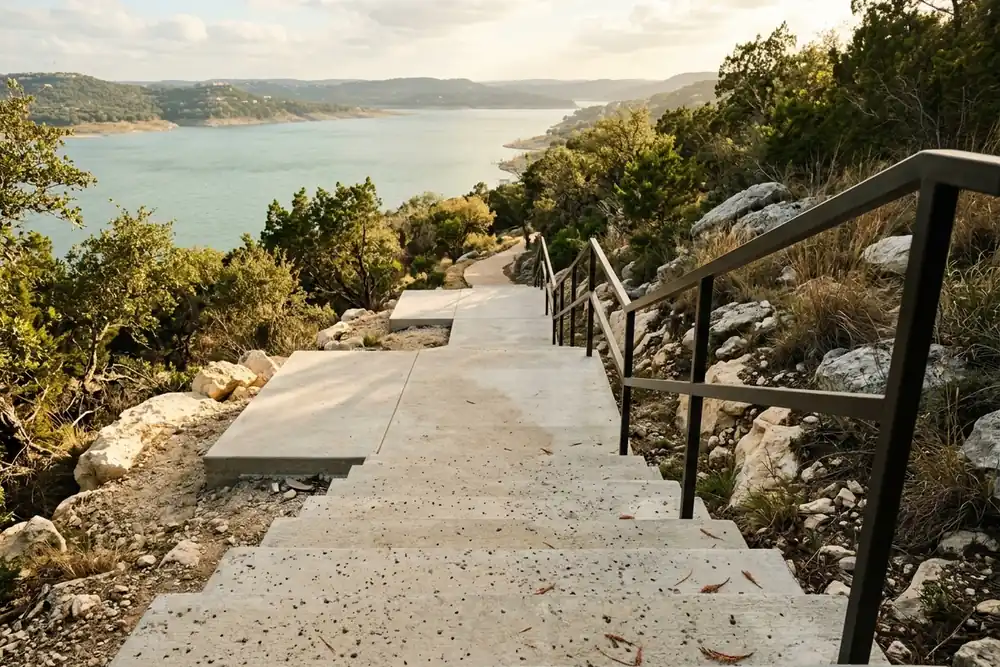
Concrete Steps in Hudson Bend, Texas
Heritage Concrete Austin handles concrete steps in Hudson Bend, Texas, from entry steps at the house to longer flights running down a lakeside lot toward Lake Travis. In the Census Bureau's 2020 boundaries, Hudson Bend takes in 3.988 square miles of land and 2.637 square miles of water.
Hudson Bend is an unincorporated community in northwestern Travis County, about 16 miles northwest of downtown Austin, named for the Wiley Hudson family, who settled near a bend of the Colorado River in the early 1850s. Its first subdivisions, Hudson Bend Colony No. 1 and No. 2, were laid out in the 1940s. Hudson Bend Middle School stands on Lariat Trail, while the zoned elementary school, Lake Travis Elementary, and the Lake Travis Community Library are in Lakeway. Describe the steps you need in the form, or call; the estimate is free, from the top step to the last landing.
Call or request a free estimate any time, 24/7
No charge · answered 24/7
Get free estimates
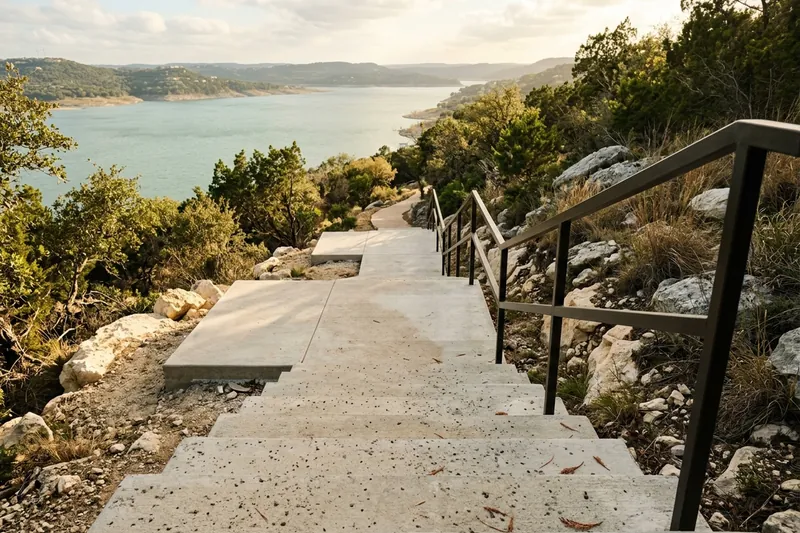
Travis County permits and a patchwork of jurisdictions
Hudson Bend has no city hall, zoning or permit office. It is a census-designated place, a statistical area the Census Bureau draws for its counts, with no government of its own, so Travis County's code applies. The County requires a Basic Development Permit for all residential and commercial construction outside incorporated areas, and a development permit before any construction starts, repair and reconstruction included, or before soil is disturbed by clearing, grading or excavation.
Which city's map a lot falls on
The City of Austin's jurisdiction data show how mixed the map is here. The Census Bureau's center point for Hudson Bend falls in Austin's 2-mile extraterritorial jurisdiction (ETJ, a band past the city limits where Austin has a say in how land is developed), other parts sit in Austin's 5-mile ETJ, many parcels are marked as released to Travis County under SB 2038, and one edge lies in Lakeway's ETJ. Status varies lot by lot, so confirm yours before any plans are drawn.
Neither the county code nor LCRA's rules mention steps or stairs by name, so ask Travis County how a flight of steps on your lot is permitted.
Call or request a free estimate any time, 24/7.
(512) 588-2862Steps toward the water: setbacks, docks and the flood pool
The county code treats Lake Travis as a "western watershed". Where a lot sits outside Austin's ETJ, the shoreline setback starts at the 681.0-foot contour and runs 100 feet inland, or 75 feet for a detached single-family home, and it has to stay free of construction apart from approved utility and roadway crossings. The County may approve the access a boat dock or pier needs, as long as its route and design hold down erosion, the clearing of vegetation and added impervious cover. This county setback doesn't apply to lots still inside Austin's ETJ, and the rule that does hasn't been confirmed, so check with the City and the County.
Lake levels
LCRA treats Lake Travis as full for water supply at 681 feet above mean sea level, when it holds about 1.1 million acre-feet. Above that is a flood pool built to hold back another 776,062 acre-feet; water flows over Mansfield Dam's spillway above 714 feet, and the top of the dam is at 754.
Below the waterline
Since January 1, 2022, LCRA's Highland Lakes Dredge and Fill Ordinance has covered placing any material, structure, wall, riprap or revetment below a lake's regulated pool elevation. Small Tier I projects need only a written notice to LCRA, and larger ones need a permit. Residential docks of 1,500 square feet or less need no LCRA permit, but they must meet its safety standards for flotation, lighting, access, anchoring and distance from shore.
Call or request a free estimate any time, 24/7.
(512) 588-2862LCRA's watershed rules for Lake Travis
Development in the Lake Travis watershed answers to LCRA's Highland Lakes Watershed Ordinance as well as the county code, and an application filed with the County goes to LCRA at the same time. A full LCRA development permit is needed when impervious cover will exceed 10,000 square feet or more than 1 acre is disturbed; smaller projects outside a creek buffer zone file a "No Permit Required" notification instead. Through interlocal agreements, Travis County and several cities administer part or all of the ordinance, so check with the County whether your project needs anything from LCRA.
The county code counts concrete as impervious cover, along with roads, driveways, parking areas and buildings. It also asks for stronger erosion and sediment controls on slopes of 5 to 10% that run longer than 50 feet and on work less than 150 feet from a waterway.
Call or request a free estimate any time, 24/7.
(512) 588-2862Mix, steel and curing for exterior steps
Outdoor steps take sun, rain and wear from every side, so the mix, the steel and the cure count as much as the forms. NRMCA says reinforcement can't stop concrete from cracking but, placed correctly, can keep cracks narrower, and it wants the steel buried under 2 inches or more of concrete. It recommends a moderate slump of no more than 5 inches and keeping new concrete moist for at least 3 days.
Where a curing compound is used, NRMCA wants one that meets ASTM C309 or C1315, ideally sprayed in two coats at right angles for even coverage; plastic sheeting used for curing should be at least 4 mils thick. We'll go over the mix, the reinforcement and the curing plan for your steps at the estimate.
Call or request a free estimate any time, 24/7.
(512) 588-2862What a longer flight of steps costs
A flight down a slope runs longer than a stoop at the door, so the number of steps drives the price. National figures from a guide dated December 2025 put poured steps at $200 to $500 for a single 7-inch step and $2,000 to $5,000 for ten, with a landing included where one is needed. A building permit for steps, where one is required, runs $100 to $1,000 nationally, depending on size and local codes.
These figures are national averages from published sources, not our quote, and pricing your own flight costs nothing.
- 1 step (7 in. rise)
- $200–$500
- 3 steps (21 in.)
- $600–$1,500
- 5 steps (35 in.)
- $1,000–$2,500
- 10 steps (70 in.)
- $2,000–$5,000
- Stair railings
- $20–$250 / linear ft
National averages, guide dated December 2025; landing included where needed. Not a quote.
Call or request a free estimate any time, 24/7.
(512) 588-2862From river fords to a lake community
Wiley Hudson, who came from Arkansas, secured a land grant near the river bend in 1854. By 1860 four families lived in the area, and farmers crossed the Colorado at Marshall Ford, Watkins Ford and Sylvester Ford to grind corn at Anderson Mill. The community covered about 4,000 acres and farmed and ranched into the mid-1900s, until Marshall Ford Dam, now Mansfield Dam, and Lake Travis took nearly half of its acreage in the early 1940s, and a cemetery was moved to Teck. LCRA and the U.S. Bureau of Reclamation built the dam from 1937 to 1942. Farms gave way to houses, marinas and lodges grew along the lake, a volunteer fire department and a garden club were organized in the 1950s, and Hudson Bend received a Texas Historical Marker in 1978.
The 2020 Census counted 4,005 residents and 2,170 housing units, 324 of them vacant. Survey estimates (2020–2024; the margins are wide for a community this small) show a mixed housing stock: about 55% single-family detached houses, about 24% of units in buildings of five or more, 142 mobile homes and 45 boats, RVs or vans. About half the homes were built in 1997 or later, and owners occupy about 71% of the homes that are lived in.
Concrete work beyond the steps
Steps meet landings, walks and patios, so we pour those too, along with driveways and retaining walls; Travis County wants a site plan sealed by a Texas licensed engineer for a retaining wall over 5 feet tall. Nearby, Heritage Concrete Austin takes on Steiner Ranch retaining walls, and on the lake's north shore it pours concrete steps and stairs in Volente.
Call or request a free estimate any time, 24/7.
(512) 588-2862How a lakeside steps job runs
General practice; the County, and LCRA where it applies, set the paperwork.
Walk the route
We measure the total drop from the house or patio to the landing or dock path and count the steps and landings it takes.
Sort out jurisdiction
The lot's ETJ status, the County permit, the shoreline setback and any LCRA notice are settled before forms go up.
Erosion controls first
Sediment controls go in before the ground is opened, more of them on the slopes the County treats as critical.
Form, reinforce and pour
Forms are set for even risers, and the steel is placed with the 2 inches of cover NRMCA asks for.
Cure and finish
The surface gets a texture for grip, and the new steps are kept moist for at least 3 days or covered with a curing compound.
Call or request a free estimate any time, 24/7.
(512) 588-2862Get a free estimate for steps in Hudson Bend
Send the form or call with where the steps go and roughly how far they drop. Heritage Concrete Austin gives free prices on steps, landings and lake-lot stairs, with the phone answered 24/7.