Concrete Cutting in Austin, TX
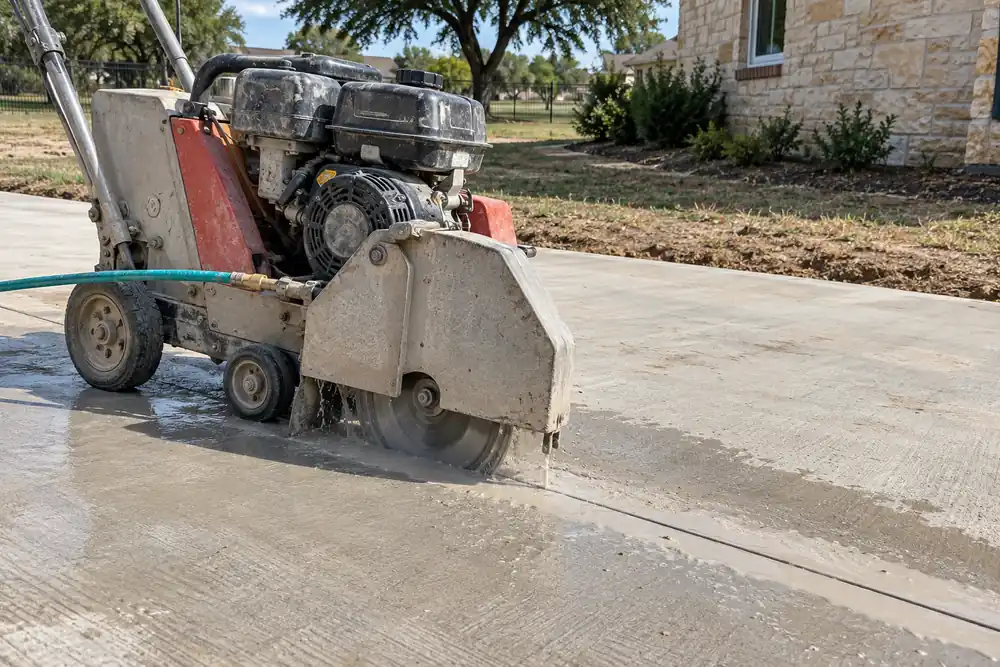
Heritage Concrete Austin provides concrete cutting in Austin, Texas: control joints sawn into new slabs, straight cuts through old driveways, walks and floors, openings in concrete walls, utility trenches through floor slabs and round core holes. Cutting into a curb for a new driveway is right-of-way work here, under a Driveway/Sidewalk permit; Austin issued 1,173 of those in 2025, and only a licensed right-of-way contractor can file one.
Estimates are free of charge, by phone or through the form. We'll talk over the cut and its depth, any steel or post-tension cable that may be in the slab, and where the pieces end up.
Call or request a free estimate any time, 24/7
No charge · answered 24/7
Get free estimates
Concrete saws, core drills and what each one cuts
Flat saws for slabs and paving
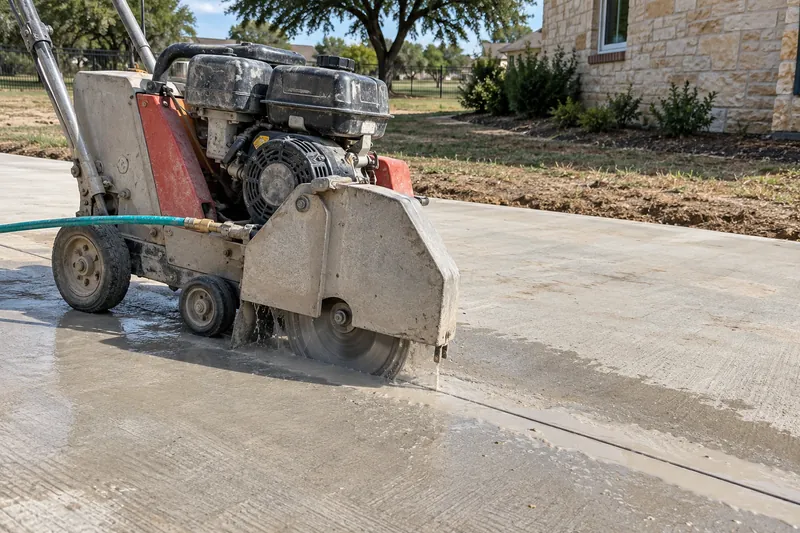
Flat saws, also called slab saws, cut horizontal concrete: pavement that is coming out, expansion joints, slab sections and trenches for utilities beneath floors. The biggest blades go down about 25 inches, though most commercial slab cutting needs only 6 to 12.
Wall saws for doorways and windows
A wall saw, sometimes called a track saw, cuts about 36 inches deep from one side of a wall, and deeper when both faces can be reached. It is the tool for door and window openings, elevator shafts and other penetrations through a concrete wall.
Wire saws, chain saws and core drills
For mass concrete more than about 36 inches thick, or for odd shapes, a wire saw has effectively unlimited depth; a chain saw reaches roughly 15 to 25 inches, depending on the length of its bar. Round holes are cored instead of sawn. Hilti's diamond coring systems bore steel-reinforced walls at up to 15 inches in diameter on a rig, or 6 inches by hand.
Call or request a free estimate any time, 24/7.
(512) 588-2862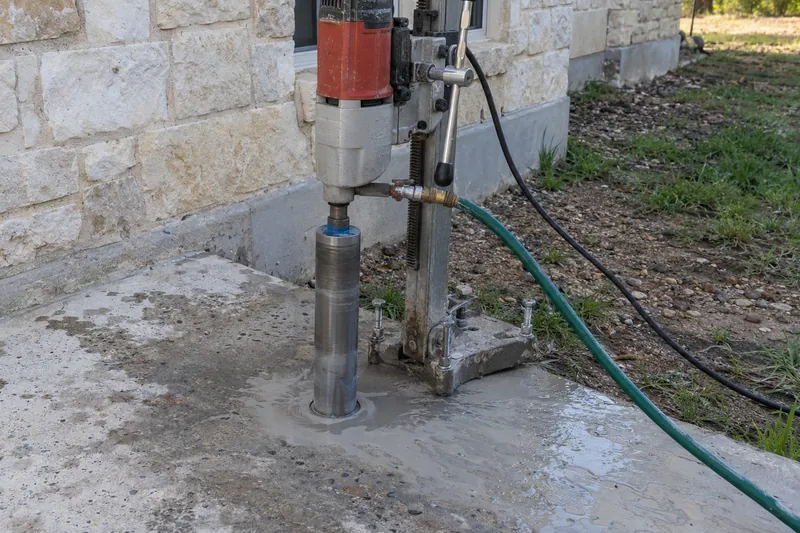
Saw-cut control joints in new slabs
Spacing and depth
NRMCA's limit for the gap between joints is 24 to 36 times the slab's depth, which works out to roughly 10 feet in a 4-inch slab; it recommends no more than 15 feet. Groove depth should be no less than one quarter of the thickness and never under an inch. Panels should be square or close to it, with the long side no more than 1.5 times the short side and no L-shaped panels, and any wire mesh should be cut or stopped at the joints.
Timing the saw
Saw timing runs on hours: an early-entry dry-cut saw generally goes in 1 to 4 hours after the finishers are done, and a conventional saw within 4 to 12. For context, Austin's normal high first reaches 90°F on May 26 and doesn't drop back below it until September 23, and the American Concrete Institute's definition of hot weather is any mix of conditions that speeds up moisture loss and setting.
Joints in industrial floors
Under heavy industrial traffic, joints need a filler that can support their edges. NRMCA advises against keyed joints in industrial floors and wants metal dowels in any slab or pavement that will carry heavy loads. See industrial concrete.
Call or request a free estimate any time, 24/7.
(512) 588-2862Cutting existing concrete in Austin
Post-tension cables
Austin's Building Criteria Manual puts foundation design for homes on expansive soil in the hands of a Texas registered engineer, who seals the plans, and PTI describes post-tensioning as a cost-efficient fix for foundations on shrink-swell soils, so a slab you want to cut may hold stressed cables. Cutting guidance calls for a ground-penetrating radar scan to find them before cutting or coring, and a structural engineer should review any core planned within 6 inches of a marked tendon.
Curb cuts for driveway approaches
Installing, moving, removing or repairing an approach brings a City transportation review, and a Grading and Drainage review is added when a storm inlet lies within 10 feet of the driveway curb cut. A new Driveway/Sidewalk permit costs $345 (fees effective October 1, 2026), and whoever builds the new approach has to close any old curb opening on the lot that isn't required anymore.
Trenches through floors
A utility trench through a floor slab starts with flat-saw cuts, and the digging below it falls under the state's one-call law, where any powered digging 16 inches deep or more counts as excavation. The Railroad Commission of Texas reminds homeowners to call 811 two business days before they dig. West of the Balcones Escarpment, hard limestone lies 4 to 20 inches under Eckrant, the soil mapped most widely in Austin.
Saw cuts for repairs
For a patch, ACI's repair steps cut the edge of each simple shape only as deep as the concrete covering the steel, and if the corroded bars have lost section, ACI wants a structural engineer consulted. Heritage Concrete Austin also does commercial concrete repair on parking lots, walks and floors; when the cut pieces have to be broken out and hauled, see concrete removal.
Call or request a free estimate any time, 24/7.
(512) 588-2862Concrete cutting questions
How much does concrete cutting cost?
National figures run $5 to $15 per linear foot for cutting a slab, with length, depth and reinforcement deciding where a job falls in that range, and minimum charges of $125 to $400 are common (2025). Wall sawing runs $15 to $35 per linear foot at depths of 1 to 12 inches, and a doorway cut through a concrete wall costs about $2,000 per 36 inches of opening width (2026). Heritage Concrete Austin prices each cut from its length and depth, free.
What's the easiest way to cut concrete?
Use the saw made for the cut, at the right time. Fresh concrete has a short window: if the joint edges ravel as the blade passes, it is too soon, and if sawing waits too long the slab gets hard to cut and random cracks can form first. Hardened slabs take a flat saw, walls a wall saw, and round holes a core drill.
What are the risks of concrete cutting?
The biggest is hitting a post-tension cable. There are between 25,000 and 33,000 pounds of tension on each strand, cutting one releases that energy explosively, and a cut cable is very difficult to put right, which is why those slabs are scanned first. Below the slab, utility operators must mark their lines within 48 hours of an 811 notice, weekends and holidays excluded.
Why does new concrete need saw-cut joints?
Because no concrete is completely free of cracks, and joints decide where they go. NRMCA calls joints simply pre-planned cracks and notes that wire mesh will not prevent cracking. Missing or poorly placed joints are among the most common causes of cracked slabs, along with poor subgrade preparation, watered-down concrete and too little curing.
Can reinforced concrete be cut?
Yes. Diamond core drills go through walls with steel in them, and saws cut reinforced slabs; reinforcement is one of the things, with length and depth, that national cutting prices depend on. Post-tensioned slabs are the exception: they need a scan and, near a tendon, an engineer's review before any cut.
Get a free estimate on concrete cutting
Tell us what needs cutting, how thick it is and where it is, or call. Heritage Concrete Austin prices joints, openings, trenches and core holes without charge, around the clock.