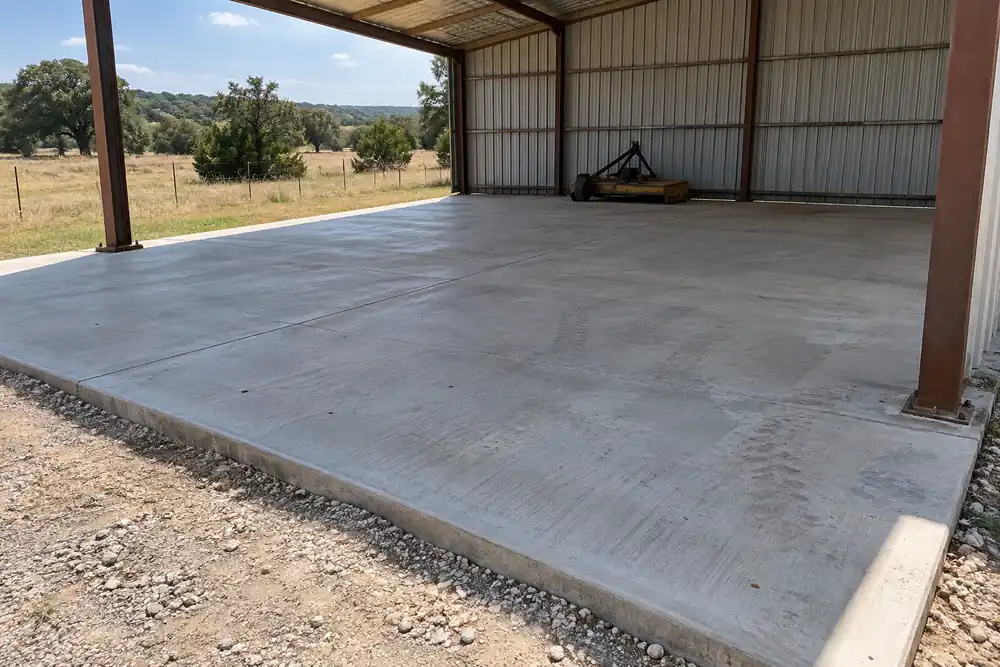
Concrete Pads in Creedmoor, Texas
Heritage Concrete Austin pours concrete pads in Creedmoor, Texas: slabs for shops, barns and metal buildings, RV and trailer pads, and pads for tractors and equipment. Creedmoor is an incorporated city, and its zoning ordinance requires a construction or development permit before any structure or improvement, of whatever kind, is placed, altered or built inside it.
The city sits at the intersection of Farm roads 1327 and 1625, fifteen miles southeast of Austin. Its Board of Aldermen meets at the Creedmoor Community Center, 12513 Farm Road 1625, and Del Valle ISD's Creedmoor Elementary opened in 2006 to serve Creedmoor and Mustang Ridge. Nearly all of Creedmoor is in Travis County: of the 402 residents the Census Bureau estimated for July 1, 2025, it places 398 in Travis and 4 in Hays County. Describe the pad in the form for a free estimate.
Call or request a free estimate any time, 24/7
No charge · answered 24/7
Get free estimates
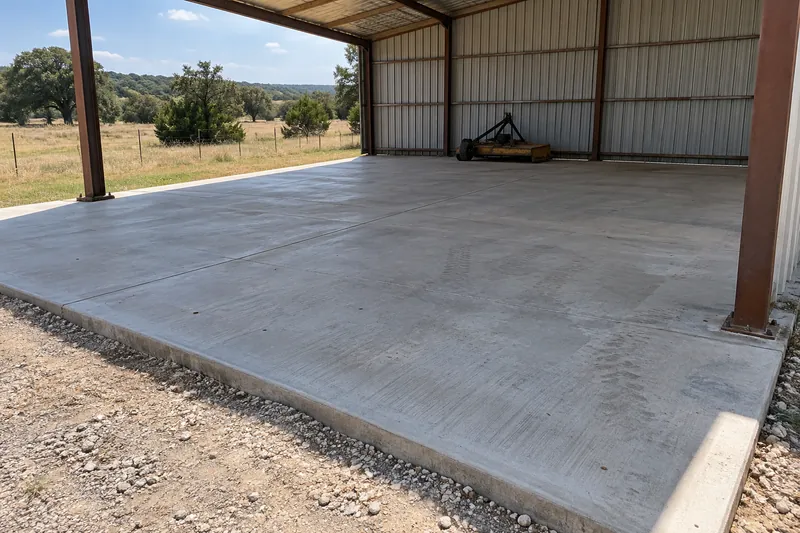
Slabs for shops, barns and metal buildings
Creedmoor's zoning ordinance defines an accessory structure as one whose use is incidental to the main building on the same lot, such as a woodshed, toolshed or greenhouse, and the City's 2025 fee schedule requires an application and permit for every accessory structure before it is built or installed; the structure then has to pass its inspections before the City issues a certificate of completion. The residential permit packet, revised December 2, 2025, groups sheds, ADUs, gyms and auxiliary office space as accessory structures, wants zoning approved before the code review, and asks for a foundation plan: a slab or pier-and-beam with material specifications, dimensions and a reinforcement schedule, or a tie-down anchorage system instead.
Metal buildings and heavy equipment
A pre-engineered metal building needs engineered plans. Under the City's July 2025 building permit schedule, a licensed engineer has to seal the foundation plans for every occupied structure and for any foundation that will hold heavy machinery or equipment.
Sprinklers in larger outbuildings
The zoning ordinance requires any structure other than a complying single-family home that is larger than 300 square feet to have a working water sprinkler system meeting the fire department's or district's requirements. That is worth knowing before the size of a shop, and of the slab under it, is settled.
Vapor retarders: inside or out
For a slab inside a building, the National Ready Mixed Concrete Association recommends putting a vapor retarder no thinner than 10 mils under it; under an open exterior slab on grade, such as an RV pad, it says one generally isn't needed. The International Residential Code leaves garages and other unheated accessory buildings out of its vapor retarder requirement, and it wants slab-on-ground reinforcement kept in position, from mid-depth up to the top third, for the whole pour.
Call or request a free estimate any time, 24/7.
(512) 588-2862RV pads and parking under the zoning ordinance
The ordinance defines a recreational vehicle as one designed for human habitation for recreational purposes and able to be used on a highway: motor homes, travel trailers, truck campers and camping trailers, though not mobile homes. It also bars anyone from living in a structure or vehicle that fails its rules for more than 14 days in any 90-day period, so ask the City before anyone stays in an RV parked on a new pad. In the Single-Family district, no more than one commercial or business vehicle per home may be parked on a lot for more than 72 hours in any 30-day period.
Letting the pad gain strength
A week or so after placement, driveway concrete has gained roughly 70% of the strength it will eventually reach, and an RV or loaded truck shouldn't roll onto it for 28 days at least. Curing is what gets it there: NRMCA says concrete allowed to dry out can end up with as little as half the strength it would have reached with moist curing.
Call or request a free estimate any time, 24/7.
(512) 588-2862Permits, fees and inspections at the City
Permit applications, fees and inspection requests go through the City's online portal, run by PSD Citywide, and paper applications are still taken at the City office. The fee schedule the City adopted on November 20, 2025 (Ordinance No. 251120-D) replaces any earlier fee it conflicts with. For homes it prices an "other non-habitable structure" permit at $0.25 per square foot, trades extra, while the older July 2025 schedule priced garages, barns, patios, storage buildings and carports on valuation. Neither one says which line covers a bare slab with nothing built on it, so put that question to the City before the pour.
Contractor registration and plan review
Builders and general contractors pay the City a $500.00 annual registration fee per company. Commercial plans are reviewed and inspected for the City by Bureau Veritas, whose inspection request form lists pier, grade beam and slab inspections.
Floodplain sites
Where a FEMA floodplain touches a site, the residential plans have to show the base flood elevation and set each structure's finished floor 2 feet above it.
Call or request a free estimate any time, 24/7.
(512) 588-2862Clay ground at the crossroads
Checked at Creedmoor's Census center point, the USDA soil survey shows "Austin-Whitewright complex, 5 to 8 percent slopes, moderately eroded." The leading soil there, Austin, is 41% clay in its top layer (0 to 23 cm), with a linear extensibility of 7.5%, the change in length a soil clod shows as it dries out. That reading comes from one spot and doesn't describe every lot in the city.
USDA describes the Austin series (first established in 1904, in Travis County) as a moderately deep silty clay over chalk, mostly the Austin Formation, and, where it's mapped in Austin, gives it a "Somewhat limited" rating for concrete driveways and sidewalks because its shrink-swell is high. Travis County's hazard mitigation plan says expansive-soil problems in the county typically show up during droughts; in the 2011 drought year the Austin area recorded just 19.68 inches of rainfall all year, along with a record 90 days of 100-degree heat.
Leveling a pad on a slope
Where part of a sloping lot has to be built up for a shop floor, the International Residential Code's fill limits come into play. Unless an exception is approved, the code allows up to 8 inches of earth fill under a slab, or up to 24 inches if the fill is clean sand or gravel, and the fill must be compacted.
Call or request a free estimate any time, 24/7.
(512) 588-2862Manufactured home foundations and entry slabs
About 24% of Creedmoor's housing units are mobile homes in the Census Bureau's 2020-2024 estimates (48 of 202, a survey figure with a wide margin). The zoning ordinance requires manufactured and industrialized homes to rest on a permanent concrete foundation that a licensed engineer certifies for the home's load on that site, and it prohibits ground anchors for any housing in the city. The scanned copy carries handwritten edits on those lines, and the 2025 permit packet asks for anchorage and foundation plans and details by a state-licensed structural engineer, so confirm the current rule with the City.
The same section calls for a stoop, porch, patio or deck at each entrance, with the floor no more than 24 inches above the average ground level at the foundation. Installing or removing a single manufactured home costs $500.00 in permit fees, trade permits not included, and a 1,620-square-foot mobile home foundation averages $29,160 in 2026 Austin-area price tables.
Call or request a free estimate any time, 24/7.
(512) 588-2862Shop slab and RV pad costs
Thickness drives the price of a working slab. In 2026 Austin-area price tables, driveway-grade slabs 4 to 8 inches thick run $6 to $12 per square foot, foundations 8 to 10 inches thick $12 to $18, and labor adds $2 to $5 per square foot, a third to a half of the bill. National 2026 add-ons: wire mesh about $0.35 per square foot, steel rebar $2 to $3, and a vapor barrier about $0.50.
None of these numbers is our price: your pad is priced on site, and the estimate costs nothing.
- 4-inch slab
- $6–$8 / sq ft
- 6-inch slab
- $8–$10 / sq ft
- 8-inch slab
- $10–$12 / sq ft
National installed averages, 2026. Not a quote.
Call or request a free estimate any time, 24/7.
(512) 588-2862From Willow Springs to a 1982 city
The site had general stores, a grocery, a meat market, a drugstore, a barbershop, a blacksmith shop and an ice cream parlor in the 1850s, but the name Creedmoor first appeared when its post office opened in 1880. The Handbook of Texas records two stories: the town was first called Willow Springs, or it was Creekmoor until settlers renamed it Creedmoor to express their faith. It grew from twenty people in 1896 to 150 by 1915, lost its four-room school and a gin to a cyclone in 1921, and in the 1950s still had two gins, with cotton a major local industry.
Under threat of annexation by Austin in 1982, Creedmoor became the ninth community in Travis County to incorporate. It counted 194 people in 1990, 211 in 2000 and 458 at the 2020 Census. Dr. Jacob T. Wilhite, who founded the Pasteur Institute at the Austin State Hospital and was once the country's leading authority on rabies, was born here.
Call or request a free estimate any time, 24/7.
(512) 588-2862Other concrete work around Creedmoor
Besides pads, we pour slab foundations for new homes, driveways and culvert approaches, porches and patios at manufactured-home entrances, sidewalks and retaining walls. Nearby, Heritage Concrete Austin builds slab foundations in Buda, in eastern Hays County, and handles concrete repair in San Leanna, a Travis County village.
Call or request a free estimate any time, 24/7.
(512) 588-2862How a shop or RV pad job runs
General practice; the City's permit and the load on the slab set the specifics.
Free estimate and the load
The estimate pins down what will sit on the pad (a building, an RV, a loaded trailer or machinery), its size, and how trucks will reach it.
Zoning and permit with the City
Zoning approval comes before the code review. The application goes through the City portal with a foundation plan, and an engineer seals it where the City requires one.
Site work and base
The pad area is cut or filled to grade, with fill compacted and kept within the code's depth limits.
Forms, steel and inspection
Forms and reinforcement go in, the steel is kept up off the ground, between mid-depth and the top third, and any inspection the permit calls for happens before the pour.
Pour, cure and wait
The slab is kept moist while it cures, and RVs and loaded trucks stay off for at least 28 days.
Call or request a free estimate any time, 24/7.
(512) 588-2862Concrete pad questions from Creedmoor
What would a 40-by-60 shop slab cost?
For a 40-by-60 slab, 2,400 square feet, one 2024 Austin price guide gives $20,600 to $35,200. Thickness, steel and site work move that number; national 2026 figures run from $6 to $8 per square foot for a 4-inch slab to $10 to $12 for an 8-inch one.
Does the drive out to a new pad need its own permit?
Yes, inside the city limits. Every driveway needs a permit before it is installed, built or remodeled and must pass inspection before use, and one built without a permit pays double fees. A residential driveway permit is $400.00 without a culvert or $600.00 with one, first inspection included, with each further inspection $100; the application sets the minimum culvert at 18 inches in diameter and 12 feet wide, and the Board of Aldermen approves or disapproves it. The City's commercial checklist adds that driveways onto state highways also need a TxDOT permit.
Price a concrete pad in Creedmoor
Ring us or fill in the form with the slab's dimensions and the load it has to take. Heritage Concrete Austin prices shop floors, RV parking and machinery pads for free in Creedmoor and southern Travis County, 24/7.