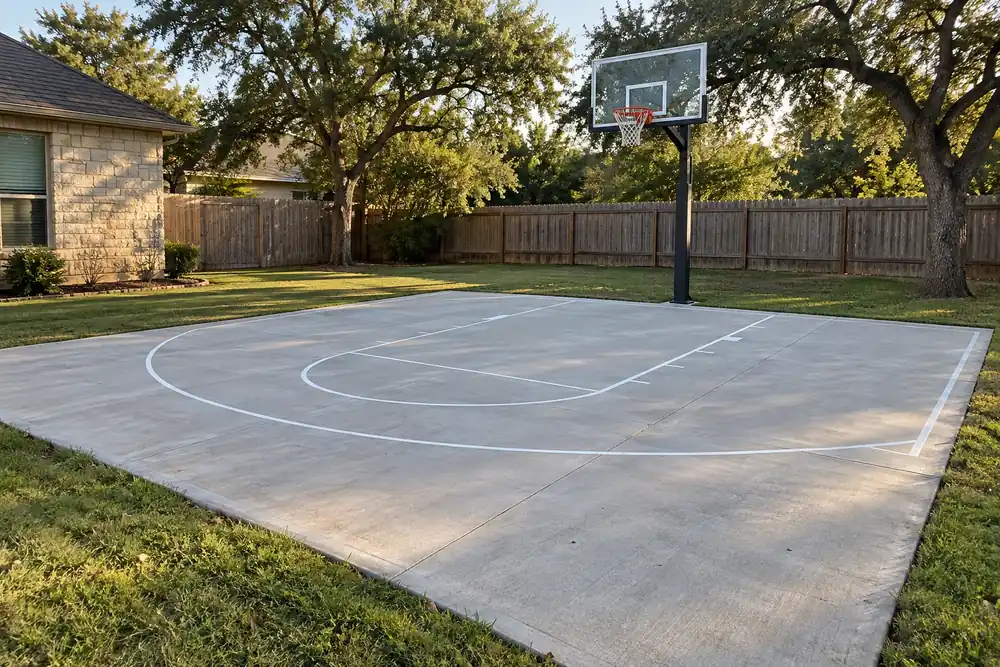
Concrete Basketball Courts in Austin, TX
Heritage Concrete Austin pours concrete basketball courts in Austin, Texas: half-court slabs for a single hoop, larger backyard courts, and court bases ready for a sport surface. The American Sports Builders Association recommends a soil analysis by a qualified geotechnical engineer to catch problems such as expansive soil, and east Austin's Houston Black clay is a clear case, with a shrink-swell potential USDA rates high.
Estimates cost nothing. Phone us or use the form, and we'll go over the court size, where it will sit in the yard, the slab and the ground beneath it.
Call or request a free estimate any time, 24/7
No charge · answered 24/7
Get free estimates
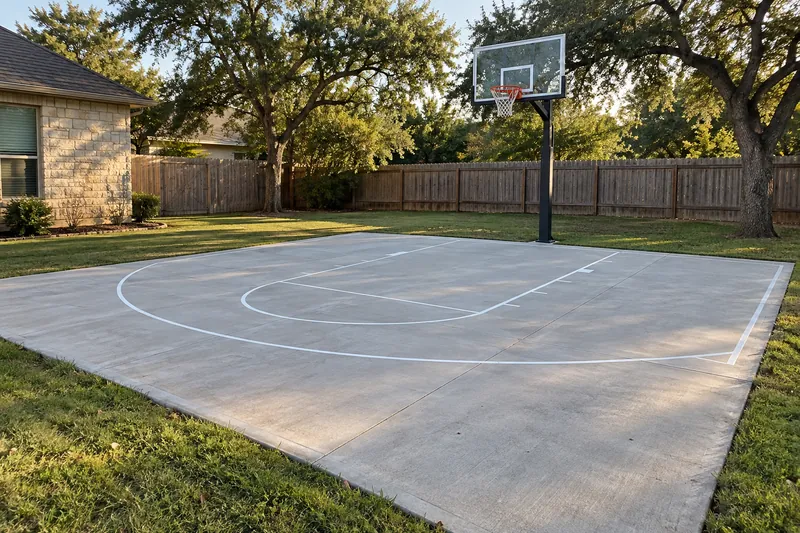
Court dimensions, lines and rim height
An NBA or NCAA regulation full court measures 94 by 50 feet. Backyard courts are more often priced as a 30-by-30-foot half-court, which one national guide describes as compact for home use. Under NBA rules the rim's upper edge is 10 feet off the floor and the free-throw line sits 15 feet out from the backboard's face, while the three-point line is an arc 23 feet 9 inches out from the basket's center, running straight where it comes within 3 feet of the sidelines.
For a single hoop over a smaller slab, see concrete pads.
Call or request a free estimate any time, 24/7.
(512) 588-2862Court slab mix, thickness and reinforcement
ASBA guidelines
American Sports Builders Association guidelines call for court concrete of at least 3,000 psi with a slump no greater than 4 inches, placed at least 4 inches thick, or 5 inches where freeze-thaw cycles repeat. For reference, Austin's residential design table lists "Negligible" weathering and a 12-inch frost line.
A court maker's base spec
One court-surface maker's concrete base recommendations add detail: 4 inches minimum at 3,000 psi at 28 days, a medium broom finish, a slope between 0.5% and 1%, control joints tooled in or saw-cut within 18 hours, and a subgrade at least 6 inches deep, compacted to 98% of its maximum density. Reinforcement is welded wire fabric (6x6 W1.4xW1.4) a third of the way down, with #5 continuous bars around the perimeter under at least 2 inches of cover, and expansion joints wherever the court meets other concrete. That slope is far flatter than the 2% commonly used to carry water off concrete patios.
Post-tensioned courts
In the ASBA's view, post-tensioned concrete performs best overall on outdoor play courts. The Post-Tensioning Institute explains that the compression from stressed tendons counteracts the pull of moving soil, the same principle used under concrete slab foundations on shrink-swell ground.
Call or request a free estimate any time, 24/7.
(512) 588-2862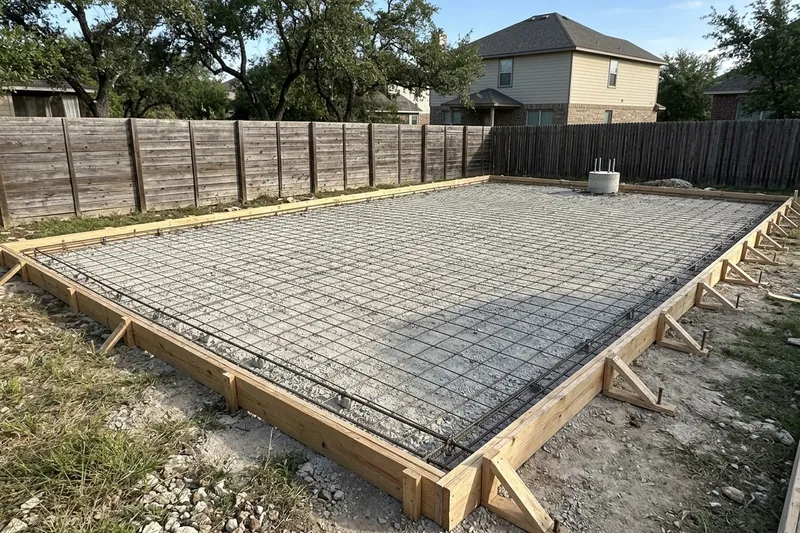
Austin ground and summer pours
Clay and limestone
Survey data for Travis County give Houston Black a linear extensibility of 12 percent and a plasticity index of 44, and the City's pavement manual treats an index from 35 to under 45 as High swell. West of the escarpment the ground changes: hard limestone can be as little as 4 to 20 inches down under Eckrant soil, and USDA rates such shallow soils "Very limited" for driveway and sidewalk slabs, the bedrock being the reason.
Pouring in summer heat
ACI's hot-weather specification caps concrete at 95°F when it leaves the truck. In hot weather, concrete older than 1½ hours shouldn't get any added water, and curing should run 3 days or longer. Plastic shrinkage cracks appear when the top dries out before the concrete has set; breezes above 5 mph, dry air and heat make them likelier. At Camp Mabry the normal high is 97.8°F in August (1991–2020).
Trees and impervious cover
A 30-by-30 half-court is 900 square feet of new concrete, all of it counted as impervious cover under Austin's rules, which cap SF-2 and SF-3 lots at 45%. Near a protected tree (19 inches or more across), any work disturbing its root zone has to clear a Tree Ordinance Review Application, whether or not the slab itself needs a permit. Heritage Concrete Austin looks at the soil, the fall of the yard and any nearby trees during the estimate.
Call or request a free estimate any time, 24/7.
(512) 588-2862Basketball court cost
No Austin price guide breaks out basketball courts, so national figures are the guide. A 30-by-30 half-court runs $3,600 to $14,000 in 2026 figures, and another guide's 2023 data, which counts the base (asphalt or concrete), surface paint and a single hoop, gives $3,600 to $14,400. A regulation 94-by-50 full court runs $18,800 to $75,200 in that 2023 data. For the slab alone, concrete runs $5 to $10 per square foot nationally (2023), and Austin slab figures for 2026 run $4 to $10 per square foot for any use.
Permits, where needed, add $100 to $1,000 nationally (2026). They are published averages only; Heritage Concrete Austin prices each court from its own size and site, free of charge.
- Concrete slab only
- $5–$10 / sq ft
- Austin slab, any use
- $4–$10 / sq ft
- Half-court (30 by 30 ft)
- $3,600–$14,000
- Regulation full court
- $18,800–$75,200
- Permit fees
- $100–$1,000
National averages 2023–2026, plus one Austin slab figure; not a quote.
Call or request a free estimate any time, 24/7.
(512) 588-2862Backyard basketball court questions
How much does a concrete basketball court cost?
For a standard full-size court, one national guide puts the 2026 average at $39,400, with homeowners spending $12,400 to $60,000. Older national figures (2022) put an installed concrete court at $4 to $20 per square foot. The estimate for your own court is free.
Do I need a permit to put a basketball court in my backyard?
Inside Austin, flatwork off the right-of-way isn't subject to a building permit; sport courts go unmentioned in the City's rules, and the building codes still apply. The court counts toward impervious cover, a regulated tree's root zone can't be disturbed without a Tree Ordinance Review Application, and deed restrictions can be enforced by the association named in them. Outside city limits, Travis County requires a permit for any development, paving included, and Creedmoor's zoning ordinance lists a sports court as an accessory structure, which needs a permit there.
What is better for a basketball court, asphalt or concrete?
The American Sports Builders Association rates post-tensioned concrete as the best overall performer for outdoor play courts. Concrete also runs cooler in the sun: ACI notes that concrete parking lots reach lower surface temperatures than asphalt ones. National cost guides price backyard courts on either base.
How thick should a court slab be?
At least 4 inches under ASBA guidelines, or 5 where freeze-thaw cycles repeat, and one court maker's spec also starts at 4 inches. An older national cost guide describes the usual base as 4 inches of concrete on ½-inch rebar (2022).
Which way should a backyard court face?
North to south, if the yard allows. The ASBA recommends that orientation as the best compromise between low early-morning and late-afternoon sun, and it advocates finishing the subgrade 4 to 6 inches higher than the surrounding ground.
Get a free estimate on a basketball court
Use the form or call with the court size you want and where it would go. Heritage Concrete Austin prices backyard court slabs at no charge and answers 24/7.